Publications
The list below is generated from the Nektar++ publications database together with a local BibTeX database built from ORCID. Each entry links to its DOI, and the full BibTeX record can be expanded for citation.
Selected publications
Numerical analysis and high-order methods
- H. M. Blackburn and S. J. SherwinBiBTeXFormulation of a Galerkin spectral element–Fourier method for three-dimensional incompressible flows in cylindrical geometriesJournal of Computational Physics, 197 (2), pp. 759–778, 2004. doi 10.1016/j.jcp.2004.02.013
@article{2004:blackburn.sherwin:formulation, author = {Blackburn, H.M. and Sherwin, S.J.}, title = {Formulation of a Galerkin spectral element--Fourier method for three-dimensional incompressible flows in cylindrical geometries}, journal = {Journal of Computational Physics}, publisher = {Elsevier BV}, year = {2004}, volume = {197}, number = {2}, pages = {759--778}, groups = {sherwin}, doi = {10.1016/j.jcp.2004.02.013} } - D. Barkley, H. M. Blackburn and S. J. SherwinBiBTeX AbstractDirect optimal growth analysis for timesteppersINTERNATIONAL JOURNAL FOR NUMERICAL METHODS IN FLUIDS, 57 (9), pp. 1435–1458, 2008. doi 10.1002/fld.1824
@article{2008:barkley.blackburn.ea:direct,
  author = {Barkley, D. and Blackburn, H. M. and Sherwin, S. J.},
  title = {Direct optimal growth analysis for timesteppers},
  journal = {INTERNATIONAL JOURNAL FOR NUMERICAL METHODS IN FLUIDS},
  year = {2008},
  volume = {57},
  pages = {1435--1458},
  month = jul,
  organization = {Santa Fe, NM},
  publisher = {JOHN WILEY \& SONS LTD},
  doi = {10.1002/fld.1824},
  startyear = {2007},
  startmonth = {Mar},
  startday = {24},
  finishyear = {2007},
  finishmonth = {Mar},
  finishday = {28},
  issn = {0271-2091},
  issue = {9},
  keyword = {MODES},
  language = {English},
  conference = {14th International Conference on Finite Elements in Flow Problems},
  day = {30},
  publicationstatus = {published},
  groups = {core}
}
Methods are described for transient growth analysis of flows with arbitrary geometric complexity, where in particular the flow is not required to vary slowly in the streamwise direction. Emphasis is on capturing the global effects arising from localized convective stability in streamwise varying flows. The methods employ the timestepper’s approach in which a nonlinear Navier Stokes code is modified to provide evolution operators for both the forward and adjoint linearized equations. First, the underlying mathematical treatment in primitive flow variables is presented. Then, details are given for the inner level code modifications and outer level eigenvalue and SVD algorithms in the timestepper’s approach. Finally, some examples are shown and guidance provided on practical aspects of this type of large-scale stability analysis - A. I. Liosi, H. Wüstenberg, P. Khurana, A. Swift, A. Chatzopoulos, F. Bottone, J. Hoessler and S. SherwinBiBTeXComparing implicit time-stepping techniques for highly resolved simulations using industrial geometriesComputers & Fluids, 311, p. 107029, 2026. doi 10.1016/j.compfluid.2026.107029
@article{2026:liosi.wustenberg.ea:comparing,
  author = {Liosi, Alexandra Ioanna and Wüstenberg, Henrik and Khurana, Parv and Swift, Adam and Chatzopoulos, Athanasios and Bottone, Francesco and Hoessler, Julien and Sherwin, Spencer},
  title = {Comparing implicit time-stepping techniques for highly resolved simulations using industrial geometries},
  journal = {Computers & Fluids},
  publisher = {Elsevier BV},
  year = {2026},
  volume = {311},
  pages = {107029},
  groups = {sherwin},
  doi = {10.1016/j.compfluid.2026.107029}
}
Software and high-performance computing
- C. D. Cantwell, D. Moxey, A. Comerford, A. Bolis, G. Rocco, G. Mengaldo, D. De Grazia, S. Yakovlev, J.-E. Lombard, D. Ekelschot, B. Jordi, H. Xu, Y. Mohamied, C. Eskilsson, B. Nelson, P. Vos, C. Biotto, R. M. Kirby and S. J. SherwinBiBTeXNektar plus plus : An open-source spectral/hp element frameworkCOMPUTER PHYSICS COMMUNICATIONS, 192, pp. 205–219, 2015. doi 10.1016/j.cpc.2015.02.008
@article{2015:cantwell.moxey.ea:nektar, author = {Cantwell, C. D. and Moxey, D. and Comerford, A. and Bolis, A. and Rocco, G. and Mengaldo, G. and De Grazia, D. and Yakovlev, S. and Lombard, J-E. and Ekelschot, D. and Jordi, B. and Xu, H. and Mohamied, Y. and Eskilsson, C. and Nelson, B. and Vos, P. and Biotto, C. and Kirby, R. M. and Sherwin, S. J.}, title = {Nektar plus plus : An open-source spectral/hp element framework}, journal = {COMPUTER PHYSICS COMMUNICATIONS}, year = {2015}, volume = {192}, pages = {205--219}, month = jul, publisher = {ELSEVIER SCIENCE BV}, doi = {10.1016/j.cpc.2015.02.008}, issn = {0010-4655}, keyword = {SYSTEM}, language = {English}, day = {1}, publicationstatus = {published}, groups = {core} } - D. Moxey, C. D. Cantwell, Y. Bao, A. Cassinelli, G. Castiglioni, S. Chun, E. Juda, E. Kazemi, K. Lackhove, J. Marcon, G. Mengaldo, D. Serson, M. Turner, H. Xu, J. Peiró, R. M. Kirby and S. J. SherwinBiBTeX AbstractNektar++: enhancing the capability and application of high-fidelity spectral/hp element methodsComputer Physics Communications, 249, p. 107110, 2020. doi 10.1016/j.cpc.2019.107110
@article{2020:moxey.cantwell.ea:nektar,
  author = {Moxey, D. and Cantwell, C. D. and Bao, Y. and Cassinelli, A. and Castiglioni, G. and Chun, S. and Juda, E. and Kazemi, E. and Lackhove, K. and Marcon, J. and Mengaldo, G. and Serson, D. and Turner, M. and Xu, H. and Peir\'o, J. and Kirby, R. M. and Sherwin, S. J.},
  title = {\emph{Nektar++}: enhancing the capability and application of high-fidelity spectral/$hp$ element methods},
  journal = {Computer Physics Communications},
  year = {2020},
  volume = {249},
  pages = {107110},
  doi = {10.1016/j.cpc.2019.107110},
  groups = {core}
}
Nektar++ is an open-source framework that provides a flexible, performant and scalable platform for the development of solvers for partial differential equations using the high-order spectral/hp element method. In particular, Nektar++ aims to overcome the complex implementation challenges that are often associated with high-order methods, thereby allowing them to be more readily used in a wide range of application areas. In this paper, we present the algorithmic, implementation and application developments associated with our Nektar++ version 5.0 release. We describe some of the key software and performance developments, including our strategies on parallel I/O, on in situ processing, the use of collective operations for exploiting current and emerging hardware, and interfaces to enable multi-solver coupling. Furthermore, we provide details on a newly developed Python interface that enable more rapid on-boarding of new users unfamiliar with spectral/hp element methods, C++ and/or Nektar++. This release also incorporates a number of numerical method developments – in particular: the method of moving frames (MMF), which provides an additional approach for the simulation of equations on embedded curvilinear manifolds and domains; a means of handling spatially variable polynomial order; and a novel technique for quasi-3D simulations (which combine a 2D spectral element and 1D Fourier spectral method) to permit spatially-varying perturbations to the geometry in the homogeneous direction. Finally, we demonstrate the new application-level features provided in this release, namely: a facility for generating high-order curvilinear meshes called NekMesh; a novel new AcousticSolver for aeroacoustic problems; our development of a ‘thick’ strip model for the modelling of fluid-structure interaction (FSI) problems in the context of vortex-induced vibrations (VIV). We conclude by commenting on some lessons learned and by discussing some directions for future code development and expansion. - D. Lindblad, J. Isler, M. M. Ginard, S. J. Sherwin and C. D. CantwellBiBTeX AbstractNektar++: Development of the compressible flow solver for jet aeroacousticsComputer Physics Communications, 300, p. 109203, 2024. doi 10.1016/j.cpc.2024.109203
@article{2024:lindblad.isler.ea:nektar,
  author = {Lindblad, Daniel and Isler, Jo{\~a}o and Ginard, Margarida Moragues and Sherwin, Spencer J and Cantwell, Chris D},
  title = {Nektar++: Development of the compressible flow solver for jet aeroacoustics},
  journal = {Computer Physics Communications},
  year = {2024},
  volume = {300},
  pages = {109203},
  publisher = {Elsevier},
  groups = {app},
  doi = {10.1016/j.cpc.2024.109203}
}
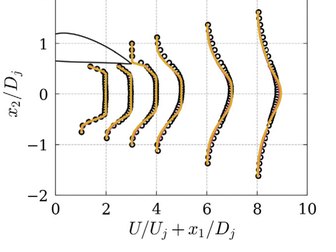
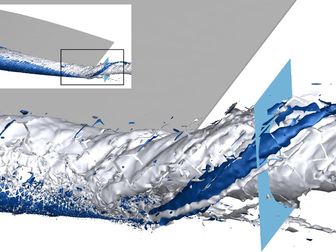
A recently developed computational framework for jet noise predictions is presented. The framework consists of two main components, focusing on source prediction and noise propagation. To compute the noise sources, the turbulent jet is simulated using the compressible flow solver implemented in the open-source spectral/hp element framework Nektar++, which solves the unfiltered Navier-Stokes equations on unstructured grids using the high-order discontinuous Galerkin method. This allows high-order accuracy to be achieved on unstructured grids, which in turn is important in order to accurately simulate industrially relevant geometries. For noise propagation, the Ffowcs Williams - Hawkings method is used to propagate the noise between the jet and the far-field. The paper provides a detailed description of the computational framework, including how the different components fit together and how to use them. To demonstrate the framework, two configurations of a single stream subsonic jet are considered. In the first configuration, the jet is treated in isolation, whereas in the second configuration, it is installed under a wing. The aerodynamic results for these two jets show strong agreement with experimental data, while some discrepancies are observed in the acoustic results, which are discussed. In addition to this, we demonstrate close to linear scaling beyond 100,000 processors on the ARCHER2 supercomputer.
High-order mesh generation
- S. J. Sherwin and J. PeiróBiBTeX AbstractMesh generation in curvilinear domains using high-order elementsInternational Journal for Numerical Methods in Engineering, 53 (1), pp. 207–223, 2001. doi 10.1002/nme.397
@article{2001:sherwin.peiro:mesh,
  author = {Sherwin, S. J. and Peiró, J.},
  title = {Mesh generation in curvilinear domains using high-order elements},
  journal = {International Journal for Numerical Methods in Engineering},
  publisher = {Wiley},
  year = {2001},
  volume = {53},
  number = {1},
  pages = {207--223},
  groups = {sherwin},
  doi = {10.1002/nme.397}
}
The ability to construct suitable computational meshes is currently a significant limiting factor in the development of compact high‐order algorithms in very complex geometries. Compact high‐order algorithms such as spectral element or p ‐type finite element techniques offer the potential of high accuracy if the solution is smooth and a well‐behaved mapping exists between the local sub‐domains and a standard region. In this paper we address the problem of coupling high‐order algorithms with unstructured mesh generation and CAD representation techniques. We present three complementary strategies to alleviate the problem of generation of elemental regions with singular elemental mappings. The first strategy investigates the influence of an anisometric parametric surface representation on the quality of high‐order unstructured meshes. We show that a straightforward splitting of a standard linear mesh for use in a high‐order method can lead to the generation of distorted, possibly invalid, meshes even for simple computational domains such as cubes. The second strategy uses hybrid meshes applying prismatic elements near curvilinear boundaries. In the third and final strategy we investigate the use of curvature driven surface discretization to incorporate higher‐order information about the surface into the mesh generation. Using the computational reconstruction of the arterial bypass graft as an example computational domain we demonstrate how the combination of all three strategies leads to a valid high‐order discretization of the computational domain. Copyright © 2001 John Wiley & Sons, Ltd. - D. Moxey, M. D. Green, S. J. Sherwin and J. PeiroBiBTeXAn isoparametric approach to high-order curvilinear boundary-layer meshingCOMPUTER METHODS IN APPLIED MECHANICS AND ENGINEERING, 283, pp. 636–650, 2015. doi 10.1016/j.cma.2014.09.019
@article{2015:moxey.green.ea:isoparametric, author = {Moxey, D. and Green, M. D. and Sherwin, S. J. and Peiro, J.}, title = {An isoparametric approach to high-order curvilinear boundary-layer meshing}, journal = {COMPUTER METHODS IN APPLIED MECHANICS AND ENGINEERING}, year = {2015}, volume = {283}, pages = {636--650}, month = jan, publisher = {ELSEVIER SCIENCE SA}, doi = {10.1016/j.cma.2014.09.019}, issn = {0045-7825}, keyword = {GRIDS}, language = {English}, day = {1}, publicationstatus = {published}, groups = {core} } - M. D. Green, K. S. Kirilov, M. Turner, J. Marcon, J. Eichstädt, E. Laughton, C. D. Cantwell, S. J. Sherwin, J. Peiró and D. MoxeyBiBTeX AbstractNekMesh: An open-source high-order mesh generation frameworkComputer Physics Communications, (298), p. 109089, 2024. doi 10.1016/j.cpc.2024.109089
@article{2024:green.kirilov.ea:nekmesh,
  author = {Green, M. D. and Kirilov, K. S. and Turner, M. and Marcon, J. and Eichst\"adt, J. and Laughton, E. and Cantwell, C. D. and Sherwin, S. J. and Peir\'o, J. and Moxey, D.},
  title = {NekMesh: An open-source high-order mesh generation framework},
  journal = {Computer Physics Communications},
  year = {2024},
  number = {298},
  pages = {109089},
  groups = {core},
  doi = {10.1016/j.cpc.2024.109089}
}
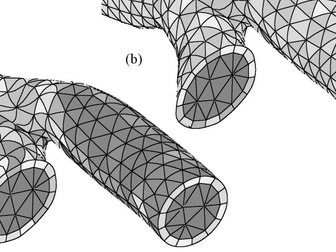
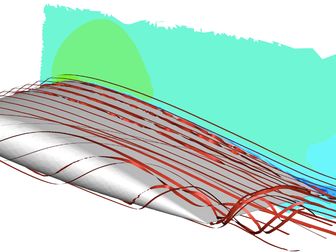
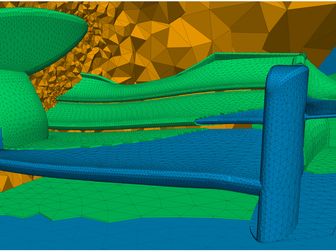
High-order spectral element simulations are now becoming increasingly popular within the computational modelling community, as they offer the potential to deliver increased accuracy at reduced cost compared to traditional low-order codes. However, to support accurate, high-fidelity simulations in complex industrial applications, there is a need to generate curvilinear meshes which robustly and accurately conform to geometrical features. This is, at present, a key challenge within the mesh generation community, with only a few open-source tools able to generate curvilinear meshes for complex geometries. We present NekMesh: an open-source mesh generation package which is designed to enable the generation of valid, high-quality curvilinear meshes of complex, three-dimensional geometries for performing high-order simulations. We outline the software architecture adopted in NekMesh, which uses a pipeline of processing modules to provide a flexible, CAD-independent high-order mesh processing tool, capable of both generating meshes for a wide range of use cases, as well as post-processing linear meshes from a range of input formats for use with high-order simulations. A number of examples in various application areas are presented, with a particular emphasis on challenging aeronautical and fluid dynamics test cases.
Bluff body and fundamental fluid mechanics
- R. M. Darekar and S. J. SherwinBiBTeX AbstractFlow past a square-section cylinder with a wavy stagnation faceJournal of Fluid Mechanics, 426, pp. 263–295, 2001. doi 10.1017/s0022112000002299
@article{2001:darekar.sherwin:flowa,
  author = {Darekar, Rupad M. and Sherwin, Spencer J.},
  title = {Flow past a square-section cylinder with a wavy stagnation face},
  journal = {Journal of Fluid Mechanics},
  publisher = {Cambridge University Press (CUP)},
  year = {2001},
  volume = {426},
  pages = {263--295},
  groups = {sherwin},
  doi = {10.1017/s0022112000002299}
}
Numerical investigations have been performed for the flow past square-section cylinders with a spanwise geometric deformation leading to a stagnation face with a sinusoidal waviness. The computations were performed using a spectral/ hp element solver over a range of Reynolds numbers from 10 to 150. Starting from fully developed shedding past a straight cylinder at a Reynolds number of 100, a sufficiently high waviness is impulsively introduced resulting in the stabilization of the near wake to a time-independent state. It is shown that the spanwise waviness sets up a cross-flow within the growing boundary layer on the leading-edge surface thereby generating streamwise and vertical components of vorticity. These additional components of vorticity appear in regions close to the inflection points of the wavy stagnation face where the spanwise vorticity is weakened. This redistribution of vorticity leads to the breakdown of the unsteady and staggered Kármán vortex wake into a steady and symmetric near-wake structure. The steady nature of the near wake is associated with a reduction in total drag of about 16% at a Reynolds number of 100 compared with the straight, non-wavy cylinder. Further increases in the amplitude of the waviness lead to the emergence of hairpin vortices from the near-wake region. This wake topology has similarities to the wake of a sphere at low Reynolds numbers. The physical structure of the wake due to the variation of the amplitude of the waviness is identified with five distinct regimes. Furthermore, the introduction of a waviness at a wavelength close to the mode A wavelength and the primary wavelength of the straight square-section cylinder leads to the suppression of the Kármán street at a minimal waviness amplitude. - G. R. S. Assi, P. W. Bearman, B. S. Carmo, J. R. Meneghini, S. J. Sherwin and R. H. J. WilldenBiBTeX AbstractThe role of wake stiffness on the wake-induced vibration of the downstream cylinder of a tandem pairJournal of Fluid Mechanics, 718, pp. 210–245, 2013. doi 10.1017/jfm.2012.606
@article{2013:assi.bearman.ea:role,
  author = {Assi, G. R. S. and Bearman, P. W. and Carmo, B. S. and Meneghini, J. R. and Sherwin, S. J. and Willden, R. H. J.},
  title = {The role of wake stiffness on the wake-induced vibration of the downstream cylinder of a tandem pair},
  journal = {Journal of Fluid Mechanics},
  publisher = {Cambridge University Press (CUP)},
  year = {2013},
  volume = {718},
  pages = {210--245},
  groups = {sherwin},
  doi = {10.1017/jfm.2012.606}
}
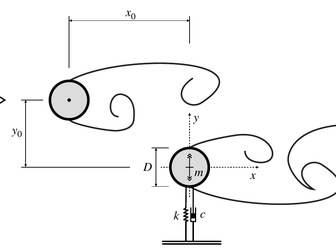
When a pair of tandem cylinders is immersed in a flow the downstream cylinder can be excited into wake-induced vibrations (WIV) due to the interaction with vortices coming from the upstream cylinder. Assi, Bearman & Meneghini ( J. Fluid Mech. , vol. 661, 2010, pp. 365–401) concluded that the WIV excitation mechanism has its origin in the unsteady vortex–structure interaction encountered by the cylinder as it oscillates across the wake. In the present paper we investigate how the cylinder responds to that excitation, characterising the amplitude and frequency of response and its dependency on other parameters of the system. We introduce the concept of wake stiffness , a fluid dynamic effect that can be associated, to a first approximation, with a linear spring with stiffness proportional to mathitRe and to the steady lift force occurring for staggered cylinders. By a series of experiments with a cylinder mounted on a base without springs we verify that such wake stiffness is not only strong enough to sustain oscillatory motion, but can also dominate over the structural stiffness of the system. We conclude that while unsteady vortex–structure interactions provide the energy input to sustain the vibrations, it is the wake stiffness phenomenon that defines the character of the WIV response. - C. H. Chan, M. Z. Hossain, S. J. Sherwin and Y. HwangBiBTeX AbstractDirect numerical simulations of transitional Rayleigh–Bénard Poiseuille flowsJournal of Fluid Mechanics, 1034, 2026. doi 10.1017/jfm.2026.11507
@article{2026:chan.hossain.ea:direct,
  author = {Chan, Chi Hin and Hossain, M.Z. and Sherwin, Spencer J. and Hwang, Yongyun},
  title = {Direct numerical simulations of transitional Rayleigh--Bénard Poiseuille flows},
  journal = {Journal of Fluid Mechanics},
  publisher = {Cambridge University Press (CUP)},
  year = {2026},
  volume = {1034},
  groups = {sherwin},
  doi = {10.1017/jfm.2026.11507}
}
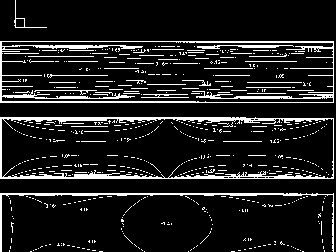
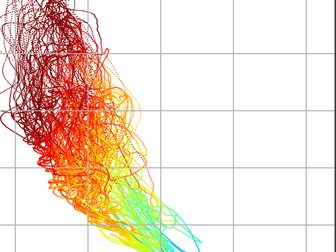
We investigate the transitional flow regimes arising from the interaction between buoyancy and shear in Rayleigh–Bénard–Poiseuille (RBP) flows, considering both large and small domains. The transition boundaries between the bistable system consisting of spiral defect chaos (SDC) and ideal straight rolls (ISRs) in Rayleigh–Bénard convection, and subcritical turbulence in plane Poiseuille flows are not known. Using direct numerical simulations in a large spatial domain over a range of Rayleigh numbers, Ra in [0, 10000] , Reynolds numbers, Re in [0, 2000] and unit Prandtl number, we identify five distinct regimes: (i) bistable SDC and ISRs; (ii) ISRs; (iii) wavy rolls; (iv) intermittent rolls; and (v) shear-driven turbulence. The newly identified intermittent rolls state features longitudinal rolls that decay towards the laminar state before regenerating. In the turbulent regime, longitudinal rolls may coexist with turbulent–laminar bands, highlighting the role of longitudinal rolls in transitional RBP flows. To this end, we examine the unstable manifold of longitudinal rolls in a small domain, integrating along which led to turbulence. This turbulence occur transiently, decaying towards the unstable laminar base state where the longitudinal rolls can be excited again, forming a quasi-cyclic process referred to as the thermally assisted sustaining process (TASP). We further investigate the behaviour of TASP as Re and Ra are varied, revealing a stable periodic orbit around the longitudinal roll and the laminar state, and a pathway towards turbulence above a certain Re threshold. Finally, we provide a state space sketch of the dynamical processes, emphasising the role of longitudinal rolls in transitional RBP in small domains, and discuss the potential connections to large domains.
Turbomachinery and industrial aerodynamics
- J.-E. W. Lombard, D. Moxey, S. J. Sherwin, J. F. A. Hoessler, S. Dhandapani and M. J. TaylorBiBTeXImplicit Large-Eddy Simulation of a Wingtip VortexAIAA JOURNAL, 54 (2), pp. 506–518, 2016. doi 10.2514/1.J054181
@article{2016:lombard.moxey.ea:implicit, author = {Lombard, J-EW and Moxey, D and Sherwin, SJ and Hoessler, JFA and Dhandapani, S and Taylor, MJ}, title = {Implicit Large-Eddy Simulation of a Wingtip Vortex}, journal = {AIAA JOURNAL}, year = {2016}, volume = {54}, pages = {506--518}, month = feb, publisher = {AMER INST AERONAUTICS ASTRONAUTICS}, doi = {10.2514/1.J054181}, issn = {0001-1452}, issue = {2}, keyword = {STABILIZATION}, language = {English}, day = {1}, publicationstatus = {published}, groups = {app} } - N. Abdessemed, S. J. Sherwin and V. TheofilisBiBTeX AbstractLinear instability analysis of low-pressure turbine flowsJournal of Fluid Mechanics, 628, pp. 57–83, 2009. doi 10.1017/s0022112009006272
@article{2009:abdessemed.sherwin.ea:linear,
  author = {Abdessemed, N. and Sherwin, S. J. and Theofilis, V.},
  title = {Linear instability analysis of low-pressure turbine flows},
  journal = {Journal of Fluid Mechanics},
  publisher = {Cambridge University Press (CUP)},
  year = {2009},
  volume = {628},
  pages = {57--83},
  groups = {sherwin},
  doi = {10.1017/s0022112009006272}
}
Three-dimensional linear BiGlobal instability of two-dimensional states over a periodic array of T-106/300 low-pressure turbine (LPT) blades is investigated for Reynolds numbers below 5000. The analyses are based on a high-order spectral/ hp element discretization using a hybrid mesh. Steady basic states are investigated by solution of the partial-derivative eigenvalue problem, while Floquet theory is used to analyse time-periodic flow set-up past the first bifurcation. The leading mode is associated with the wake and long-wavelength perturbations, while a second short-wavelength mode can be associated with the separation bubble at the trailing edge. The leading eigenvalues and Floquet multipliers of the LPT flow have been obtained in a range of spanwise wavenumbers. For the most general configuration all secondary modes were observed to be stable in the Reynolds number regime considered. When a single LPT blade with top to bottom periodicity is considered as a base flow, the imposed periodicity forces the wakes of adjacent blades to be synchronized. This enforced synchronization can produce a linear instability due to long-wavelength disturbances. However, relaxing the periodic restrictions is shown to remove this instability. A pseudo-spectrum analysis shows that the eigenvalues can become unstable due to the non-orthogonal properties of the eigenmodes. Three-dimensional direct numerical simulations confirm all perturbations identified herein. An optimum growth analysis based on singular-value decomposition identifies perturbations with energy growths O (10 5 ). - J. Isler, G. Vivarelli, C. Cantwell, F. Montomoli, S. Sherwin, Y. Frey, M. Meyer and R. VazquezBiBTeX AbstractSource Term-Based Synthetic Turbulence Generator Applied to Compressible DNS of the T106A Low-Pressure TurbineInternational Journal of Turbomachinery, Propulsion and Power, 10 (3), p. 13, 2025. doi 10.3390/ijtpp10030013
@article{2025:isler.vivarelli.ea:source,
  author = {Isler, João and Vivarelli, Guglielmo and Cantwell, Chris and Montomoli, Francesco and Sherwin, Spencer and Frey, Yuri and Meyer, Marcus and Vazquez, Raul},
  title = {Source Term-Based Synthetic Turbulence Generator Applied to Compressible DNS of the T106A Low-Pressure Turbine},
  journal = {International Journal of Turbomachinery, Propulsion and Power},
  publisher = {MDPI AG},
  year = {2025},
  volume = {10},
  number = {3},
  pages = {13},
  groups = {sherwin},
  doi = {10.3390/ijtpp10030013}
}
Direct numerical simulations (DNSs) of the T106A low-pressure turbine were conducted for various turbulence intensities and length scales to investigate their effects on flow behaviour and transition. A source-term formulation of the synthetic eddy method (SEM) was implemented in the Nektar++ spectral/hp element framework to introduce anisotropic turbulence into the flow field. A single sponge layer was imposed, which covers the inflow and outflow regions just downstream and upstream of the inflow and outflow boundaries, respectively, to avoid acoustic wave reflections on the boundary conditions. Additionally, in the T106A model, mixed polynomial orders were utilized, as Nektar++ allows different polynomial orders for adjacent elements. A lower polynomial order was employed in the outflow region to further assist the sponge layer by coarsening the mesh and diffusing the turbulence near the outflow boundary. Thus, this study contributes to the development of a more robust and efficient model for high-fidelity simulations of turbine blades by enhancing stability and producing a more accurate flow field. The main findings are compared with experimental and DNS data, showing good agreement and providing new insights into the influence of turbulence length scales on flow separation, transition, wake behaviour, and loss profiles.
Shallow water and free surface flows
- C. Eskilsson and S. J. SherwinBiBTeX AbstractA triangular spectral/ hp discontinuous Galerkin method for modelling 2D shallow water equationsInternational Journal for Numerical Methods in Fluids, 45 (6), pp. 605–623, 2004. doi 10.1002/fld.709
@article{2004:eskilsson.sherwin:triangular,
  author = {Eskilsson, C. and Sherwin, S. J.},
  title = {A triangular spectral/ hp discontinuous Galerkin method for modelling 2D shallow water equations},
  journal = {International Journal for Numerical Methods in Fluids},
  publisher = {Wiley},
  year = {2004},
  volume = {45},
  number = {6},
  pages = {605--623},
  groups = {sherwin},
  doi = {10.1002/fld.709}
}
We present a spectral/ hp element discontinuous Galerkin model for simulating shallow water flows on unstructured triangular meshes. The model uses an orthogonal modal expansion basis of arbitrary order for the spatial discretization and a third‐order Runge–Kutta scheme to advance in time. The local elements are coupled together by numerical fluxes, evaluated using the HLLC Riemann solver. We apply the model to test cases involving smooth flows and demonstrate the exponentially fast convergence with regard to polynomial order. We also illustrate that even for results of ‘engineering accuracy’ the computational efficiency increases with increasing order of the model and time of integration. The model is found to be robust in the presence of shocks where Gibbs oscillations can be suppressed by slope limiting. Copyright 2004 John Wiley & Sons, Ltd. - C. Eskilsson and S. J. SherwinBiBTeXSpectral/hp discontinuous Galerkin methods for modelling 2D Boussinesq equationsJournal of Computational Physics, 212 (2), pp. 566–589, 2006. doi 10.1016/j.jcp.2005.07.017
@article{2006:eskilsson.sherwin:spectralhp, author = {Eskilsson, Claes and Sherwin, Spencer J.}, title = {Spectral/hp discontinuous Galerkin methods for modelling 2D Boussinesq equations}, journal = {Journal of Computational Physics}, publisher = {Elsevier BV}, year = {2006}, volume = {212}, number = {2}, pages = {566--589}, groups = {sherwin}, doi = {10.1016/j.jcp.2005.07.017} } - P. Alpresa, S. Sherwin, P. Weinberg and M. van ReeuwijkBiBTeXOrbitally shaken shallow fluid layers. I. Regime classificationPhysics of Fluids, 30 (3), p. 032107, 2018. doi 10.1063/1.4996916
@article{2018:alpresa.sherwin.ea:orbitally,
  author = {Alpresa, Paola and Sherwin, Spencer and Weinberg, Peter and van Reeuwijk, Maarten},
  title = {Orbitally shaken shallow fluid layers. I. Regime classification},
  journal = {Physics of Fluids},
  publisher = {AIP Publishing},
  year = {2018},
  volume = {30},
  number = {3},
  pages = {032107},
  groups = {sherwin},
  doi = {10.1063/1.4996916}
}
Physiological flow modelling
- S. J. Sherwin, V. Franke, J. Peiró and K. ParkerBiBTeXOne-dimensional modelling of a vascular network in space-time variablesJournal of Engineering Mathematics, 47 (3-4), pp. 217–250, 2003. doi 10.1023/b:engi.0000007979.32871.e2
@article{2003:sherwin.franke.ea:onedimensional, author = {Sherwin, S.J. and Franke, V. and Peiró, J. and Parker, K.}, title = {One-dimensional modelling of a vascular network in space-time variables}, journal = {Journal of Engineering Mathematics}, publisher = {Springer Science and Business Media LLC}, year = {2003}, volume = {47}, number = {3-4}, pages = {217--250}, groups = {sherwin}, doi = {10.1023/b:engi.0000007979.32871.e2} } - J. Alastruey, K. H. Parker, J. Peiró, S. M. Byrd and S. J. SherwinBiBTeXModelling the circle of Willis to assess the effects of anatomical variations and occlusions on cerebral flowsJournal of Biomechanics, 40 (8), pp. 1794–1805, 2007. doi 10.1016/j.jbiomech.2006.07.008
@article{2007:alastruey.parker.ea:modelling, author = {Alastruey, J. and Parker, K.H. and Peiró, J. and Byrd, S.M. and Sherwin, S.J.}, title = {Modelling the circle of Willis to assess the effects of anatomical variations and occlusions on cerebral flows}, journal = {Journal of Biomechanics}, publisher = {Elsevier BV}, year = {2007}, volume = {40}, number = {8}, pages = {1794--1805}, groups = {sherwin}, doi = {10.1016/j.jbiomech.2006.07.008} } - P. Kandangwa, K. Cheng, M. Patel, S. J. Sherwin, R. de Silva and P. D. WeinbergBiBTeX AbstractRelative Residence Time Can Account for Half of the Anatomical Variation in Fatty Streak Prevalence Within the Right Coronary ArteryAnnals of Biomedical Engineering, 53 (1), pp. 144–157, 2024. doi 10.1007/s10439-024-03607-9
@article{2024:kandangwa.cheng.ea:relative,
  author = {Kandangwa, Pratik and Cheng, Kevin and Patel, Miten and Sherwin, Spencer J. and de Silva, Ranil and Weinberg, Peter D.},
  title = {Relative Residence Time Can Account for Half of the Anatomical Variation in Fatty Streak Prevalence Within the Right Coronary Artery},
  journal = {Annals of Biomedical Engineering},
  publisher = {Springer Science and Business Media LLC},
  year = {2024},
  volume = {53},
  number = {1},
  pages = {144--157},
  groups = {sherwin},
  doi = {10.1007/s10439-024-03607-9}
}
Purpose The patchy anatomical distribution of atherosclerosis has been attributed to variation in haemodynamic wall shear stress (WSS). The consensus is that low WSS and a high Oscillatory Shear Index (OSI) trigger the disease. We found that atherosclerosis at aortic branch sites correlates threefold better with transverse WSS (transWSS), a metric which quantifies multidirectional near-wall flow. Coronary artery disease has greater clinical significance than aortic disease but computation of WSS metrics is complicated by the substantial vessel motion occurring during each cardiac cycle. Here we present the first comparison of the distribution of atherosclerosis with WSS metrics computed for moving coronary arteries. Methods Maps of WSS metrics were computed using dynamic geometries reconstructed from angiograms of ten non-stenosed human right coronary arteries (RCAs). They were compared with maps of fatty streak prevalence derived from a previous study of 1852 RCAs. Results Time average WSS (TAWSS), OSI, transWSS and the cross-flow index (CFI), a non-dimensional form of the transWSS, gave non-significant or significant but low spatial correlations with lesion prevalence. The highest correlation coefficient (0.71) was for the relative residence time (RRT), a metric that decreases with TAWSS and increases with OSI. The coefficient was not changed if RRT was calculated using CFI, which captures multidirectional WSS only, rather than OSI, which encompasses both multidirectional and oscillatory WSS. Conclusion Contrary to our earlier findings in the aorta, low WSS in combination with highly multidirectional flow correlates best with lesion location in the RCA, explaining approximately half of its anatomical variation.
Books and chapters
2009
- J. Alastruey, D. Doorly, S. Giordana, J. Peiró and S. SherwinBiBTeXApplications and test casesin Cardiovascular Mathematics, Springer Milan, 2009, pp. 447–475. doi 10.1007/978-88-470-1152-6_12
@incollection{2009:alastruey.doorly.ea:applications, author = {Alastruey, J. and Doorly, Denis and Giordana, Sergio and Peiró, Joaquim and Sherwin, Spencer}, title = {Applications and test cases}, booktitle = {Cardiovascular Mathematics}, publisher = {Springer Milan}, year = {2009}, pages = {447--475}, groups = {sherwin}, doi = {10.1007/978-88-470-1152-6_12} } - D. Doorly and S. SherwinBiBTeXGeometry and flowin Cardiovascular Mathematics, Springer Milan, 2009, pp. 177–209. doi 10.1007/978-88-470-1152-6_5
@incollection{2009:doorly.sherwin:geometrya,
  author = {Doorly, Denis and Sherwin, Spencer},
  title = {Geometry and flow},
  booktitle = {Cardiovascular Mathematics},
  publisher = {Springer Milan},
  year = {2009},
  pages = {177--209},
  groups = {sherwin},
  doi = {10.1007/978-88-470-1152-6_5}
}
2005
- G. Karniadakis and S. SherwinSpectral/hp element methods for computational fluid dynamics. Oxford University Press, 2005. doi 10.1093/acprof:oso/9780198528692.001.0001BiBTeX Abstract
@book{2005:karniadakis.sherwin:spectralhp,
  author = {Karniadakis, G and Sherwin, S},
  title = {Spectral/hp element methods for computational fluid dynamics},
  publisher = {Oxford University Press},
  year = {2005},
  edition = {2nd edition},
  doi = {10.1093/acprof:oso/9780198528692.001.0001},
  groups = {core}
}
Spectral methods have long been popular in direct and large eddy simulation of turbulent flows, but their use in areas with complex-geometry computational domains has historically been much more limited. More recently, the need to find accurate solutions to the viscous flow equations around complex configurations has led to the development of high-order discretization procedures on unstructured meshes, which are also recognized as more efficient for solution of time-dependent oscillatory solutions over long time periods. This book, an updated edition on the original text, presents the recent and significant progress in multi-domain spectral methods at both the fundamental and application level. Containing material on discontinuous Galerkin methods, non-tensorial nodal spectral element methods in simplex domains, and stabilization and filtering techniques, this text introduces the use of spectral/hp element methods with particular emphasis on their application to unstructured meshes. It provides a detailed explanation of the key concepts underlying the methods along with practical examples of their derivation and application. - J. Peiró and S. SherwinBiBTeXFinite Difference, Finite Element and Finite Volume Methods for Partial Differential Equationsin Handbook of Materials Modeling, Springer Netherlands, 2005, pp. 2415–2446. doi 10.1007/978-1-4020-3286-8_127
@incollection{2005:peiro.sherwin:finite,
  author = {Peiró, Joaquim and Sherwin, Spencer},
  title = {Finite Difference, Finite Element and Finite Volume Methods for Partial Differential Equations},
  booktitle = {Handbook of Materials Modeling},
  publisher = {Springer Netherlands},
  year = {2005},
  pages = {2415--2446},
  groups = {sherwin},
  doi = {10.1007/978-1-4020-3286-8_127}
}
2003
- J. Peiro, S. J. Sherwin, K. H. Parker, V. Franke, L. Formaggia, D. Lamponi, A. Quarteroni, M. W. Collins, G. Pontrelli and M. A. AthertonBiBTeXNumerical simulation of arterial pulse propagation using one-dimensional models2003.
@incollection{2003:peiro.sherwin.ea:numerical,
  author = {Peiro, J. and Sherwin, S.J. and Parker, K.H. and Franke, V. and Formaggia, L. and Lamponi, D. and Quarteroni, A. and Collins, M W and Pontrelli, G and Atherton, M A},
  title = {Numerical simulation of arterial pulse propagation using one-dimensional models},
  year = {2003},
  groups = {sherwin}
}
2002
- S. J. Sherwin, D. J. Doorly, A. Tura, M. Rahman and M. G. SatishBiBTeXFlow dynamics within model distal arterial bypass grafts2002.
@incollection{2002:sherwin.doorly.ea:flow,
  author = {Sherwin, S.J. and Doorly, D.J. and Tura, A and Rahman, M and Satish, M G},
  title = {Flow dynamics within model distal arterial bypass grafts},
  year = {2002},
  groups = {sherwin}
}
Journal articles
2026
- C. H. Chan, M. Z. Hossain, S. J. Sherwin and Y. HwangBiBTeX AbstractDirect numerical simulations of transitional Rayleigh–Bénard Poiseuille flowsJournal of Fluid Mechanics, 1034, 2026. doi 10.1017/jfm.2026.11507
@article{2026:chan.hossain.ea:direct,
  author = {Chan, Chi Hin and Hossain, M.Z. and Sherwin, Spencer J. and Hwang, Yongyun},
  title = {Direct numerical simulations of transitional Rayleigh--Bénard Poiseuille flows},
  journal = {Journal of Fluid Mechanics},
  publisher = {Cambridge University Press (CUP)},
  year = {2026},
  volume = {1034},
  groups = {sherwin},
  doi = {10.1017/jfm.2026.11507}
}
We investigate the transitional flow regimes arising from the interaction between buoyancy and shear in Rayleigh–Bénard–Poiseuille (RBP) flows, considering both large and small domains. The transition boundaries between the bistable system consisting of spiral defect chaos (SDC) and ideal straight rolls (ISRs) in Rayleigh–Bénard convection, and subcritical turbulence in plane Poiseuille flows are not known. Using direct numerical simulations in a large spatial domain over a range of Rayleigh numbers, Ra in [0, 10000] , Reynolds numbers, Re in [0, 2000] and unit Prandtl number, we identify five distinct regimes: (i) bistable SDC and ISRs; (ii) ISRs; (iii) wavy rolls; (iv) intermittent rolls; and (v) shear-driven turbulence. The newly identified intermittent rolls state features longitudinal rolls that decay towards the laminar state before regenerating. In the turbulent regime, longitudinal rolls may coexist with turbulent–laminar bands, highlighting the role of longitudinal rolls in transitional RBP flows. To this end, we examine the unstable manifold of longitudinal rolls in a small domain, integrating along which led to turbulence. This turbulence occur transiently, decaying towards the unstable laminar base state where the longitudinal rolls can be excited again, forming a quasi-cyclic process referred to as the thermally assisted sustaining process (TASP). We further investigate the behaviour of TASP as Re and Ra are varied, revealing a stable periodic orbit around the longitudinal roll and the laminar state, and a pathway towards turbulence above a certain Re threshold. Finally, we provide a state space sketch of the dynamical processes, emphasising the role of longitudinal rolls in transitional RBP in small domains, and discuss the potential connections to large domains. - A. I. Liosi, H. Wüstenberg, P. Khurana, A. Swift, A. Chatzopoulos, F. Bottone, J. Hoessler and S. SherwinBiBTeXComparing implicit time-stepping techniques for highly resolved simulations using industrial geometriesComputers & Fluids, 311, p. 107029, 2026. doi 10.1016/j.compfluid.2026.107029
@article{2026:liosi.wustenberg.ea:comparing,
  author = {Liosi, Alexandra Ioanna and Wüstenberg, Henrik and Khurana, Parv and Swift, Adam and Chatzopoulos, Athanasios and Bottone, Francesco and Hoessler, Julien and Sherwin, Spencer},
  title = {Comparing implicit time-stepping techniques for highly resolved simulations using industrial geometries},
  journal = {Computers & Fluids},
  publisher = {Elsevier BV},
  year = {2026},
  volume = {311},
  pages = {107029},
  groups = {sherwin},
  doi = {10.1016/j.compfluid.2026.107029}
}
2025
- J. Isler, G. Vivarelli, C. Cantwell, F. Montomoli, S. Sherwin, Y. Frey, M. Meyer and R. VazquezBiBTeX AbstractSource Term-Based Synthetic Turbulence Generator Applied to Compressible DNS of the T106A Low-Pressure TurbineInternational Journal of Turbomachinery, Propulsion and Power, 10 (3), p. 13, 2025. doi 10.3390/ijtpp10030013
@article{2025:isler.vivarelli.ea:source,
  author = {Isler, João and Vivarelli, Guglielmo and Cantwell, Chris and Montomoli, Francesco and Sherwin, Spencer and Frey, Yuri and Meyer, Marcus and Vazquez, Raul},
  title = {Source Term-Based Synthetic Turbulence Generator Applied to Compressible DNS of the T106A Low-Pressure Turbine},
  journal = {International Journal of Turbomachinery, Propulsion and Power},
  publisher = {MDPI AG},
  year = {2025},
  volume = {10},
  number = {3},
  pages = {13},
  groups = {sherwin},
  doi = {10.3390/ijtpp10030013}
}
Direct numerical simulations (DNSs) of the T106A low-pressure turbine were conducted for various turbulence intensities and length scales to investigate their effects on flow behaviour and transition. A source-term formulation of the synthetic eddy method (SEM) was implemented in the Nektar++ spectral/hp element framework to introduce anisotropic turbulence into the flow field. A single sponge layer was imposed, which covers the inflow and outflow regions just downstream and upstream of the inflow and outflow boundaries, respectively, to avoid acoustic wave reflections on the boundary conditions. Additionally, in the T106A model, mixed polynomial orders were utilized, as Nektar++ allows different polynomial orders for adjacent elements. A lower polynomial order was employed in the outflow region to further assist the sponge layer by coarsening the mesh and diffusing the turbulence near the outflow boundary. Thus, this study contributes to the development of a more robust and efficient model for high-fidelity simulations of turbine blades by enhancing stability and producing a more accurate flow field. The main findings are compared with experimental and DNS data, showing good agreement and providing new insights into the influence of turbulence length scales on flow separation, transition, wake behaviour, and loss profiles. - G. Vivarelli, J. A. Isler, C. D. Cantwell, F. Montomoli, S. J. Sherwin, Y. Frey-Marioni, M. Meyer, I. Naqavi and R. Vazquez-DiazBiBTeX AbstractA Quasi-Direct Numerical Simulation of a Compressor Blade with Separation Bubbles and Inflow TurbulenceInternational Journal of Turbomachinery, Propulsion and Power, 10 (2), p. 8, 2025. doi 10.3390/ijtpp10020008
@article{2025:vivarelli.isler.ea:quasi-direct,
  author = {Vivarelli, Guglielmo and Isler, Jo{\~a}o Anderson and Cantwell, Chris D and Montomoli, Francesco and Sherwin, Spencer J and Frey-Marioni, Yuri and Meyer, Marcus and Naqavi, Iftekhar and Vazquez-Diaz, Raul},
  title = {A Quasi-Direct Numerical Simulation of a Compressor Blade with Separation Bubbles and Inflow Turbulence},
  journal = {International Journal of Turbomachinery, Propulsion and Power},
  year = {2025},
  volume = {10},
  number = {2},
  pages = {8},
  publisher = {MDPI},
  groups = {app},
  doi = {10.3390/ijtpp10020008}
}
Within the turbomachinery industry, components are currently assessed deploying standard second-order steady solvers. These are unable to capture complicated unsteady phenomena that have a critical impact on component performance. In this work, the high-order spectral h/p solver Nektar++ will be applied to a compressor blade to study the turbulent transition mechanisms and assess the effect of incoming disturbances with quasi-DNS resolution. The case will be modelled at an angle of incidence of 53.5\textdegree to match the original experimental loading at 52.8\textdegree. At clean inflow conditions, Kelvin-Helmholtz instabilities appear on both sides of the blade due to a double separation, with the pressure side one not being reported in the experiments. The separation is gradually removed by the incoming turbulent structures but at different rates on the two sides of the blade. It will be shown that there is an optimal amount of turbulence intensity that minimises momentum thickness, which is strongly related to losses. Moreover, a discussion on the spanwise extrusion will be included, this being a major player in the modelling costs. Finally, the wall-clock time and the exact expenditure to run this case will be outlined, providing quantitative evidence of the feasibility of considering a quasi-DNS resolution in an industrial setting.
2024
- M. D. Green, K. S. Kirilov, M. Turner, J. Marcon, J. Eichstädt, E. Laughton, C. D. Cantwell, S. J. Sherwin, J. Peiró and D. MoxeyBiBTeX AbstractNekMesh: An open-source high-order mesh generation frameworkComputer Physics Communications, (298), p. 109089, 2024. doi 10.1016/j.cpc.2024.109089
@article{2024:green.kirilov.ea:nekmesh,
  author = {Green, M. D. and Kirilov, K. S. and Turner, M. and Marcon, J. and Eichst\"adt, J. and Laughton, E. and Cantwell, C. D. and Sherwin, S. J. and Peir\'o, J. and Moxey, D.},
  title = {NekMesh: An open-source high-order mesh generation framework},
  journal = {Computer Physics Communications},
  year = {2024},
  number = {298},
  pages = {109089},
  groups = {core},
  doi = {10.1016/j.cpc.2024.109089}
}
High-order spectral element simulations are now becoming increasingly popular within the computational modelling community, as they offer the potential to deliver increased accuracy at reduced cost compared to traditional low-order codes. However, to support accurate, high-fidelity simulations in complex industrial applications, there is a need to generate curvilinear meshes which robustly and accurately conform to geometrical features. This is, at present, a key challenge within the mesh generation community, with only a few open-source tools able to generate curvilinear meshes for complex geometries. We present NekMesh: an open-source mesh generation package which is designed to enable the generation of valid, high-quality curvilinear meshes of complex, three-dimensional geometries for performing high-order simulations. We outline the software architecture adopted in NekMesh, which uses a pipeline of processing modules to provide a flexible, CAD-independent high-order mesh processing tool, capable of both generating meshes for a wide range of use cases, as well as post-processing linear meshes from a range of input formats for use with high-order simulations. A number of examples in various application areas are presented, with a particular emphasis on challenging aeronautical and fluid dynamics test cases. - P. Kandangwa, K. Cheng, M. Patel, S. J. Sherwin, R. de Silva and P. D. WeinbergBiBTeX AbstractRelative Residence Time Can Account for Half of the Anatomical Variation in Fatty Streak Prevalence Within the Right Coronary ArteryAnnals of Biomedical Engineering, 53 (1), pp. 144–157, 2024. doi 10.1007/s10439-024-03607-9
@article{2024:kandangwa.cheng.ea:relative,
  author = {Kandangwa, Pratik and Cheng, Kevin and Patel, Miten and Sherwin, Spencer J. and de Silva, Ranil and Weinberg, Peter D.},
  title = {Relative Residence Time Can Account for Half of the Anatomical Variation in Fatty Streak Prevalence Within the Right Coronary Artery},
  journal = {Annals of Biomedical Engineering},
  publisher = {Springer Science and Business Media LLC},
  year = {2024},
  volume = {53},
  number = {1},
  pages = {144--157},
  groups = {sherwin},
  doi = {10.1007/s10439-024-03607-9}
}
Purpose The patchy anatomical distribution of atherosclerosis has been attributed to variation in haemodynamic wall shear stress (WSS). The consensus is that low WSS and a high Oscillatory Shear Index (OSI) trigger the disease. We found that atherosclerosis at aortic branch sites correlates threefold better with transverse WSS (transWSS), a metric which quantifies multidirectional near-wall flow. Coronary artery disease has greater clinical significance than aortic disease but computation of WSS metrics is complicated by the substantial vessel motion occurring during each cardiac cycle. Here we present the first comparison of the distribution of atherosclerosis with WSS metrics computed for moving coronary arteries. Methods Maps of WSS metrics were computed using dynamic geometries reconstructed from angiograms of ten non-stenosed human right coronary arteries (RCAs). They were compared with maps of fatty streak prevalence derived from a previous study of 1852 RCAs. Results Time average WSS (TAWSS), OSI, transWSS and the cross-flow index (CFI), a non-dimensional form of the transWSS, gave non-significant or significant but low spatial correlations with lesion prevalence. The highest correlation coefficient (0.71) was for the relative residence time (RRT), a metric that decreases with TAWSS and increases with OSI. The coefficient was not changed if RRT was calculated using CFI, which captures multidirectional WSS only, rather than OSI, which encompasses both multidirectional and oscillatory WSS. Conclusion Contrary to our earlier findings in the aorta, low WSS in combination with highly multidirectional flow correlates best with lesion location in the RCA, explaining approximately half of its anatomical variation. - D. Lindblad, J. Isler, M. M. Ginard, S. J. Sherwin and C. D. CantwellBiBTeX AbstractNektar++: Development of the compressible flow solver for jet aeroacousticsComputer Physics Communications, 300, p. 109203, 2024. doi 10.1016/j.cpc.2024.109203
@article{2024:lindblad.isler.ea:nektar,
  author = {Lindblad, Daniel and Isler, Jo{\~a}o and Ginard, Margarida Moragues and Sherwin, Spencer J and Cantwell, Chris D},
  title = {Nektar++: Development of the compressible flow solver for jet aeroacoustics},
  journal = {Computer Physics Communications},
  year = {2024},
  volume = {300},
  pages = {109203},
  publisher = {Elsevier},
  groups = {app},
  doi = {10.1016/j.cpc.2024.109203}
}
A recently developed computational framework for jet noise predictions is presented. The framework consists of two main components, focusing on source prediction and noise propagation. To compute the noise sources, the turbulent jet is simulated using the compressible flow solver implemented in the open-source spectral/hp element framework Nektar++, which solves the unfiltered Navier-Stokes equations on unstructured grids using the high-order discontinuous Galerkin method. This allows high-order accuracy to be achieved on unstructured grids, which in turn is important in order to accurately simulate industrially relevant geometries. For noise propagation, the Ffowcs Williams - Hawkings method is used to propagate the noise between the jet and the far-field. The paper provides a detailed description of the computational framework, including how the different components fit together and how to use them. To demonstrate the framework, two configurations of a single stream subsonic jet are considered. In the first configuration, the jet is treated in isolation, whereas in the second configuration, it is installed under a wing. The aerodynamic results for these two jets show strong agreement with experimental data, while some discrepancies are observed in the acoustic results, which are discussed. In addition to this, we demonstrate close to linear scaling beyond 100,000 processors on the ARCHER2 supercomputer. - R. C. Moura, L. D. Fernandes, A. F. C. da Silva and S. J. SherwinBiBTeX AbstractJoint-mode diffusion analysis of spectral/hp continuous Galerin Methods: Towards superior dissipation estimates for implicit LESComputer Methods in Applied Mechanics and Engineering, 2024. doi 10.1016/j.cma.2024.117025
@article{2024:moura.l-d-fernandes.ea:joint-mode,
  author = {Moura, R.C. and Fernandes, L.D. and da Silva, A.F. C. and Sherwin, S. J.},
  title = {Joint-mode diffusion analysis of spectral/hp continuous Galerin Methods: Towards superior dissipation estimates for implicit LES},
  journal = {Computer Methods in Applied Mechanics and Engineering},
  year = {2024},
  doi = {10.1016/j.cma.2024.117025},
  groups = {core}
}
We present a new linear eigensolution analysis technique that provides superior estimates of dissipation distribution in wavenumber space for the continuous Galerkin (CG) method. The technique builds upon traditional dispersion-diffusion analyses that have been applied to spectral/hp element methods, but in particular is an improvement upon the non-modal eigenanalysis approach proposed by Fernandez et al. (2019). The present technique takes into account the indirect effects that dispersion may have on dissipation, as recently discussed by Moura et al. (2022), in order to better represent dissipation itself. Also, a concept used by the dynamic mode decomposition (DMD) community is invoked to weight the relative contribution of the multiple diffusion curves that stem from temporal eigenanalysis. This allows for obtaining a single dissipation profile in wavenumber space, so that the proposed technique is named joint-mode analysis. Although the non-modal approach also provides a single diffusion curve, the joint-mode dissipation curve is shown to correlate significantly better with the energy spectrum of Burgers’ turbulence at large and intermediate scales, which is particularly relevant for implicit large-eddy simulation (LES). The proposed technique is readily extensible to other spectral/hp element methods. - R. C. Moura, L. D. Fernandes, A. F. C. da Silva and S. J. SherwinBiBTeXJoint-mode diffusion analysis of discontinuous Galerkin methods: Towards superior dissipation estimates for nonlinear problems and implicit LESJournal of Computational Physics, 505, p. 112912, 2024. doi 10.1016/j.jcp.2024.112912
@article{2024:moura.fernandes.ea:jointmode, author = {Moura, R.C. and Fernandes, L.D. and da Silva, A.F.C. and Sherwin, S.J.}, title = {Joint-mode diffusion analysis of discontinuous Galerkin methods: Towards superior dissipation estimates for nonlinear problems and implicit LES}, journal = {Journal of Computational Physics}, publisher = {Elsevier BV}, year = {2024}, volume = {505}, pages = {112912}, groups = {sherwin}, doi = {10.1016/j.jcp.2024.112912} } - G. Vivarelli, J. A. Isler, F. Montomoli, C. Cantwell, S. J. Sherwin, Y. Frey-Marioni and R. Vazquez-DiazBiBTeX AbstractApplications and Recent Developments of the Open-Source Computational Fluid Dynamics High-Fidelity Spectral/Hp Element Framework Nektar++ for Turbomachinery ConfigurationsTurbo Expo: Power for Land, Sea, and Air, 88070, p. V12CT32A022, 2024. doi 10.1115/GT2024-125039
@article{2024:vivarelli.isler.ea:applications,
  author = {Vivarelli, Guglielmo and Isler, Jo{\~a}o Anderson and Montomoli, Francesco and Cantwell, Chris and Sherwin, Spencer J and Frey-Marioni, Yuri and Vazquez-Diaz, Raul},
  title = {Applications and Recent Developments of the Open-Source Computational Fluid Dynamics High-Fidelity Spectral/Hp Element Framework Nektar++ for Turbomachinery Configurations},
  journal = {Turbo Expo: Power for Land, Sea, and Air},
  year = {2024},
  volume = {88070},
  pages = {V12CT32A022},
  publisher = {American Society of Mechanical Engineers},
  groups = {app},
  doi = {10.1115/GT2024-125039}
}
Reynolds-Averaged-Navier-Stokes (RANS) modelling has had a significant amount of success within the industrial setting. In fact, such techniques are used on a daily basis to compute the flow field around a broad spectrum of geometries in very different conditions. To this end, many codes have now reached a good level of maturity in terms of capabilities and robustness. However, there is a growing need for more efficient designs and higher performance. Therefore, aspects that are either challenging or impossible to capture by means of standard second-order steady discretisations are starting to become of interest. The computational hardware improvements seen over the decades and the persistent development of high-order numerical techniques, are allowing Implicit Large Eddy Simulation (iLES) if not Direct Numerical Simulation (DNS). These would allow accurate capturing of unsteady flow phenomena that can be critical to properly understand aspects such as flow separation, reattachment and transition to turbulence in components relevant to the turbomachinery community. The advantage that high-order solvers, such as Nektar++, have over their standard second-order discretisation counterpart, relates to their ability to reach higher fidelity solutions with a saving in terms of number of degrees of freedom and therefore computational cost. In this paper, a detailed introduction to the characteristics and features of the open-source high-order Nektar++ Computational Fluid Dynamics (CFD) framework will be given. An initial discussion of the numerics will be provided, therefore explaining the main features of this solver, followed by a set of different capabilities that are of interest to the turbomachinery community, such as meshing, incompressible and compressible solvers and post-processing. Examples of successful deployment of these features to jet engine components will then be presented. To start, preliminary design components, such as flat plates with different loadings will be discussed. In these cases, the effects of adverse and favourable pressure gradients representative of those seen on modern engine intakes and fan blades, respectively, on boundary layers will be studied. Following, a description on low and high pressure turbine components will be provided with a discussion relating to the relevant experimental comparison. Finally, future developments and improvements to the code will be detailed, such as new schemes and interfaces to hardware enhancements, i.e. Graphical Processing Units.
2023
- M. Arshad, S. Cheng, M. van Reeuwijk, S. J. Sherwin and P. D. WeinbergBiBTeX AbstractModification of the swirling well cell culture model to alter shear stress metricsBiotechnology and Bioengineering, 120 (5), pp. 1254–1268, 2023. doi 10.1002/bit.28331
@article{2023:arshad.cheng.ea:modification,
  author = {Arshad, Mehwish and Cheng, Shuyu and van Reeuwijk, Maarten and Sherwin, Spencer J. and Weinberg, Peter D.},
  title = {Modification of the swirling well cell culture model to alter shear stress metrics},
  journal = {Biotechnology and Bioengineering},
  publisher = {Wiley},
  year = {2023},
  volume = {120},
  number = {5},
  pages = {1254--1268},
  groups = {sherwin},
  doi = {10.1002/bit.28331}
}
Effects of hemodynamic shear stress on endothelial cells have been extensively investigated using the “swirling well” method, in which cells are cultured in dishes or multiwell plates placed on an orbital shaker. A wave rotates around the well, producing complex patterns of shear. The method allows chronic exposure to flow with high throughput at low cost but has two disadvantages: a number of shear stress characteristics change in a broadly similar way from the center to the edge of the well, and cells at one location in the well may release mediators into the medium that affect the behavior of cells at other locations, exposed to different shears. These properties make it challenging to correlate cell properties with shear. The present study investigated simple alterations to ameliorate these issues. Flows were obtained by numerical simulation. Increasing the volume of fluid in the well‐altered dimensional but not dimensionless shear metrics. Adding a central cylinder to the base of the well‐forced fluid to flow in a square toroidal channel and reduced multidirectionality. Conversely, suspending a cylinder above the base of the well made the flow highly multidirectional. Increasing viscosity in the latter model increased the magnitude of dimensional but not dimensionless metrics. Finally, tilting the well changed the patterns of different wall shear stress metrics in different ways. Collectively, these methods allow similar flows over most of the cells cultured and/or allow the separation of different shear metrics. A combination of the methods overcomes the limitations of the baseline model. - A.-K. Gao, C. D. Cantwell, O. Son and S. J. SherwinBiBTeX AbstractThree-dimensional transition and force characteristics of low-Reynolds-number flows past a plunging airfoilJournal of Fluid Mechanics, 973, p. A43, 2023. doi 10.1017/jfm.2023.735
@article{2023:gao.cantwell.ea:three-dimensional,
  author = {Gao, An-Kang and Cantwell, Chris D and Son, Onur and Sherwin, Spencer J},
  title = {Three-dimensional transition and force characteristics of low-Reynolds-number flows past a plunging airfoil},
  journal = {Journal of Fluid Mechanics},
  year = {2023},
  volume = {973},
  pages = {A43},
  publisher = {Cambridge University Press},
  groups = {app},
  doi = {10.1017/jfm.2023.735}
}
The three-dimensional (3-D) transition of the leading-edge vortex (LEV) and the force characteristics of the plunging airfoil are investigated in the chord-based Strouhal number Stc range of 0.10 to 1.0 by means of experimental measurements, numerical simulations and linear stability analysis in order to understand the spanwise instabilities and the effects on the force. We find that the interaction pattern of the LEV, the LEV from a previous cycle (pLEV) and the trailing-edge vortex (TEV) is the primary mechanism that affects the 3-D transition and associated force characteristics. For Stc≤0.16, the 3-D transition is dominated by the LEV-TEV interaction. For 0.16<Stc≤0.44, the TEV lies in the middle of the LEV and the pLEV and therefore vortex interaction between them is relatively weak; as a result, the LEV remains two-dimensional up to a relatively high Reynolds number of Re=4000 at Stc=0.32. For 0.44<Stc≤0.54, and at relatively low Reynolds numbers, the pLEV and the TEV tend to form a clockwise vortex pair, which is beneficial for the high lift and stability of the LEV. For 0.49\leqStc, the pLEV and TEV tend to form an anticlockwise vortex pair, which is detrimental to the lift and flow stability. In the last Stc$ range, vortex interaction involving the LEV, the TEV and the pLEV results in an unstable period-doubling mode which has a wavelength of about two chord-lengths and the 3-D transition enhances the lift. - M. Lahooti, Y. Bao, D. Scott, R. Palacios and S. J. SherwinBiBTeX AbstractLES/DNS fluid-structure interaction simulation of non-linear slender structures in Nektar++ frameworkComputer Physics Communications, 282, p. 108528, 2023. doi 10.1016/j.cpc.2022.108528
@article{2023:lahooti.bao.ea:lesdns,
  author = {Lahooti, Mohsen and Bao, Yan and Scott, David and Palacios, Rafael and Sherwin, Spencer J},
  title = {{LES/DNS} fluid-structure interaction simulation of non-linear slender structures in {Nektar++} framework},
  journal = {Computer Physics Communications},
  year = {2023},
  volume = {282},
  pages = {108528},
  publisher = {Elsevier},
  groups = {app},
  doi = {10.1016/j.cpc.2022.108528}
}
Nektar++ is a spectral/hp element open-source framework written in C++ for the construction of classical low-order h-type as well as higher-order p-type finite element solvers. It seeks to overcome the implementation challenges of the complex data structures associated with high-order finite element methods; hence, providing an efficient, flexible and HPC scalable platform for the development of solvers for partial differential equations using the spectral/hp element method. In the present work, capabilities of Nektar++ is leveraged for development of two fluid-structure interaction (FSI) solvers for simulations of highly deformable nonlinear slender structures. The FSI solver uses the incompressible Navier-Stokes (NS) solvers of Nektar++ for fluid flow while the structural dynamics is modelled using Geometrically-Exact Composite Beams (GECB). The open-source SHARPy framework is linked to Nektar++ and used for structural simulation. Aiming at high-fidelity (LES/DNS) FSI simulations, the thick-strip approach is used to reduce computational costs. In this approach, the full 3D fluid domain is represented with series of smaller 3D domains normal to the local axis of the structure and having a finite thickness in the spanwise direction where periodicity is also assumed. Hence, while reducing the computational costs by avoiding the discretization of equations over the entire slender structure, the strip thickness allows capturing the local 3D turbulent wake and accurately predict the fluid forces on the structure. Two approaches are adopted to avoid the dynamic remeshing due to the large and non-linear deformation of the structure. In the first approach, the transformed the NS equations are solved in the non-inertial body-fitted coordinates while in the second approach the NS equations are formulated in the moving frame of reference and solved with the spectral/hp element method. A hybrid parallelisation approach of Nektar++ is extended for the thick-strip method which allows having non-constant cross-section along the structural span as well as efficient and flexible use of computational resources, and excellent HPC performance for the FSI simulations. The capability of the FSI solver is demonstrated via several examples. - G. Lyu, C. Chen, X. Du and S. J. SherwinBiBTeXStable, entropy-pressure compatible subsonic Riemann boundary condition for embedded DG compressible flow simulationsJournal of Computational Physics, 476, p. 111896, 2023. doi 10.1016/j.jcp.2022.111896
@article{2023:lyu.chen.ea:stable, author = {Lyu, Ganlin and Chen, Chao and Du, Xi and Sherwin, Spencer J.}, title = {Stable, entropy-pressure compatible subsonic Riemann boundary condition for embedded DG compressible flow simulations}, journal = {Journal of Computational Physics}, publisher = {Elsevier BV}, year = {2023}, volume = {476}, pages = {111896}, groups = {sherwin}, doi = {10.1016/j.jcp.2022.111896} } - J. Slaughter, D. Moxey and S. SherwinBiBTeX AbstractLarge Eddy Simulation of an Inverted Multi-element Wing in Ground EffectFlow, Turbulence and Combustion, 110 (4), pp. 917–944, 2023. doi 10.1007/s10494-023-00404-7
@article{2023:slaughter.moxey.ea:large,
  author = {Slaughter, James and Moxey, David and Sherwin, Spencer},
  title = {Large Eddy Simulation of an Inverted Multi-element Wing in Ground Effect},
  journal = {Flow, Turbulence and Combustion},
  publisher = {Springer Science and Business Media LLC},
  year = {2023},
  volume = {110},
  number = {4},
  pages = {917--944},
  groups = {sherwin},
  doi = {10.1007/s10494-023-00404-7}
}
Due to the proprietary nature of modern motorsport and Formula 1, current scientific literature lacks relevant studies and benchmarks that can be used to understand flow physics in this area, as well as to test and validate new simulation methodology. With the release of a new, open-source geometry (the Imperial Front Wing), we present a computational study of a multi-element aerofoil at a ride height of 0.36 h / c and a Reynolds number of mathbf2 mathbf.2 times 10^ mathbf5 2 . 2 × 10 5 . A 0.16 c slice of the Imperial Front Wing has been examined using high-order spectral/ hp element methods. Time averaged force data is presented, finding lift and drag coefficients of - - 8.33 and 0.17 respectively. Unsteady analysis of the force and surface pressure data has allowed salient feature identification with respect to the transition mechanisms of each element. The mainplane and flap laminar separation are studied and the cross-spectral phase is presented for the lower frequency modes. At varvecSt = 40 S t = 40 an in-phase relationship is identified between mainplane and flap laminar separation bubbles, whilst at varvecSt = 60 S t = 60 a distinct out-of-phase relationship is observed. Wake results, including wake-momentum deficit and turbulent kinetic energy are presented, which show wake meandering and subsequent breakdown due to a Kelvin–Helmholtz instability. These results, in particular the transition mechanisms, will allow for the construction of a dataset to validate novel methods in this area.
2022
- F. F. Buscariolo, J. Hoessler, D. Moxey, A. Jassim, K. Gouder, J. Basley, Y. Murai, G. R. S. Assi and S. J. SherwinBiBTeXSpectral/hp element simulation of flow past a Formula One front wing: Validation against experimentsJournal of Wind Engineering and Industrial Aerodynamics, 221, p. 104832, 2022. doi 10.1016/j.jweia.2021.104832
@article{2022:buscariolo.hoessler.ea:spectralhp, author = {Buscariolo, Filipe F. and Hoessler, Julien and Moxey, David and Jassim, Ayad and Gouder, Kevin and Basley, Jeremy and Murai, Yushi and Assi, Gustavo R.S. and Sherwin, Spencer J.}, title = {Spectral/hp element simulation of flow past a Formula One front wing: Validation against experiments}, journal = {Journal of Wind Engineering and Industrial Aerodynamics}, publisher = {Elsevier BV}, year = {2022}, volume = {221}, pages = {104832}, groups = {sherwin}, doi = {10.1016/j.jweia.2021.104832} } - A. Cassinelli, A. Mateo Gabín, F. Montomoli, P. Adami, R. Vázquez Díaz and S. J. SherwinBiBTeX AbstractReynolds Sensitivity of the Wake Passing Effect on a LPT Cascade Using Spectral/hp Element MethodsInternational Journal of Turbomachinery, Propulsion and Power, 7 (1), p. 8, 2022. doi 10.3390/ijtpp7010008
@article{2022:cassinelli.mateogabin.ea:reynolds,
  author = {Cassinelli, Andrea and Mateo Gabín, Andrés and Montomoli, Francesco and Adami, Paolo and Vázquez Díaz, Raul and Sherwin, Spencer J.},
  title = {Reynolds Sensitivity of the Wake Passing Effect on a LPT Cascade Using Spectral/hp Element Methods},
  journal = {International Journal of Turbomachinery, Propulsion and Power},
  publisher = {MDPI AG},
  year = {2022},
  volume = {7},
  number = {1},
  pages = {8},
  groups = {sherwin},
  doi = {10.3390/ijtpp7010008}
}
Reynolds-Averaged Navier–Stokes (RANS) methods continue to be the backbone of CFD-based design; however, the recent development of high-order unstructured solvers and meshing algorithms, combined with the lowering cost of HPC infrastructures, has the potential to allow for the introduction of high-fidelity simulations in the design loop, taking the role of a virtual wind tunnel. Extensive validation and verification is required over a broad design space. This is challenging for a number of reasons, including the range of operating conditions, the complexity of industrial geometries and their relative motion. A representative industrial low pressure turbine (LPT) cascade subject to wake passing interactions is analysed, adopting the incompressible Navier–Stokes solver implemented in the spectral/hp element framework Nektar++. The bar passing effect is modelled by leveraging a spectral-element/Fourier Smoothed Profile Method. The Reynolds sensitivity is analysed, focusing in detail on the dynamics of the separation bubble on the suction surface as well as the mean flow properties, wake profiles and loss estimations. The main findings are compared with experimental data, showing agreement in the prediction of wake traverses and losses across the entire range of flow regimes, the latter within 5% of the experimental measurements. - S. Chun, J. Marcon, J. Peiró and S. J. SherwinBiBTeXReducing errors caused by geometrical inaccuracy to solve partial differential equations with moving frames on curvilinear domainComputer Methods in Applied Mechanics and Engineering, 398, p. 115261, 2022. doi 10.1016/j.cma.2022.115261
@article{2022:chun.marcon.ea:reducing, author = {Chun, Sehun and Marcon, Julian and Peiró, Joaquim and Sherwin, Spencer J.}, title = {Reducing errors caused by geometrical inaccuracy to solve partial differential equations with moving frames on curvilinear domain}, journal = {Computer Methods in Applied Mechanics and Engineering}, publisher = {Elsevier BV}, year = {2022}, volume = {398}, pages = {115261}, groups = {sherwin}, doi = {10.1016/j.cma.2022.115261} } - W. Hambli, J. Slaughter, F. F. Buscariolo and S. SherwinBiBTeX AbstractExtension of Spectral/hp Element Methods towards Robust Large-Eddy Simulation of Industrial Automotive GeometriesFluids, 7 (3), p. 106, 2022. doi 10.3390/fluids7030106
@article{2022:hambli.slaughter.ea:extension,
  author = {Hambli, Walid and Slaughter, James and Buscariolo, Filipe Fabian and Sherwin, Spencer},
  title = {Extension of Spectral/hp Element Methods towards Robust Large-Eddy Simulation of Industrial Automotive Geometries},
  journal = {Fluids},
  publisher = {MDPI AG},
  year = {2022},
  volume = {7},
  number = {3},
  pages = {106},
  groups = {sherwin},
  doi = {10.3390/fluids7030106}
}
A spectral/hp element methodology is utilised to investigate the SAE Notchback geometry with 20∘ backlight and 3∘ diffuser at Re=2.3×10⁶. The study presented here considered two different mesh approaches: one focusing on classical h-type refinement with standard solution polynomial order (HFP3) and a second case considering relatively coarse mesh combined with high solution polynomial order (HCP5). For the same targeted number of degrees of freedom in both meshes, the results show significant differences in vorticity, flow structures and surface pressure. The first guidelines for hp refinement strategy are deduced for complex industrial cases. Further work on investigating the requirements for these hybrid techniques is required in order to maximize the benefits of the solution and mesh refinements in spectral/hp element method simulations. - P. Kandangwa, R. Torii, P. D. Gatehouse, S. J. Sherwin and P. D. WeinbergBiBTeX AbstractInfluence of right coronary artery motion, flow pulsatility and non-Newtonian rheology on wall shear stress metricsFrontiers in Bioengineering and Biotechnology, 10, 2022. doi 10.3389/fbioe.2022.962687
@article{2022:kandangwa.torii.ea:influence,
  author = {Kandangwa, Pratik and Torii, Ryo and Gatehouse, Peter D. and Sherwin, Spencer J. and Weinberg, Peter D.},
  title = {Influence of right coronary artery motion, flow pulsatility and non-Newtonian rheology on wall shear stress metrics},
  journal = {Frontiers in Bioengineering and Biotechnology},
  publisher = {Frontiers Media SA},
  year = {2022},
  volume = {10},
  groups = {sherwin},
  doi = {10.3389/fbioe.2022.962687}
}
The patchy distribution of atherosclerosis within the arterial system is consistent with a controlling influence of hemodynamic wall shear stress (WSS). Patterns of low, oscillatory and transverse WSS have been invoked to explain the distribution of disease in the aorta. Disease of coronary arteries has greater clinical importance but blood flow in these vessels may be complicated by their movement during the cardiac cycle. Previous studies have shown that time average WSS is little affected by the dynamic geometry, and that oscillatory shear is influenced more. Here we additionally investigate effects on transverse WSS. We also investigate the influence of non-Newtonian blood rheology as it can influence vortical structure, on which transverse WSS depends; Carreau-Yasuda models were used. WSS metrics were derived from numerical simulations of blood flow in a model of a moving right coronary artery which, together with a subject-specific inflow waveform, was obtained by MR imaging of a healthy human subject in a previous study. The results confirmed that time average WSS was little affected by dynamic motion and that oscillatory WSS was more affected. They additionally showed that transverse WSS and its non-dimensional analogue, the Cross Flow Index, were affected still further. This appeared to reflect time-varying vortical structures caused by the changes in curvature. The influence of non-Newtonian rheology was significant with some physiologically realistic parameter values, and hence may be important in certain subjects. Dynamic geometry and non-Newtonian rheology should be incorporated into models designed to produce maps of transverse WSS in coronary arteries. - R. C. Moura, L. D. Fernandes, A. F. C. Silva, G. Mengaldo and S. J. SherwinBiBTeXSpectral/hp element methods’ linear mechanism of (apparent) energy transfer in Fourier space: Insights into dispersion analysis for implicit LESJournal of Computational Physics, 471, p. 111613, 2022. doi 10.1016/j.jcp.2022.111613
@article{2022:moura.fernandes.ea:spectralhp, author = {Moura, R.C. and Fernandes, L.D. and Silva, A.F.C. and Mengaldo, G. and Sherwin, S.J.}, title = {Spectral/hp element methods' linear mechanism of (apparent) energy transfer in Fourier space: Insights into dispersion analysis for implicit LES}, journal = {Journal of Computational Physics}, publisher = {Elsevier BV}, year = {2022}, volume = {471}, pages = {111613}, groups = {sherwin}, doi = {10.1016/j.jcp.2022.111613} } - R. C. Moura, A. Cassinelli, A. F. C. da Silva, E. Burman and S. J. SherwinBiBTeXGradient jump penalty stabilisation of spectral/hp element discretisation for under-resolved turbulence simulationsComputer Methods in Applied Mechanics and Engineering, 388, p. 114200, 2022. doi 10.1016/j.cma.2021.114200
@article{2022:moura.cassinelli.ea:gradient, author = {Moura, Rodrigo C. and Cassinelli, Andrea and da Silva, André F.C. and Burman, Erik and Sherwin, Spencer J.}, title = {Gradient jump penalty stabilisation of spectral/hp element discretisation for under-resolved turbulence simulations}, journal = {Computer Methods in Applied Mechanics and Engineering}, publisher = {Elsevier BV}, year = {2022}, volume = {388}, pages = {114200}, groups = {sherwin}, doi = {10.1016/j.cma.2021.114200} } - O. Son, A.-K. Gao, I. Gursul, C. D. Cantwell, Z. Wang and S. J. SherwinBiBTeXLeading-Edge Vortex Dynamics on Plunging Airfoils and WingsJournal of Fluid Mechanics, 940, p. A28, 2022. doi 10.1017/jfm.2022.224
@article{2022:son.gao.ea:leading-edge, author = {Son, O. and Gao, A.-K. and Gursul, I. and Cantwell, C.D. and Wang, Z. and Sherwin, S.J.}, title = {Leading-Edge Vortex Dynamics on Plunging Airfoils and Wings}, journal = {Journal of Fluid Mechanics}, year = {2022}, volume = {940}, pages = {A28}, groups = {app}, doi = {10.1017/jfm.2022.224} } - H. Xu, G. Tu and S. J. SherwinBiBTeXTheoretical advances and applications of high-fidelity computation and modelling in fluid dynamicsComputers & Fluids, 241, p. 105492, 2022. doi 10.1016/j.compfluid.2022.105492
@article{2022:xu.tu.ea:theoretical,
  author = {Xu, Hui and Tu, Guohua and Sherwin, Spencer J.},
  title = {Theoretical advances and applications of high-fidelity computation and modelling in fluid dynamics},
  journal = {Computers & Fluids},
  publisher = {Elsevier BV},
  year = {2022},
  volume = {241},
  pages = {105492},
  groups = {sherwin},
  doi = {10.1016/j.compfluid.2022.105492}
}
2021
- M. Arshad, M. Ghim, Y. Mohamied, S. J. Sherwin and P. D. WeinbergBiBTeX AbstractEndothelial cells do not align with the mean wall shear stress vectorJournal of The Royal Society Interface, 18 (174), p. 20200772, 2021. doi 10.1098/rsif.2020.0772
@article{2021:arshad.ghim.ea:endothelial,
  author = {Arshad, Mehwish and Ghim, Mean and Mohamied, Yumnah and Sherwin, Spencer J. and Weinberg, Peter D.},
  title = {Endothelial cells do not align with the mean wall shear stress vector},
  journal = {Journal of The Royal Society Interface},
  publisher = {The Royal Society},
  year = {2021},
  volume = {18},
  number = {174},
  pages = {20200772},
  groups = {sherwin},
  doi = {10.1098/rsif.2020.0772}
}
The alignment of arterial endothelial cells (ECs) with the mean wall shear stress (WSS) vector is the prototypical example of their responsiveness to flow. However, evidence for this behaviour rests on experiments where many WSS metrics had the same orientation or where they were incompletely characterized. In the present study, we tested the phenomenon more rigorously. Aortic ECs were cultured in cylindrical wells on the platform of an orbital shaker. In this system, orientation would differ depending on the WSS metric to which the cells aligned. Variation in flow features and hence in possible orientations was further enhanced by altering the viscosity of the medium. Orientation of endothelial nuclei was compared with WSS characteristics obtained by computational fluid dynamics. At low mean WSS magnitudes, ECs aligned with the modal WSS vector, while at high mean WSS magnitudes they aligned so as to minimize the shear acting across their long axis (transverse WSS). Their failure to align with the mean WSS vector implies that other aspects of endothelial behaviour attributed to this metric require re-examination. The evolution of a mechanism for minimizing transverse WSS is consistent with it having detrimental effects on the cells and with its putative role in atherogenesis. - M. Arshad, E. M. Rowland, K. Riemer, S. J. Sherwin and P. D. WeinbergBiBTeX AbstractImprovement and validation of a computational model of flow in the swirling well cell culture modelBiotechnology and Bioengineering, 119 (1), pp. 72–88, 2021. doi 10.1002/bit.27951
@article{2021:arshad.rowland.ea:improvement,
  author = {Arshad, Mehwish and Rowland, Ethan M. and Riemer, Kai and Sherwin, Spencer J. and Weinberg, Peter D.},
  title = {Improvement and validation of a computational model of flow in the swirling well cell culture model},
  journal = {Biotechnology and Bioengineering},
  publisher = {Wiley},
  year = {2021},
  volume = {119},
  number = {1},
  pages = {72--88},
  groups = {sherwin},
  doi = {10.1002/bit.27951}
}
Effects of fluid dynamics on cells are often studied by growing the cells on the base of cylindrical wells or dishes that are swirled on the horizontal platform of an orbital shaker. The swirling culture medium applies a shear stress to the cells that varies in magnitude and directionality from the center to the edge of the vessel. Computational fluid dynamics methods are used to simulate the flow and hence calculate shear stresses at the base of the well. The shear characteristics at each radial location are then compared with cell behavior at the same position. Previous simulations have generally ignored effects of surface tension and wetting, and results have only occasionally been experimentally validated. We investigated whether such idealized simulations are sufficiently accurate, examining a commonly‐used swirling well configuration. The breaking wave predicted by earlier simulations was not seen, and the edge‐to‐center difference in shear magnitude (but not directionality) almost disappeared, when surface tension and wetting were included. Optical measurements of fluid height and velocity agreed well only with the computational model that incorporated surface tension and wetting. These results demonstrate the importance of including accurate fluid properties in computational models of the swirling well method. - R. L. G. Basso, Y. Hwang, G. R. S. Assi and S. J. SherwinBiBTeX AbstractInstabilities and sensitivities in a flow over a rotationally flexible cylinder with a rigid splitter plateJournal of Fluid Mechanics, 928, 2021. doi 10.1017/jfm.2021.830
@article{2021:basso.hwang.ea:instabilities,
  author = {Basso, R.L.G. and Hwang, Y. and Assi, G.R.S. and Sherwin, S.J.},
  title = {Instabilities and sensitivities in a flow over a rotationally flexible cylinder with a rigid splitter plate},
  journal = {Journal of Fluid Mechanics},
  publisher = {Cambridge University Press (CUP)},
  year = {2021},
  volume = {928},
  groups = {sherwin},
  doi = {10.1017/jfm.2021.830}
}
This paper investigates the origin of flow-induced instabilities and their sensitivities in a flow over a rotationally flexible circular cylinder with a rigid splitter plate. A linear stability and sensitivity problem is formulated in the Eulerian frame by considering the geometric nonlinearity arising from the rotational motion of the cylinder which is not present in the stationary or purely translating stability methodology. This nonlinearity needs careful and consistent treatment in the linearised problem particularly when considering the Eulerian frame or reference adopted in this study that is not so widely considered. Two types of instabilities arising from the fluid–structure interaction are found. The first type of instabilities is the stationary symmetry breaking mode, which was well reported in previous studies. This instability exhibits a strong correlation with the length of the recirculation zone. A detailed analysis of the instability mode and its sensitivity reveals the importance of the flow near the tip region of the plate for the generation and control of this instability mode. The second type is an oscillatory torsional flapping mode, which has not been well reported. This instability typically emerges when the length of the splitter plate is sufficiently long. Unlike the symmetry breaking mode, it is not so closely correlated with the length of the recirculation zone. The sensitivity analysis however also reveals the crucial role played by the flow near the tip region in this instability. Finally, it is found that many physical features of this instability are reminiscent of those of the flapping (or flutter instability) observed in a flow over a flexible plate or a flag, suggesting that these instabilities share the same physical origin. - F. F. Buscariolo, G. R. S. Assi and S. J. SherwinBiBTeXComputational study on an Ahmed Body equipped with simplified underbody diffuserJournal of Wind Engineering and Industrial Aerodynamics, 209, p. 104411, 2021. doi 10.1016/j.jweia.2020.104411
@article{2021:buscariolo.assi.ea:computational, author = {Buscariolo, Filipe F. and Assi, Gustavo R.S. and Sherwin, Spencer J.}, title = {Computational study on an Ahmed Body equipped with simplified underbody diffuser}, journal = {Journal of Wind Engineering and Industrial Aerodynamics}, publisher = {Elsevier BV}, year = {2021}, volume = {209}, pages = {104411}, groups = {sherwin}, doi = {10.1016/j.jweia.2020.104411} } - M. Z. Hossain, C. D. Cantwell and S. J. SherwinBiBTeX AbstractA spectral/hp element method for thermal convectionInternational Journal for Numerical Methods in Fluids, 93 (7), pp. 2380–2395, 2021. doi 10.1002/fld.4978
@article{2021:hossain.cantwell.ea:spectralhp,
  author = {Hossain, Mohammad Z and Cantwell, Chris D and Sherwin, Spencer J},
  title = {A spectral/$hp$ element method for thermal convection},
  journal = {International Journal for Numerical Methods in Fluids},
  year = {2021},
  volume = {93},
  number = {7},
  pages = {2380--2395},
  publisher = {Wiley Online Library},
  groups = {app},
  doi = {10.1002/fld.4978}
}
We report on a high-fidelity, spectral/hp element algorithm developed for the direct numerical simulation of thermal convection problems. We consider the incompressible Navier-Stokes (NS) and advection-diffusion equations coupled through a thermal body-forcing term. The flow is driven by a prescribed flowrate forcing with explicit treatment of the nonlinear advection terms. The explicit treatment of the body-force term also decouples both the NS and the advection-diffusion equations. The problem is then temporally discretized using an implicit-explicit scheme in conjunction with a velocity-correction splitting scheme to decouple the velocity and pressure fields in the momentum equation. Although not unique, this type of discretization has not been widely applied to thermal convection problems and we therefore provide a comprehensive overview of the algorithm and implementation which is available through the open-source package Nektar++. After verifying the algorithm on a number of illustrative problems we then apply the code to investigate flow in a channel with uniform or streamwise sinusoidal lower wall, in addition to a patterned sinusoidal heating. We verify the solver against previously published two-dimensional results. Finally, for the first time we consider a three-dimensional problem with a streamwise sinusoidal lower wall and sinusoidal heating which, for the chosen parameter, leads to the unusual dynamics of an initially unsteady two-dimensional instability leading to a steady three-dimensional nonlinear saturated state. - J. Mariscal-Harana, P. H. Charlton, S. Vennin, J. Aramburu, M. C. Florkow, A. van Engelen, T. Schneider, H. de Bliek, B. Ruijsink, I. Valverde, P. Beerbaum, H. Grotenhuis, M. Charakida, P. Chowienczyk, S. J. Sherwin and J. AlastrueyBiBTeX AbstractEstimating central blood pressure from aortic flow: development and assessment of algorithmsAmerican Journal of Physiology-Heart and Circulatory Physiology, 320 (2), pp. H494–H510, 2021. doi 10.1152/ajpheart.00241.2020
@article{2021:mariscalharana.charlton.ea:estimating,
  author = {Mariscal-Harana, Jorge and Charlton, Peter H. and Vennin, Samuel and Aramburu, Jorge and Florkow, Mateusz Cezary and van Engelen, Arna and Schneider, Torben and de Bliek, Hubrecht and Ruijsink, Bram and Valverde, Israel and Beerbaum, Philipp and Grotenhuis, Heynric and Charakida, Marietta and Chowienczyk, Phil and Sherwin, Spencer J. and Alastruey, Jordi},
  title = {Estimating central blood pressure from aortic flow: development and assessment of algorithms},
  journal = {American Journal of Physiology-Heart and Circulatory Physiology},
  publisher = {American Physiological Society},
  year = {2021},
  volume = {320},
  number = {2},
  pages = {H494--H510},
  groups = {sherwin},
  doi = {10.1152/ajpheart.00241.2020}
}
First, our proposed methods for CV parameter estimation and a comprehensive set of methods from the literature were tested using in silico and clinical datasets. Second, optimized algorithms for estimating cBP from aortic flow were developed and tested for a wide range of cBP morphologies, including catheter cBP data. Third, a dataset of simulated cBP waves was created using a three-element Windkessel model. Fourth, the Windkessel model dataset and optimized algorithms are freely available. - G. Mengaldo, D. Moxey, M. Turner, R. C. Moura, A. Jassim, M. Taylor, J. Peiró and S. SherwinBiBTeX AbstractIndustry-Relevant Implicit Large-Eddy Simulation of a High-Performance Road Car via Spectral/ hp Element MethodsSIAM Review, 63 (4), pp. 723–755, 2021. doi 10.1137/20m1345359
@article{2021:mengaldo.moxey.ea:industryrelevant,
  author = {Mengaldo, Gianmarco and Moxey, David and Turner, Michael and Moura, Rodrigo Costa and Jassim, Ayad and Taylor, Mark and Peiró, Joaquim and Sherwin, Spencer},
  title = {Industry-Relevant Implicit Large-Eddy Simulation of a High-Performance Road Car via Spectral/ hp Element Methods},
  journal = {SIAM Review},
  publisher = {Society for Industrial & Applied Mathematics (SIAM)},
  year = {2021},
  volume = {63},
  number = {4},
  pages = {723--755},
  groups = {sherwin},
  doi = {10.1137/20m1345359}
}
We present a successful deployment of high-fidelity large-eddy simulation (LES) technologies based on spectral/hp element methods to industrial flow problems, which are characterized by high Reynolds numbers and complex geometries. In particular, we describe the numerical methods, software development, and steps that were required to perform the implicit LES of a real automotive car, namely, the Elemental Rp1 model. To the best of the authors’ knowledge, this simulation represents the first high-order accurate transient LES of an entire real car geometry. Moreover, it constitutes a key milestone toward considerably expanding the computational design envelope currently allowed in industry, where steady-state modeling remains the standard. A number of novel developments had to be made in order to overcome obstacles in mesh generation and solver technology to achieve this simulation, which we detail in this paper. The main objective is to present to the industrial and applied mathematics community a viable pathway to translating academic developments into industrial tools that can substantially advance the analysis and design capabilities of high-end engineering stakeholders. The novel developments and results were achieved using the academic-driven open-source framework nekpp. - Y. Pan, Z.-G. Yan, J. Peiró and S. J. SherwinBiBTeX AbstractDevelopment of a Balanced Adaptive Time-Stepping Strategy Based on an Implicit JFNK-DG Compressible Flow SolverCommunications on Applied Mathematics and Computation, 4 (2), pp. 728–757, 2021. doi 10.1007/s42967-021-00138-1
@article{2021:pan.yan.ea:development,
  author = {Pan, Yu and Yan, Zhen-Guo and Peiró, Joaquim and Sherwin, Spencer J.},
  title = {Development of a Balanced Adaptive Time-Stepping Strategy Based on an Implicit JFNK-DG Compressible Flow Solver},
  journal = {Communications on Applied Mathematics and Computation},
  publisher = {Springer Science and Business Media LLC},
  year = {2021},
  volume = {4},
  number = {2},
  pages = {728--757},
  groups = {sherwin},
  doi = {10.1007/s42967-021-00138-1}
}
A balanced adaptive time-stepping strategy is implemented in an implicit discontinuous Galerkin solver to guarantee the temporal accuracy of unsteady simulations. A proper relation between the spatial, temporal and iterative errors generated within one time step is constructed. With an estimate of temporal and spatial error using an embedded Runge-Kutta scheme and a higher order spatial discretization, an adaptive time-stepping strategy is proposed based on the idea that the time step should be the maximum without obviously influencing the total error of the discretization. The designed adaptive time-stepping strategy is then tested in various types of problems including isentropic vortex convection, steady-state flow past a flat plate, Taylor-Green vortex and turbulent flow over a circular cylinder at Re=3 ,900 Re = 3 900 . The results indicate that the adaptive time-stepping strategy can maintain that the discretization error is dominated by the spatial error and relatively high efficiency is obtained for unsteady and steady, well-resolved and under-resolved simulations. - R. M. Reavette, S. J. Sherwin, M.-X. Tang and P. D. WeinbergBiBTeX AbstractWave Intensity Analysis Combined With Machine Learning can Detect Impaired Stroke Volume in Simulations of Heart FailureFrontiers in Bioengineering and Biotechnology, 9, 2021. doi 10.3389/fbioe.2021.737055
@article{2021:reavette.sherwin.ea:wave,
  author = {Reavette, Ryan M. and Sherwin, Spencer J. and Tang, Meng-Xing and Weinberg, Peter D.},
  title = {Wave Intensity Analysis Combined With Machine Learning can Detect Impaired Stroke Volume in Simulations of Heart Failure},
  journal = {Frontiers in Bioengineering and Biotechnology},
  publisher = {Frontiers Media SA},
  year = {2021},
  volume = {9},
  groups = {sherwin},
  doi = {10.3389/fbioe.2021.737055}
}
Heart failure is treatable, but in the United Kingdom, the 1-, 5- and 10-year mortality rates are 24.1, 54.5 and 75.5%, respectively. The poor prognosis reflects, in part, the lack of specific, simple and affordable diagnostic techniques; the disease is often advanced by the time a diagnosis is made. Previous studies have demonstrated that certain metrics derived from pressure–velocity-based wave intensity analysis are significantly altered in the presence of impaired heart performance when averaged over groups, but to date, no study has examined the diagnostic potential of wave intensity on an individual basis, and, additionally, the pressure waveform can only be obtained accurately using invasive methods, which has inhibited clinical adoption. Here, we investigate whether a new form of wave intensity based on noninvasive measurements of arterial diameter and velocity can detect impaired heart performance in an individual. To do so, we have generated a virtual population of two-thousand elderly subjects, modelling half as healthy controls and half with an impaired stroke volume. All metrics derived from the diameter–velocity-based wave intensity waveforms in the carotid, brachial and radial arteries showed significant crossover between groups—no one metric in any artery could reliably indicate whether a subject’s stroke volume was normal or impaired. However, after applying machine learning to the metrics, we found that a support vector classifier could simultaneously achieve up to 99% recall and 95% precision. We conclude that noninvasive wave intensity analysis has significant potential to improve heart failure screening and diagnosis. - R. Wang, F. Wu, H. Xu and S. J. SherwinBiBTeX AbstractImplicit large-eddy simulations of turbulent flow in a channel via spectral/hp element methodsPhysics of Fluids, 33 (3), 2021. doi 10.1063/5.0040845
@article{2021:wang.wu.ea:implicit,
  author = {Wang, Rui and Wu, Feng and Xu, Hui and Sherwin, Spencer J.},
  title = {Implicit large-eddy simulations of turbulent flow in a channel via spectral/hp element methods},
  journal = {Physics of Fluids},
  publisher = {AIP Publishing},
  year = {2021},
  volume = {33},
  number = {3},
  groups = {sherwin},
  doi = {10.1063/5.0040845}
}
The spectral/hp element method [which is the hp-version finite element method, where h denotes the h-version finite element method and p denotes the p-version finite element method (or the spectral element method) with elementwise expansion based on (modified) orthogonal polynomials up to pth-order in each element] together with the regularized spectral vanishing viscosity (SVV) is employed to perform implicit large eddy simulation (iLES) of the turbulent separated flows in a channel with streamwise periodic hill-shaped constriction. The simulations are conducted at a Reynolds number of 10 595 based on the hill height and the bulk velocity magnitude above the crest, where the standard benchmark was presented with abundant experimental and numerical data. The flow statistical properties are discussed in detail, including mean velocities, Reynolds stresses, anisotropy measures, and spectra, which are in good agreement with the available numerical and experimental data in the literature. It is demonstrated that the SVV-iLES model performs at least as well as the established explicit models and therefore, the high-order spectral/hp element method via the calibrated model-free iLES is well-prepared for highly resolved wall-bounded turbulent simulations with large-scale separations and certainly for industrial complex flows. - Z.-G. Yan, Y. Pan, G. Castiglioni, K. Hillewaert, J. Peiró, D. Moxey and S. J. SherwinBiBTeX AbstractNektar++: Design and implementation of an implicit, spectral/hp element, compressible flow solver using a Jacobian-free Newton Krylov approachComputers & Mathematics with Applications, 81, pp. 351–372, 2021. doi 10.1016/j.camwa.2020.03.009
@article{2021:yan.pan.ea:nektar,
  author = {Yan, Zhen-Guo and Pan, Yu and Castiglioni, Giacomo and Hillewaert, Koen and Peir{\'o}, Joaquim and Moxey, David and Sherwin, Spencer J},
  title = {Nektar++: Design and implementation of an implicit, spectral/hp element, compressible flow solver using a Jacobian-free Newton Krylov approach},
  journal = {Computers \& Mathematics with Applications},
  year = {2021},
  volume = {81},
  pages = {351--372},
  publisher = {Elsevier},
  groups = {core},
  doi = {10.1016/j.camwa.2020.03.009}
}
At high Reynolds numbers the use of explicit in time compressible flow simulations with spectral/ element discretization can become significantly limited by time step. To alleviate this limitation we extend the capability of the spectral/ element open-source software framework, Nektar++, to include an implicit discontinuous Galerkin compressible flow solver. The integration in time is carried out by a singly diagonally implicit Runge-Kutta method. The non-linear system arising from the implicit time integration is iteratively solved by the Jacobian-free Newton Krylov (JFNK) method. A favorable feature of the JFNK approach is its extensive use of the explicit operators available from the previous explicit in time implementation. The functionalities of different building blocks of the implicit solver are analyzed from the point of view of software design and placed in appropriate hierarchical levels in the C++ libraries. In the detailed implementation, the contributions of different parts of the solver to computational cost, memory consumption and programming complexity are also analyzed. A combination of analytical and numerical methods is adopted to simplify the programming complexity in forming the preconditioning matrix. The solver is verified and tested using cases such as manufactured compressible Poiseuille flow, Taylor-Green vortex, turbulent flow over a circular cylinder at Re=3900 and shock wave boundary-layer interaction. The results show that the implicit solver can speed-up the simulations while maintaining good simulation accuracy.
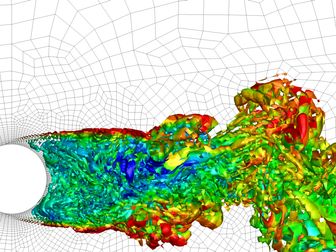
2020
- F. F. Buscariolo, W. Hambli, J. Slaughter and S. SherwinBiBTeX AbstractUsing a spectral/hp element method for high-order implicit-LES of bluff automotive geometries2020. doi 10.17028/rd.lboro.12102594.v1
@article{2020:buscariolo.hambli.ea:using,
  author = {Buscariolo, Filipe Fabian and Hambli, Walid and Slaughter, James and Sherwin, Spencer},
  title = {Using a spectral/$hp$ element method for high-order implicit-{LES} of bluff automotive geometries},
  year = {2020},
  publisher = {Loughborough University},
  groups = {app},
  doi = {10.17028/rd.lboro.12102594.v1}
}
The combination of High-order methods and Large-Eddy Simulation (LES) is an ongoing research focus in turbulence due to the attractive dissipation characteristics of high-order methods. Whilst numerically speaking these methodologies are advantageous, their application is inhibited on industrial cases due to the inherent geometric complexities of such problems. Spectral/hp Element (SEM) solvers such as Nektar++, have potential to be bridge the gap between high-order methods and industrial geometric complexity. This study focuses on the intersection of the application of the SEM solver Nektar++ to an automotive geometry as well as the presentation of high-order mean flow characteristics for the SAE Notchback body. Using a 5th order polynomial expansion at ReL = 2.3 × 10⁶ on a curvilinear grid, results are compared with those empirically achieved in other works. Implicit Sub-Grid scale modelling along with a novel Spectral-Vanishing Viscosity (SVV) approach is employed acting as an artificial diffusion operator preventing high-frequency instabilities and spurious oscillations. Suitable qualitative agreement between PIV and CFD methods is obtained, and quantitative agreement is demonstrated on CD with 9% difference. More extensive backlight separation and subsequent bootlid impingement is observed in CFD than presented in the literature. This might be caused due to differing inflow characteristics, resulting in CM and CL variance to experimental values. Along with the mean flow field characteristics, the methodology and the pipeline used to achieve such results and agreement is presented. The use of a wall-conforming unstructured curvilinear grid allows for significantly greater geometric flexibility whilst retaining the advantages of the high-order polynomial expansion. - M. Ghim, P. Alpresa, S. W. Yang, S. T. Braakman, S. G. Gray, S. J. Sherwin, M. van Reeuwijk and P. D. WeinbergBiBTeXCorrigendumAmerican Journal of Physiology-Heart and Circulatory Physiology, 319 (2), pp. H359–H359, 2020. doi 10.1152/ajpheart.zh4-3151-corr.2020
@article{2020:ghim.alpresa.ea:corrigendum, author = {Ghim, M and Alpresa, P and Yang, S W and Braakman, S T and Gray, S G and Sherwin, S J and van Reeuwijk, M and Weinberg, P D}, title = {Corrigendum}, journal = {American Journal of Physiology-Heart and Circulatory Physiology}, publisher = {American Physiological Society}, year = {2020}, volume = {319}, number = {2}, pages = {H359--H359}, groups = {sherwin}, doi = {10.1152/ajpheart.zh4-3151-corr.2020} } - J. Marcon, G. Castiglioni, D. Moxey, S. J. Sherwin and J. PeiróBiBTeX Abstractrp-adaptation for compressible flowsInternational Journal for Numerical Methods in Engineering, 121 (23), pp. 5405–5425, 2020. doi 10.1002/nme.6529
@article{2020:marcon.castiglioni.ea:rpadaptation,
  author = {Marcon, Julian and Castiglioni, Giacomo and Moxey, David and Sherwin, Spencer J. and Peiró, Joaquim},
  title = {rp-adaptation for compressible flows},
  journal = {International Journal for Numerical Methods in Engineering},
  publisher = {Wiley},
  year = {2020},
  volume = {121},
  number = {23},
  pages = {5405--5425},
  groups = {sherwin},
  doi = {10.1002/nme.6529}
}
We present a novel rp ‐adaptation strategy for high‐fidelity simulations of compressible inviscid flows with shocks. The mesh resolution in regions of flow discontinuities is increased by using a variational optimizer to r ‐adapt the mesh and cluster degrees of freedom there. In regions of smooth flow, we locally increase or decrease the local resolution through increasing or decreasing the polynomial order of the elements, respectively. This dual approach allows us to take advantage of the strengths of both methods for best computational performance, thereby reducing the overall cost of the simulation. The adaptation workflow uses a sensor for both discontinuities and smooth regions that is cheap to calculate, but the framework is general and could be used in conjunction with other feature‐based sensors or error estimators. We demonstrate this proof‐of‐concept using two geometries in transonic and supersonic flow regimes. The method has been implemented in the open‐source spectral/ hp element framework Nektar++ , and adaptivity is performed by its dedicated high‐order mesh generation tool NekMesh . The results show that the proposed rp ‐adaptation methodology is a reasonably cost‐effective way of improving simulation accuracy. - R. C. Moura, M. Aman, J. Peiró and S. J. SherwinBiBTeXSpatial eigenanalysis of spectral/hp continuous Galerkin schemes and their stabilisation via DG-mimicking spectral vanishing viscosity for high Reynolds number flowsJournal of Computational Physics, 406, p. 109112, 2020. doi 10.1016/j.jcp.2019.109112
@article{2020:moura.aman.ea:spatial, author = {Moura, Rodrigo C. and Aman, Mansoor and Peiró, Joaquim and Sherwin, Spencer J.}, title = {Spatial eigenanalysis of spectral/hp continuous Galerkin schemes and their stabilisation via DG-mimicking spectral vanishing viscosity for high Reynolds number flows}, journal = {Journal of Computational Physics}, publisher = {Elsevier BV}, year = {2020}, volume = {406}, pages = {109112}, groups = {sherwin}, doi = {10.1016/j.jcp.2019.109112} } - D. Moxey, C. D. Cantwell, Y. Bao, A. Cassinelli, G. Castiglioni, S. Chun, E. Juda, E. Kazemi, K. Lackhove, J. Marcon, G. Mengaldo, D. Serson, M. Turner, H. Xu, J. Peiró, R. M. Kirby and S. J. SherwinBiBTeX AbstractNektar++: enhancing the capability and application of high-fidelity spectral/hp element methodsComputer Physics Communications, 249, p. 107110, 2020. doi 10.1016/j.cpc.2019.107110
@article{2020:moxey.cantwell.ea:nektar,
  author = {Moxey, D. and Cantwell, C. D. and Bao, Y. and Cassinelli, A. and Castiglioni, G. and Chun, S. and Juda, E. and Kazemi, E. and Lackhove, K. and Marcon, J. and Mengaldo, G. and Serson, D. and Turner, M. and Xu, H. and Peir\'o, J. and Kirby, R. M. and Sherwin, S. J.},
  title = {\emph{Nektar++}: enhancing the capability and application of high-fidelity spectral/$hp$ element methods},
  journal = {Computer Physics Communications},
  year = {2020},
  volume = {249},
  pages = {107110},
  doi = {10.1016/j.cpc.2019.107110},
  groups = {core}
}
Nektar++ is an open-source framework that provides a flexible, performant and scalable platform for the development of solvers for partial differential equations using the high-order spectral/hp element method. In particular, Nektar++ aims to overcome the complex implementation challenges that are often associated with high-order methods, thereby allowing them to be more readily used in a wide range of application areas. In this paper, we present the algorithmic, implementation and application developments associated with our Nektar++ version 5.0 release. We describe some of the key software and performance developments, including our strategies on parallel I/O, on in situ processing, the use of collective operations for exploiting current and emerging hardware, and interfaces to enable multi-solver coupling. Furthermore, we provide details on a newly developed Python interface that enable more rapid on-boarding of new users unfamiliar with spectral/hp element methods, C++ and/or Nektar++. This release also incorporates a number of numerical method developments – in particular: the method of moving frames (MMF), which provides an additional approach for the simulation of equations on embedded curvilinear manifolds and domains; a means of handling spatially variable polynomial order; and a novel technique for quasi-3D simulations (which combine a 2D spectral element and 1D Fourier spectral method) to permit spatially-varying perturbations to the geometry in the homogeneous direction. Finally, we demonstrate the new application-level features provided in this release, namely: a facility for generating high-order curvilinear meshes called NekMesh; a novel new AcousticSolver for aeroacoustic problems; our development of a ‘thick’ strip model for the modelling of fluid-structure interaction (FSI) problems in the context of vortex-induced vibrations (VIV). We conclude by commenting on some lessons learned and by discussing some directions for future code development and expansion. - R. M. Reavette, S. J. Sherwin, M. Tang and P. D. WeinbergBiBTeX AbstractComparison of arterial wave intensity analysis by pressure–velocity and diameter–velocity methods in a virtual population of adult subjectsProceedings of the Institution of Mechanical Engineers, Part H: Journal of Engineering in Medicine, 234 (11), pp. 1260–1276, 2020. doi 10.1177/0954411920926094
@article{2020:reavette.sherwin.ea:comparison,
  author = {Reavette, Ryan M and Sherwin, Spencer J and Tang, Mengxing and Weinberg, Peter D},
  title = {Comparison of arterial wave intensity analysis by pressure--velocity and diameter--velocity methods in a virtual population of adult subjects},
  journal = {Proceedings of the Institution of Mechanical Engineers, Part H: Journal of Engineering in Medicine},
  publisher = {SAGE Publications},
  year = {2020},
  volume = {234},
  number = {11},
  pages = {1260--1276},
  groups = {sherwin},
  doi = {10.1177/0954411920926094}
}
Pressure–velocity-based analysis of arterial wave intensity gives clinically relevant information about the performance of the heart and vessels, but its utility is limited because accurate pressure measurements can only be obtained invasively. Diameter–velocity-based wave intensity can be obtained noninvasively using ultrasound; however, due to the nonlinear relationship between blood pressure and arterial diameter, the two wave intensities might give disparate clinical indications. To test the magnitude of the disagreement, we have generated an age-stratified virtual population to investigate how the two dominant nonlinearities, viscoelasticity and strain-stiffening, cause the two formulations to differ. We found strong agreement between the pressure–velocity and diameter–velocity methods, particularly for the systolic wave energy, the ratio between systolic and diastolic wave heights, and older subjects. The results are promising regarding the introduction of noninvasive wave intensities in the clinic.
2019
- Y. Bao, H. B. Zhu, P. Huan, R. Wang, D. Zhou, Z. L. Han, R. Palacios, M. Graham and S. SherwinBiBTeXNumerical prediction of vortex-induced vibration of flexible riser with thick strip methodJournal of Fluids and Structures, 89, pp. 166–173, 2019. doi 10.1016/j.jfluidstructs.2019.02.010
@article{2019:bao.zhu.ea:numerical, author = {Bao, Y. and Zhu, H.B. and Huan, P. and Wang, R. and Zhou, D. and Han, Z.L. and Palacios, R. and Graham, M. and Sherwin, S.}, title = {Numerical prediction of vortex-induced vibration of flexible riser with thick strip method}, journal = {Journal of Fluids and Structures}, publisher = {Elsevier BV}, year = {2019}, volume = {89}, pages = {166--173}, groups = {sherwin}, doi = {10.1016/j.jfluidstructs.2019.02.010} } - A. N. Cookson, D. J. Doorly and S. J. SherwinBiBTeX AbstractEfficiently Generating Mixing by Combining Differing Small Amplitude Helical GeometriesFluids, 4 (2), p. 59, 2019. doi 10.3390/fluids4020059
@article{2019:cookson.doorly.ea:efficiently,
  author = {Cookson, Andrew N. and Doorly, Denis J. and Sherwin, Spencer J.},
  title = {Efficiently Generating Mixing by Combining Differing Small Amplitude Helical Geometries},
  journal = {Fluids},
  publisher = {MDPI AG},
  year = {2019},
  volume = {4},
  number = {2},
  pages = {59},
  groups = {sherwin},
  doi = {10.3390/fluids4020059}
}
Helical geometries have been used in recent years to form cardiovascular prostheses such as stents and shunts. The helical geometry has been found to induce swirling flow, promoting in-plane mixing. This is hypothesised to reduce the formation of thrombosis and neo-intimal hyperplasia, in turn improving device patency and reducing re-implantation rates. In this paper we investigate whether joining together two helical geometries, of differing helical radii, in a repeating sequence, can produce significant gains in mixing effectiveness, by embodying a ‘streamline crossing’ flow environment. Since the computational cost of calculating particle trajectories over extended domains is high, in this work we devised a procedure for efficiently exploring the large parameter space of possible geometry combinations. Velocity fields for the single geometries were first obtained using the spectral/hp element method. These were then discontinuously concatenated, in series, for the particle tracking based mixing analysis of the combined geometry. Full computations of the most promising combined geometries were then performed. Mixing efficiency was evaluated quantitatively using Poincaré sections, particle residence time data, and information entropy. Excellent agreement was found between the idealised (concatenated flow field) and the full simulations of mixing performance, revealing that a strict discontinuity between velocity fields is not required for mixing enhancement, via streamline crossing, to occur. Optimal mixing was found to occur for the combination R = 0.2 D and R = 0.5 D , producing a 70 % increase in mixing, compared with standard single helical designs. The findings of this work point to the benefits of swirl disruption and suggest concatenation as an efficient means to determine optimal configurations of repeating geometries for future designs of vascular prostheses. - J. Marcon, D. A. Kopriva, S. J. Sherwin and J. PeiróBiBTeX AbstractA high resolution PDE approach to quadrilateral mesh generationJournal of Computational Physics, 399, p. 108918, 2019. doi 10.1016/j.jcp.2019.108918
@article{2019:marcon.kopriva.ea:high,
  author = {Marcon, Julian and Kopriva, David A and Sherwin, Spencer J and Peir{\'o}, Joaquim},
  title = {A high resolution {PDE} approach to quadrilateral mesh generation},
  journal = {Journal of Computational Physics},
  year = {2019},
  volume = {399},
  pages = {108918},
  publisher = {Elsevier},
  groups = {core},
  doi = {10.1016/j.jcp.2019.108918}
}
We describe a high order technique to generate quadrilateral decompositions and meshes for complex two dimensional domains using spectral elements in a field guided procedure. Inspired by cross field methods, we never actually compute crosses. Instead, we compute a high order accurate guiding field using a continuous Galerkin (CG) or discontinuous Galerkin (DG) spectral element method to solve a Laplace equation for each of the field variables using the open source code Nektar++. The spectral method provides spectral convergence and sub-element resolution of the fields. The DG approximation allows meshing of corners that are not multiples of π/2 in a discretization consistent manner, when needed. The high order field can then be exploited to accurately find irregular nodes, and can be accurately integrated using a high order separatrix integration method to avoid features like limit cycles. The result is a mesh with naturally curved quadrilateral elements that do not need to be curved a posteriori to eliminate invalid elements. The mesh generation procedure is implemented in the open source mesh generation program NekMesh. - M. Vymazal, D. Moxey, S. Sherwin, C. D. Cantwell and R. M. KirbyBiBTeX AbstractOn weak Dirichlet boundary conditions for elliptic problems in the continuous Galerkin methodJournal of Computational Physics, 394, pp. 732–744, 2019. doi 10.1016/j.jcp.2019.05.021
@article{2019:vymazal.moxey.ea:on,
  author = {Vymazal, M. and Moxey, D. and Sherwin, S. and Cantwell, C. D. and Kirby, R. M.},
  title = {On weak {Dirichlet} boundary conditions for elliptic problems in the continuous {Galerkin} method},
  journal = {Journal of Computational Physics},
  year = {2019},
  volume = {394},
  pages = {732--744},
  doi = {10.1016/j.jcp.2019.05.021},
  groups = {core}
}
We combine continuous and discontinuous Galerkin methods in the setting of a model diffusion problem. Starting from a hybrid discontinuous formulation, we replace element interiors by more general subsets of the computational domain - groups of elements that support a piecewise-polynomial continuous expansion. This step allows us to identify a new weak formulation of Dirichlet boundary condition in the continuous framework. We show that the boundary condition leads to a stable discretization with a single parameter insensitive to mesh size and polynomial order of the expansion. The robustness of the approach is demonstrated on several numerical examples. - A. Yakhot, Y. Feldman, D. Moxey, S. Sherwin and G. E. KarniadakisBiBTeXTurbulence in a Localized Puff in a PipeFlow, Turbulence and Combustion, 103 (1), pp. 1–24, 2019. doi 10.1007/s10494-018-0002-8
@article{2019:yakhot.feldman.ea:turbulence, author = {Yakhot, Alexander and Feldman, Yuri and Moxey, David and Sherwin, Spencer and Karniadakis, George Em}, title = {Turbulence in a Localized Puff in a Pipe}, journal = {Flow, Turbulence and Combustion}, publisher = {Springer Science and Business Media LLC}, year = {2019}, volume = {103}, number = {1}, pages = {1--24}, groups = {sherwin}, doi = {10.1007/s10494-018-0002-8} } - H. Zhu, R. Wang, Y. Bao, D. Zhou, H. Ping, Z. Han and S. J. SherwinBiBTeXFlow over a symmetrically curved circular cylinder with the free stream parallel to the plane of curvature at low Reynolds numberJournal of Fluids and Structures, 87, pp. 23–38, 2019. doi 10.1016/j.jfluidstructs.2019.03.012
@article{2019:zhu.wang.ea:flow,
  author = {Zhu, Hongbo and Wang, Rui and Bao, Yan and Zhou, Dai and Ping, Huan and Han, Zhaolong and Sherwin, Spencer J.},
  title = {Flow over a symmetrically curved circular cylinder with the free stream parallel to the plane of curvature at low Reynolds number},
  journal = {Journal of Fluids and Structures},
  publisher = {Elsevier BV},
  year = {2019},
  volume = {87},
  pages = {23--38},
  groups = {sherwin},
  doi = {10.1016/j.jfluidstructs.2019.03.012}
}
2018
- P. Alpresa, S. Sherwin, P. Weinberg and M. van ReeuwijkBiBTeXOrbitally shaken shallow fluid layers. II. An improved wall shear stress modelPhysics of Fluids, 30 (3), p. 032108, 2018. doi 10.1063/1.5016343
@article{2018:alpresa.sherwin.ea:orbitallya, author = {Alpresa, Paola and Sherwin, Spencer and Weinberg, Peter and van Reeuwijk, Maarten}, title = {Orbitally shaken shallow fluid layers. II. An improved wall shear stress model}, journal = {Physics of Fluids}, publisher = {AIP Publishing}, year = {2018}, volume = {30}, number = {3}, pages = {032108}, groups = {sherwin}, doi = {10.1063/1.5016343} } - P. Alpresa, S. Sherwin, P. Weinberg and M. van ReeuwijkBiBTeXOrbitally shaken shallow fluid layers. I. Regime classificationPhysics of Fluids, 30 (3), p. 032107, 2018. doi 10.1063/1.4996916
@article{2018:alpresa.sherwin.ea:orbitally, author = {Alpresa, Paola and Sherwin, Spencer and Weinberg, Peter and van Reeuwijk, Maarten}, title = {Orbitally shaken shallow fluid layers. I. Regime classification}, journal = {Physics of Fluids}, publisher = {AIP Publishing}, year = {2018}, volume = {30}, number = {3}, pages = {032107}, groups = {sherwin}, doi = {10.1063/1.4996916} } - M. Calder, C. Craig, D. Culley, R. de Cani, C. A. Donnelly, R. Douglas, B. Edmonds, J. Gascoigne, N. Gilbert, C. Hargrove, D. Hinds, D. C. Lane, D. Mitchell, G. Pavey, D. Robertson, B. Rosewell, S. Sherwin, M. Walport and A. WilsonBiBTeX AbstractComputational modelling for decision-making: where, why, what, who and howRoyal Society Open Science, 5 (6), p. 172096, 2018. doi 10.1098/rsos.172096
@article{2018:calder.craig.ea:computational,
  author = {Calder, Muffy and Craig, Claire and Culley, Dave and de Cani, Richard and Donnelly, Christl A. and Douglas, Rowan and Edmonds, Bruce and Gascoigne, Jonathon and Gilbert, Nigel and Hargrove, Caroline and Hinds, Derwen and Lane, David C. and Mitchell, Dervilla and Pavey, Giles and Robertson, David and Rosewell, Bridget and Sherwin, Spencer and Walport, Mark and Wilson, Alan},
  title = {Computational modelling for decision-making: where, why, what, who and how},
  journal = {Royal Society Open Science},
  publisher = {The Royal Society},
  year = {2018},
  volume = {5},
  number = {6},
  pages = {172096},
  groups = {sherwin},
  doi = {10.1098/rsos.172096}
}
In order to deal with an increasingly complex world, we need ever more sophisticated computational models that can help us make decisions wisely and understand the potential consequences of choices. But creating a model requires far more than just raw data and technical skills: it requires a close collaboration between model commissioners, developers, users and reviewers. Good modelling requires its users and commissioners to understand more about the whole process, including the different kinds of purpose a model can have and the different technical bases. This paper offers a guide to the process of commissioning, developing and deploying models across a wide range of domains from public policy to science and engineering. It provides two checklists to help potential modellers, commissioners and users ensure they have considered the most significant factors that will determine success. We conclude there is a need to reinforce modelling as a discipline, so that misconstruction is less likely; to increase understanding of modelling in all domains, so that the misuse of models is reduced; and to bring commissioners closer to modelling, so that the results are more useful. - G. Mengaldo, D. De Grazia, R. C. Moura and S. J. SherwinBiBTeX AbstractSpatial eigensolution analysis of energy-stable flux reconstruction schemes and influence of the numerical flux on accuracy and robustnessJournal of Computational Physics, 2018. doi 10.1016/j.jcp.2017.12.019
@article{2018:mengaldo.de-grazia.ea:spatial,
  author = {Mengaldo, Gianmarco and De Grazia, Daniele and Moura, Rodrigo C and Sherwin, Spencer J},
  title = {Spatial eigensolution analysis of energy-stable flux reconstruction schemes and influence of the numerical flux on accuracy and robustness},
  journal = {Journal of Computational Physics},
  year = {2018},
  publisher = {Elsevier},
  doi = {10.1016/j.jcp.2017.12.019},
  groups = {core}
}
This study focuses on the dispersion and diffusion characteristics of high-order energy-stable flux reconstruction (ESFR) schemes via the spatial eigensolution analysis framework proposed in doi.org/10.1016/j.compfluid.2017.09.016. The analysis is performed for five ESFR schemes, where the parameter c dictating the properties of the specific scheme recovered is chosen such that it spans the entire class of ESFR methods, also referred to as VCJH schemes, proposed in doi.org/10.1007/s10915-010-9420-z. In particular, we used five values of c, two that correspond to its lower and upper bounds and the others that identify three schemes that are linked to common high-order methods, namely the ESFR recovering two versions of discontinuous Galerkin methods and one recovering the spectral difference scheme. The performance of each scheme is assessed when using different numerical intercell fluxes (e.g. different levels of upwinding), ranging from under- to over-upwinding. In contrast to the more common temporal analysis, the spatial eigensolution analysis framework adopted here allows one to grasp crucial insights into the diffusion and dispersion properties of FR schemes for problems involving non-periodic boundary conditions, typically found in open-flow problems, including turbulence, unsteady aerodynamics and aeroacoustics. - H. Xu, C. D. Cantwell, C. Monteserin, C. Eskilsson, A. P. Engsig-Karup and S. J. SherwinBiBTeXSpectral/hp element methods: Recent developments, applications, and perspectivesJournal of Hydrodynamics, 30 (1), pp. 1–22, 2018. doi 10.1007/s42241-018-0001-1
@article{2018:xu.cantwell.ea:spectralhpa, author = {Xu, Hui and Cantwell, Chris D. and Monteserin, Carlos and Eskilsson, Claes and Engsig-Karup, Allan P. and Sherwin, Spencer J.}, title = {Spectral/hp element methods: Recent developments, applications, and perspectives}, journal = {Journal of Hydrodynamics}, publisher = {Springer Science and Business Media LLC}, year = {2018}, volume = {30}, number = {1}, pages = {1--22}, groups = {sherwin}, doi = {10.1007/s42241-018-0001-1} } - D. de Grazia, D. Moxey, S. J. Sherwin, M. A. Kravtsova and A. I. RubanBiBTeX AbstractDNS of a compressible boundary layer flow past an isolated three-dimensional hump in a high-speed subsonic regimePhysical Review Fluids, 3, p. 024101, 2018. doi 10.1103/PhysRevFluids.3.024101
@article{2018:grazia.moxey.ea:dns,
  author = {de Grazia, D. and Moxey, D. and Sherwin, S. J. and Kravtsova, M. A. and Ruban, A. I.},
  title = {DNS of a compressible boundary layer flow past an isolated three-dimensional hump in a high-speed subsonic regime},
  journal = {Physical Review Fluids},
  year = {2018},
  volume = {3},
  pages = {024101},
  doi = {10.1103/PhysRevFluids.3.024101},
  groups = {app}
}
In this paper we study the boundary-layer separation produced in a high-speed subsonic boundary layer by a small wall roughness. Specifically, we present a direct numerical simulation (DNS) of a two-dimensional boundary-layer flow over a flat plate encountering a three-dimensional Gaussian-shaped hump. This work was motivated by the lack of DNS data of boundary-layer flows past roughness elements in a similar regime which is typical of civil aviation. The Mach and Reynolds numbers are chosen to be relevant for aeronautical applications when considering small imperfections at the leading edge of wings. We analyze different heights of the hump: The smaller heights result in a weakly nonlinear regime, while the larger result in a fully nonlinear regime with an increasing laminar separation bubble arising downstream of the roughness element and the formation of a pair of streamwise counterrotating vortices which appear to support themselves.
2017
- P. Burovskiy, P. Grigoras, S. Sherwin and W. LukBiBTeX AbstractEfficient Assembly for High-Order Unstructured FEM Meshes (FPL 2015)ACM Transactions on Reconfigurable Technology and Systems, 10 (2), pp. 1–22, 2017. doi 10.1145/3024064
@article{2017:burovskiy.grigoras.ea:efficient,
  author = {Burovskiy, Pavel and Grigoras, Paul and Sherwin, Spencer and Luk, Wayne},
  title = {Efficient Assembly for High-Order Unstructured FEM Meshes (FPL 2015)},
  journal = {ACM Transactions on Reconfigurable Technology and Systems},
  publisher = {Association for Computing Machinery (ACM)},
  year = {2017},
  volume = {10},
  number = {2},
  pages = {1--22},
  groups = {sherwin},
  doi = {10.1145/3024064}
}
The Finite Element Method (FEM) is a common numerical technique used for solving Partial Differential Equations on large and unstructured domain geometries. Numerical methods for FEM typically use algorithms and data structures which exhibit an unstructured memory access pattern. This makes acceleration of FEM on Field-Programmable Gate Arrays using an efficient, deeply pipelined architecture particularly challenging. In this work, we focus on implementing and optimising a vector assembly operation which, in the context of FEM, induces the unstructured memory access. We propose a dataflow architecture, graph-based theoretical model, and design flow for optimising the assembly operation for spectral/hp finite element method on reconfigurable accelerators. We evaluate the proposed approach on two benchmark meshes and show that the graph-theoretic method of generating a static data access schedule results in a significant improvement in resource utilisation compared to prior work. This enables supporting larger FEM meshes on FPGA than previously possible. - K. Y. Chooi, A. Comerford, S. J. Sherwin and P. D. WeinbergBiBTeXNoradrenaline has opposing effects on the hydraulic conductance of arterial intima and mediaJournal of Biomechanics, 54, pp. 4–10, 2017. doi 10.1016/j.jbiomech.2017.01.027
@article{2017:chooi.comerford.ea:noradrenaline, author = {Chooi, K.Y. and Comerford, A. and Sherwin, S.J. and Weinberg, P.D.}, title = {Noradrenaline has opposing effects on the hydraulic conductance of arterial intima and media}, journal = {Journal of Biomechanics}, publisher = {Elsevier BV}, year = {2017}, volume = {54}, pages = {4--10}, groups = {sherwin}, doi = {10.1016/j.jbiomech.2017.01.027} } - M. Ghim, P. Alpresa, S.-W. Yang, S. T. Braakman, S. G. Gray, S. J. Sherwin, M. van Reeuwijk and P. D. WeinbergBiBTeX AbstractVisualization of three pathways for macromolecule transport across cultured endothelium and their modification by flowAmerican Journal of Physiology-Heart and Circulatory Physiology, 313 (5), pp. H959–H973, 2017. doi 10.1152/ajpheart.00218.2017
@article{2017:ghim.alpresa.ea:visualization,
  author = {Ghim, Mean and Alpresa, Paola and Yang, Sung-Wook and Braakman, Sietse T. and Gray, Stephen G. and Sherwin, Spencer J. and van Reeuwijk, Maarten and Weinberg, Peter D.},
  title = {Visualization of three pathways for macromolecule transport across cultured endothelium and their modification by flow},
  journal = {American Journal of Physiology-Heart and Circulatory Physiology},
  publisher = {American Physiological Society},
  year = {2017},
  volume = {313},
  number = {5},
  pages = {H959--H973},
  groups = {sherwin},
  doi = {10.1152/ajpheart.00218.2017}
}
Transport of macromolecules across vascular endothelium and its modification by fluid mechanical forces are important for normal tissue function and in the development of atherosclerosis. However, the routes by which macromolecules cross endothelium, the hemodynamic stresses that maintain endothelial physiology or trigger disease, and the dependence of transendothelial transport on hemodynamic stresses are controversial. We visualized pathways for macromolecule transport and determined the effect on these pathways of different types of flow. Endothelial monolayers were cultured under static conditions or on an orbital shaker producing different flow profiles in different parts of the wells. Fluorescent tracers that bound to the substrate after crossing the endothelium were used to identify transport pathways. Maps of tracer distribution were compared with numerical simulations of flow to determine effects of different shear stress metrics on permeability. Albumin-sized tracers dominantly crossed the cultured endothelium via junctions between neighboring cells, high-density lipoprotein-sized tracers crossed at tricellular junctions, and low-density lipoprotein-sized tracers crossed through cells. Cells aligned close to the angle that minimized shear stresses across their long axis. The rate of paracellular transport under flow correlated with the magnitude of these minimized transverse stresses, whereas transport across cells was uniformly reduced by all types of flow. These results contradict the long-standing two-pore theory of solute transport across microvessel walls and the consensus view that endothelial cells align with the mean shear vector. They suggest that endothelial cells minimize transverse shear, supporting its postulated proatherogenic role. Preliminary data show that similar tracer techniques are practicable in vivo. NEW & NOTEWORTHY Solutes of increasing size crossed cultured endothelium through intercellular junctions, through tricellular junctions, or transcellularly. Cells aligned to minimize the shear stress acting across their long axis. Paracellular transport correlated with the level of this minimized shear, but transcellular transport was reduced uniformly by flow regardless of the shear profile. - X. Mao, T. A. Zaki, S. J. Sherwin and H. M. BlackburnBiBTeX AbstractTransition induced by linear and nonlinear perturbation growth in flow past a compressor bladeJournal of Fluid Mechanics, 820, pp. 604–632, 2017. doi 10.1017/jfm.2017.240
@article{2017:mao.zaki.ea:transition,
  author = {Mao, X. and Zaki, T. A. and Sherwin, S. J. and Blackburn, H. M.},
  title = {Transition induced by linear and nonlinear perturbation growth in flow past a compressor blade},
  journal = {Journal of Fluid Mechanics},
  publisher = {Cambridge University Press (CUP)},
  year = {2017},
  volume = {820},
  pages = {604--632},
  groups = {sherwin},
  doi = {10.1017/jfm.2017.240}
}
Flow past a NACA 65 blade at chord-based Reynolds number 138 500 is studied using stability analysis, generalized (spatially weighted) transient growth analysis and direct numerical simulations (DNS). The mechanisms of transition on various sections of the blade observed in previous work by Zaki et al. ( J. Fluid Mech. , vol. 665, 2010, pp. 57–98) are examined, with a focus on the pressure side around the leading edge. In this region, the linearly most energetic perturbation has spanwise wavenumber 40 unicode[STIX]x03C0 (five boundary-layer thicknesses) and is tilted against the mean shear to take advantage of the Orr mechanism. In a DNS, the nonlinear development of this optimal perturbation induces unicode[STIX]x1D6EC structures, which are further stretched to hairpin vortices before breaking down to turbulence. At higher spanwise wavenumber, e.g. 120 unicode[STIX]x03C0 , a free-stream optimal perturbation is obtained upstream of the leading edge, in the form of streamwise vortices. During its nonlinear evolution, this optimal perturbation tilts the mean shear and generates spanwise periodic high- and low-speed streaks. Then through a nonlinear lift-up mechanism, the low-speed streaks are lifted above the high-speed ones. This layout of streaks generates a mean shear with two inflectional points and activates secondary instabilities, namely inner and outer instabilities previously reported in the literature. - G. Mengaldo, R. C. Moura, B. Giralda, J. Peiró and S. J. SherwinBiBTeX AbstractSpatial eigensolution analysis of discontinuous Galerkin schemes with practical insights for under-resolved computations and implicit LESComputers & Fluids, 2017. doi 10.1016/j.compfluid.2017.09.016
@article{2017:mengaldo.moura.ea:spatial,
  author = {Mengaldo, G. and Moura, R.C. and Giralda, B. and Peir{\'o}, J. and Sherwin, S.J.},
  title = {Spatial eigensolution analysis of discontinuous Galerkin schemes with practical insights for under-resolved computations and implicit {LES}},
  journal = {Computers \& Fluids},
  year = {2017},
  publisher = {Elsevier},
  groups = {core},
  doi = {10.1016/j.compfluid.2017.09.016}
}
The study focusses on the dispersion and diffusion characteristics of discontinuous spectral element methods - specifically discontinuous Galerkin (DG) - via the spatial eigensolution analysis framework built around a one-dimensional linear problem, namely the linear advection equation. Dispersion and diffusion characteristics are of critical importance when dealing with under-resolved computations, as they affect both the numerical stability of the simulation and the solution accuracy. The spatial eigensolution analysis carried out in this paper complements previous analyses based on the temporal approach, which are more commonly found in the literature. While the latter assumes periodic boundary conditions, the spatial approach assumes inflow/outflow type boundary conditions and is therefore better suited for the investigation of open flows typical of aerodynamic problems, including transitional and fully turbulent flows and aeroacoustics. The influence of spurious/reflected eigenmodes is assessed with regard to the presence of upwind dissipation, naturally present in DG methods. This provides insights into the accuracy and robustness of these schemes for under-resolved computations, including under-resolved direct numerical simulation (uDNS) and implicit large-eddy simulation (iLES). The results estimated from the spatial eigensolution analysis are verified using the one-dimensional linear advection equation and successively by performing two-dimensional compressible Euler simulations that mimic (spatially developing) grid turbulence. - Y. Mohamied, S. J. Sherwin and P. D. WeinbergBiBTeXUnderstanding the fluid mechanics behind transverse wall shear stressJournal of Biomechanics, 50, pp. 102–109, 2017. doi 10.1016/j.jbiomech.2016.11.035
@article{2017:mohamied.sherwin.ea:understanding, author = {Mohamied, Yumnah and Sherwin, Spencer J. and Weinberg, Peter D.}, title = {Understanding the fluid mechanics behind transverse wall shear stress}, journal = {Journal of Biomechanics}, publisher = {Elsevier BV}, year = {2017}, volume = {50}, pages = {102--109}, groups = {sherwin}, doi = {10.1016/j.jbiomech.2016.11.035} } - R. C. Moura, G. Mengaldo, J. Peiró and S. J. SherwinBiBTeX AbstractOn the eddy-resolving capability of high-order discontinuous Galerkin approaches to implicit LES/under-resolved DNS of Euler turbulenceJournal of Computational Physics, 330, pp. 615–623, 2017. doi 10.1016/j.jcp.2016.10.056
@article{2017:moura.mengaldo.ea:on,
  author = {Moura, R.C. and Mengaldo, G. and Peir{\'o}, J. and Sherwin, S.J.},
  title = {On the eddy-resolving capability of high-order discontinuous {Galerkin} approaches to implicit {LES}/under-resolved {DNS} of {Euler} turbulence},
  journal = {Journal of Computational Physics},
  year = {2017},
  volume = {330},
  pages = {615--623},
  publisher = {Elsevier},
  groups = {core},
  doi = {10.1016/j.jcp.2016.10.056}
}
The study focusses on the dispersion and diffusion characteristics of discontinuous spectral element methods - specifically discontinuous Galerkin (DG) - via the spatial eigensolution analysis framework built around a one-dimensional linear problem, namely the linear advection equation. Dispersion and diffusion characteristics are of critical importance when dealing with under-resolved computations, as they affect both the numerical stability of the simulation and the solution accuracy. The spatial eigensolution analysis carried out in this paper complements previous analyses based on the temporal approach, which are more commonly found in the literature. While the latter assumes periodic boundary conditions, the spatial approach assumes inflow/outflow type boundary conditions and is therefore better suited for the investigation of open flows typical of aerodynamic problems, including transitional and fully turbulent flows and aeroacoustics. The influence of spurious/reflected eigenmodes is assessed with regard to the presence of upwind dissipation, naturally present in DG methods. This provides insights into the accuracy and robustness of these schemes for under-resolved computations, including under-resolved direct numerical simulation (uDNS) and implicit large-eddy simulation (iLES). The results estimated from the spatial eigensolution analysis are verified using the one-dimensional linear advection equation and successively by performing two-dimensional compressible Euler simulations that mimic (spatially developing) grid turbulence. - J. Serbanovic-Canic, A. de Luca, C. Warboys, P. F. Ferreira, L. A. Luong, S. Hsiao, I. Gauci, M. Mahmoud, S. Feng, C. Souilhol, N. Bowden, J.-P. Ashton, H. Walczak, D. Firmin, R. Krams, J. C. Mason, D. O. Haskard, S. Sherwin, V. Ridger, T. J. A. Chico and P. C. EvansBiBTeX AbstractZebrafish Model for Functional Screening of Flow-Responsive GenesArteriosclerosis, Thrombosis, and Vascular Biology, 37 (1), pp. 130–143, 2017. doi 10.1161/atvbaha.116.308502
@article{2017:serbanoviccanic.deluca.ea:zebrafish,
  author = {Serbanovic-Canic, Jovana and de Luca, Amalia and Warboys, Christina and Ferreira, Pedro F. and Luong, Le A. and Hsiao, Sarah and Gauci, Ismael and Mahmoud, Marwa and Feng, Shuang and Souilhol, Celine and Bowden, Neil and Ashton, John-Paul and Walczak, Henning and Firmin, David and Krams, Rob and Mason, Justin C. and Haskard, Dorian O. and Sherwin, Spencer and Ridger, Victoria and Chico, Timothy J.A. and Evans, Paul C.},
  title = {Zebrafish Model for Functional Screening of Flow-Responsive Genes},
  journal = {Arteriosclerosis, Thrombosis, and Vascular Biology},
  publisher = {Ovid Technologies (Wolters Kluwer Health)},
  year = {2017},
  volume = {37},
  number = {1},
  pages = {130--143},
  groups = {sherwin},
  doi = {10.1161/atvbaha.116.308502}
}
Objective— Atherosclerosis is initiated at branches and bends of arteries exposed to disturbed blood flow that generates low shear stress. This mechanical environment promotes lesions by inducing endothelial cell (EC) apoptosis and dysfunction via mechanisms that are incompletely understood. Although transcriptome-based studies have identified multiple shear-responsive genes, most of them have an unknown function. To address this, we investigated whether zebrafish embryos can be used for functional screening of mechanosensitive genes that regulate EC apoptosis in mammalian arteries. Approach and Results— First, we demonstrated that flow regulates EC apoptosis in developing zebrafish vasculature. Specifically, suppression of blood flow in zebrafish embryos (by targeting cardiac troponin) enhanced that rate of EC apoptosis (≈10%) compared with controls exposed to flow (≈1%). A panel of candidate regulators of apoptosis were identified by transcriptome profiling of ECs from high and low shear stress regions of the porcine aorta. Genes that displayed the greatest differential expression and possessed 1 to 2 zebrafish orthologues were screened for the regulation of apoptosis in zebrafish vasculature exposed to flow or no-flow conditions using a knockdown approach. A phenotypic change was observed in 4 genes; p53-related protein ( PERP ) and programmed cell death 2–like protein functioned as positive regulators of apoptosis, whereas angiopoietin-like 4 and cadherin 13 were negative regulators. The regulation of perp , cdh13 , angptl4 , and pdcd2l by shear stress and the effects of perp and cdh13 on EC apoptosis were confirmed by studies of cultured EC exposed to flow. Conclusions— We conclude that a zebrafish model of flow manipulation coupled to gene knockdown can be used for functional screening of mechanosensitive genes in vascular ECs, thus providing potential therapeutic targets to prevent or treat endothelial injury at atheroprone sites. - D. Serson, J. R. Meneghini and S. J. SherwinBiBTeXDirect numerical simulations of the flow around wings with spanwise waviness at a very low Reynolds numberComputers & Fluids, 146, pp. 117–124, 2017. doi 10.1016/j.compfluid.2017.01.013
@article{2017:serson.meneghini.ea:directa, author = {Serson, D. and Meneghini, J.R. and Sherwin, S.J.}, title = {Direct numerical simulations of the flow around wings with spanwise waviness at a very low Reynolds number}, journal = {Computers & Fluids}, publisher = {Elsevier BV}, year = {2017}, volume = {146}, pages = {117--124}, groups = {sherwin}, doi = {10.1016/j.compfluid.2017.01.013} } - D. Serson, J. R. Meneghini and S. J. SherwinBiBTeX AbstractDirect numerical simulations of the flow around wings with spanwise wavinessJournal of Fluid Mechanics, 826, pp. 714–731, 2017. doi 10.1017/jfm.2017.475
@article{2017:serson.meneghini.ea:direct,
  author = {Serson, Douglas and Meneghini, Julio R. and Sherwin, Spencer J.},
  title = {Direct numerical simulations of the flow around wings with spanwise waviness},
  journal = {Journal of Fluid Mechanics},
  publisher = {Cambridge University Press (CUP)},
  year = {2017},
  volume = {826},
  pages = {714--731},
  groups = {sherwin},
  doi = {10.1017/jfm.2017.475}
}
The use of spanwise waviness in wings has been proposed in the literature as a possible mechanism for obtaining improved aerodynamic characteristics, motivated by the tubercles that cover the leading edge of the pectoral flippers of the humpback whale. We investigate the effect of this type of waviness on the incompressible flow around infinite wings with a NACA0012 profile, using direct numerical simulations employing the spectral/hp method. Simulations were performed for Reynolds numbers of Re=10 ,000 and Re=50 ,000 , considering different angles of attack in both the pre-stall and post-stall regimes. The results show that the waviness can either increase or decrease the lift coefficient, depending on the particular Re and flow regime. We observe that the flow around the wavy wing exhibits a tendency to remain attached behind the waviness peak, with separation restricted to the troughs, which is consistent with results from the literature. Then, we identify three important physical mechanisms in this flow. The first mechanism is the weakening of the suction peak on the sections corresponding to the waviness peaks. This characteristic had been observed in a previous investigation for a very low Reynolds number of Re=1000 , and we show that this is still important even at Re=50 ,000 . As a second mechanism, the waviness has a significant effect on the stability of the separated shear layers, with transition occurring earlier for the wavy wing. In the pre-stall regime, for Re=10 ,000 , the flow around the baseline wing is completely laminar, and the earlier transition leads to a large increase in the lift coefficient, while for Re=50 ,000 , the earlier transition leads to a shortening of the separation bubble which does not lead to an increased lift coefficient. The last mechanism corresponds to a sub-harmonic behaviour, with the flow being notably different between subsequent wavelengths. This allows the wing to maintain higher lift coefficients in some portions of the span. - A. R. Winters, R. C. Moura, G. Mengaldo, G. J. Gassner, S. Walch, J. Peiro and S. J. SherwinBiBTeXA comparative study on polynomial dealiasing and split form discontinuous Galerkin schemes for under-resolved turbulence computationsarXiv preprint arXiv:1711.10180, 2017. doi 10.48550/arXiv.1711.10180
@article{2017:winters.moura.ea:comparative, author = {Winters, Andrew R and Moura, Rodrigo C and Mengaldo, Gianmarco and Gassner, Gregor J and Walch, Stefanie and Peiro, Joaquim and Sherwin, Spencer J}, title = {A comparative study on polynomial dealiasing and split form discontinuous Galerkin schemes for under-resolved turbulence computations}, journal = {arXiv preprint arXiv:1711.10180}, year = {2017}, doi = {10.48550/arXiv.1711.10180}, groups = {core} } - H. Xu, J.-E. W. Lombard and S. J. SherwinBiBTeXInfluence of localised smooth steps on the instability of a boundary layerJournal of Fluid Mechanics, 817, pp. 138–170, 2017. doi 10.1017/jfm.2017.113
@article{2017:xu.lombard.ea:influence, author = {Xu, Hui and Lombard, Jean-Eloi W. and Sherwin, Spencer J.}, title = {Influence of localised smooth steps on the instability of a boundary layer}, journal = {Journal of Fluid Mechanics}, publisher = {Cambridge University Press (CUP)}, year = {2017}, volume = {817}, pages = {138--170}, groups = {sherwin}, doi = {10.1017/jfm.2017.113} } - H. Xu, S. M. Mughal, E. R. Gowree, C. J. Atkin and S. J. SherwinBiBTeX AbstractDestabilisation and modification of Tollmien–Schlichting disturbances by a three-dimensional surface indentationJournal of Fluid Mechanics, 819, pp. 592–620, 2017. doi 10.1017/jfm.2017.193
@article{2017:xu.mughal.ea:destabilisation,
  author = {Xu, Hui and Mughal, Shahid M. and Gowree, Erwin R. and Atkin, Chris J. and Sherwin, Spencer J.},
  title = {Destabilisation and modification of Tollmien--Schlichting disturbances by a three-dimensional surface indentation},
  journal = {Journal of Fluid Mechanics},
  publisher = {Cambridge University Press (CUP)},
  year = {2017},
  volume = {819},
  pages = {592--620},
  groups = {sherwin},
  doi = {10.1017/jfm.2017.193}
}
We consider the influence of a smooth three-dimensional (3-D) indentation on the instability of an incompressible boundary layer by linear and nonlinear analyses. The numerical work was complemented by an experimental study to investigate indentations of approximately 11 unicode[STIX]x1D6FF99 and 22 unicode[STIX]x1D6FF99 width at depths of 45 %, 52 % and 60 % of unicode[STIX]x1D6FF99 , where unicode[STIX]x1D6FF99 indicates 99% boundary layer thickness. For these indentations a separation bubble confined within the indentation arises. Upstream of the indentation, spanwise-uniform Tollmien–Schlichting (TS) waves are assumed to exist, with the objective to investigate how the 3-D surface indentation modifies the 2-D TS disturbance. Numerical corroboration against experimental data reveals good quantitative agreement. Comparing the structure of the 3-D separation bubble to that created by a purely 2-D indentation, there are a number of topological changes particularly in the case of the widest indentation; more rapid amplification and modification of the upstream TS waves along the symmetry plane of the indentation is observed. For the shortest indentations, beyond a certain depth there are then no distinct topological changes of the separation bubbles and hence on flow instability. The destabilising mechanism is found to be due to the confined separation bubble and is attributed to the inflectional instability of the separated shear layer. Finally for the widest width indentation investigated ( 22 unicode[STIX]x1D6FF99 ), results of the linear analysis are compared with direct numerical simulations. A comparison with the traditional criteria of using N -factors to assess instability of properly 3-D disturbances reveals that a general indication of flow destabilisation and development of strongly nonlinear behaviour is indicated as N=6 values are attained. However N -factors, based on linear models, can only be used to provide indications and severity of the destabilisation, since the process of disturbance breakdown to turbulence is inherently nonlinear and dependent on the magnitude and scope of the initial forcing.
2016
- Y. Bao, R. Palacios, J. M. R. Graham and S. J. SherwinJournal of Computational Physics, 2016.BiBTeX
@article{2016:bao.palacios.ea:generalized, author = {Bao, Y and Palacios, R and Graham, JMR and Sherwin, SJ}, title = {Generalized thick strip modelling for vortex-induced vibration of long flexible cylinders}, journal = {Journal of Computational Physics}, year = {2016}, url = {http://hdl.handle.net/10044/1/33432}, groups = {core} } - A. Bolis, C. D. Cantwell, D. Moxey, D. Serson and S. J. SherwinBiBTeXAn adaptable parallel algorithm for the direct numerical simulation of incompressible turbulent flows using a Fourier spectral/hp element method and MPI virtual topologiesComputer Physics Communications, 2016. doi 10.1016/j.cpc.2016.04.011
@article{2016:bolis.cantwell.ea:adaptable, author = {Bolis, A and Cantwell, CD and Moxey, D and Serson, D and Sherwin, SJ}, title = {An adaptable parallel algorithm for the direct numerical simulation of incompressible turbulent flows using a Fourier spectral/hp element method and MPI virtual topologies}, journal = {Computer Physics Communications}, year = {2016}, month = apr, doi = {10.1016/j.cpc.2016.04.011}, issn = {0010-4655}, publicationstatus = {published}, groups = {core} } - C. H. Chan, M. Z. Hossain, S. J. Sherwin and Y. HwangBiBTeX AbstractThe state-space structure around spiral-defect chaos in Rayleigh–Bénard convectionProceedings of the Royal Society A Mathematical Physical and Engineering Science, 482 (2332), 2016. doi 10.1098/rspa.2024.0974
@article{2016:chan.hossain.ea:statespace,
  author = {Chan, Chi Hin and Hossain, Mohammad Z. and Sherwin, Spencer J. and Hwang, Yongyun},
  title = {The state-space structure around spiral-defect chaos in Rayleigh--Bénard convection},
  journal = {Proceedings of the Royal Society A Mathematical Physical and Engineering Science},
  publisher = {The Royal Society},
  year = {2016},
  volume = {482},
  number = {2332},
  groups = {sherwin},
  doi = {10.1098/rspa.2024.0974}
}
The co-existence of ideal straight rolls (ISRs) and spiral-defect chaos (SDC) as bistable states in Rayleigh–Bénard convection (RBC) above the onset of the linear instability is well established in extended spatial domains (Γ≥80, where Γ is the aspect ratio of the domain). However, multiple stable states have also been found independently, raising questions about the precise understanding of this observed bistability in extended domains. In this study, we isolate the localized structures of SDC by gradually reducing the spatial domain. By minimizing the domain systematically to Γ=4π, SDC appears transiently and eventually stabilizes into new stable states referred to as elementary states. These elementary states are visibly and statistically similar to the spatially local patterns of SDC, indicative of invariant solutions underpinning the pattern formation in SDC. To understand the state-space structure further, we have examined the edge between ISRs and the elementary states, revealing multiple edge states, and conducted a series of numerical simulations along the unstable manifolds of unstable ISRs. The unstable ISRs near the Busse balloon are connected to stable ISRs and the base state through networks of heteroclinic orbits, forming a basin of attraction for each stable ISR. In contrast, the unstable ISRs farther from the Busse balloon contain some unstable manifolds, along which the solution trajectory leads to SDC, suggesting that these unstable ISRs sit on the boundary between stable ISRs and SDC. Finally, we propose a state-space structure around the basic heat conduction state, stable/unstable ISRs, elementary states and transient SDC. - K. Y. Chooi, A. Comerford, S. J. Sherwin and P. D. WeinbergBiBTeX AbstractIntimal and medial contributions to the hydraulic resistance of the arterial wall at different pressures: a combined computational and experimental studyJournal of The Royal Society Interface, 13 (119), p. 20160234, 2016. doi 10.1098/rsif.2016.0234
@article{2016:chooi.comerford.ea:intimal,
  author = {Chooi, K. Y. and Comerford, A. and Sherwin, S. J. and Weinberg, P. D.},
  title = {Intimal and medial contributions to the hydraulic resistance of the arterial wall at different pressures: a combined computational and experimental study},
  journal = {Journal of The Royal Society Interface},
  publisher = {The Royal Society},
  year = {2016},
  volume = {13},
  number = {119},
  pages = {20160234},
  groups = {sherwin},
  doi = {10.1098/rsif.2016.0234}
}
The hydraulic resistances of the intima and media determine water flux and the advection of macromolecules into and across the arterial wall. Despite several experimental and computational studies, these transport processes and their dependence on transmural pressure remain incompletely understood. Here, we use a combination of experimental and computational methods to ascertain how the hydraulic permeability of the rat abdominal aorta depends on these two layers and how it is affected by structural rearrangement of the media under pressure. Ex vivo experiments determined the conductance of the whole wall, the thickness of the media and the geometry of medial smooth muscle cells (SMCs) and extracellular matrix (ECM). Numerical methods were used to compute water flux through the media. Intimal values were obtained by subtraction. A mechanism was identified that modulates pressure-induced changes in medial transport properties: compaction of the ECM leading to spatial reorganization of SMCs. This is summarized in an empirical constitutive law for permeability and volumetric strain. It led to the physiologically interesting observation that, as a consequence of the changes in medial microstructure, the relative contributions of the intima and media to the hydraulic resistance of the wall depend on the applied pressure; medial resistance dominated at pressures above approximately 93 mmHg in this vessel. - J.-E. W. Lombard, D. Moxey, S. J. Sherwin, J. F. A. Hoessler, S. Dhandapani and M. J. TaylorBiBTeXImplicit Large-Eddy Simulation of a Wingtip VortexAIAA JOURNAL, 54 (2), pp. 506–518, 2016. doi 10.2514/1.J054181
@article{2016:lombard.moxey.ea:implicit, author = {Lombard, J-EW and Moxey, D and Sherwin, SJ and Hoessler, JFA and Dhandapani, S and Taylor, MJ}, title = {Implicit Large-Eddy Simulation of a Wingtip Vortex}, journal = {AIAA JOURNAL}, year = {2016}, volume = {54}, pages = {506--518}, month = feb, publisher = {AMER INST AERONAUTICS ASTRONAUTICS}, doi = {10.2514/1.J054181}, issn = {0001-1452}, issue = {2}, keyword = {STABILIZATION}, language = {English}, day = {1}, publicationstatus = {published}, groups = {app} } - G. Mengaldo, D. de Grazia, P. E. Vincent and S. J. SherwinBiBTeX AbstractOn the Connections Between Discontinuous Galerkin and Flux Reconstruction Schemes: Extension to Curvilinear MeshesJournal of Scientific Computing, 67, pp. 1272–1292, 2016. doi 10.1007/s10915-015-0119-z
@article{2016:mengaldo.grazia.ea:on,
  author = {Mengaldo, G. and de Grazia, D. and Vincent, P. E. and Sherwin, S. J.},
  title = {On the Connections Between Discontinuous Galerkin and Flux Reconstruction Schemes: Extension to Curvilinear Meshes},
  journal = {Journal of Scientific Computing},
  year = {2016},
  volume = {67},
  pages = {1272--1292},
  month = oct,
  doi = {10.1007/s10915-015-0119-z},
  issn = {0885-7474},
  day = {19},
  publicationstatus = {accepted},
  groups = {core}
}
This paper investigates the connections between many popular variants of the well-established discontinuous Galerkin method and the recently developed high-order flux reconstruction approach on irregular tensor-product grids. We explore these connections by analysing three nodal versions of tensor-product discontinuous Galerkin spectral element approximations and three types of flux reconstruction schemes for solving systems of conservation laws on irregular tensor-product meshes. We demonstrate that the existing connections established on regular grids are also valid on deformed and curved meshes for both linear and nonlinear problems, provided that the metric terms are accounted for appropriately. We also find that the aliasing issues arising from nonlinearities either due to a deformed/curved elements or due to the nonlinearity of the equations are equivalent and can be addressed using the same strategies both in the discontinuous Galerkin method and in the flux reconstruction approach. In particular, we show that the discontinuous Galerkin and the flux reconstruction approach are equivalent also when using higher-order quadrature rules that are commonly employed in the context of over- or consistent-integration-based dealiasing methods. The connections found in this work help to complete the picture regarding the relations between these two numerical approaches and show the possibility of using over- or consistent-integration in an equivalent manner for both the approaches. - R. C. Moura, S. J. Sherwin and J. PeiroBiBTeX AbstractEigensolution analysis of spectral/hp continuous Galerkin approximations to advection-diffusion problems: Insights into spectral vanishing viscosityJournal of Computational Physics, 307, pp. 401–422, 2016. doi 10.1016/j.jcp.2015.12.009
@article{2016:moura.sherwin.ea:eigensolution,
  author = {Moura, R. C. and Sherwin, S. J. and Peiro, J},
  title = {Eigensolution analysis of spectral/hp continuous Galerkin approximations to advection-diffusion problems: Insights into spectral vanishing viscosity},
  journal = {Journal of Computational Physics},
  year = {2016},
  volume = {307},
  pages = {401--422},
  month = feb,
  doi = {10.1016/j.jcp.2015.12.009},
  issn = {0021-9991},
  eissn = {1090-2716},
  day = {15},
  publicationstatus = {accepted},
  groups = {core}
}
This study addresses linear dispersion-diffusion analysis for the spectral/hp continuous Galerkin (CG) formulation in one dimension. First, numerical dispersion and diffusion curves are obtained for the advection-diffusion problem and the role of multiple eigencurves peculiar to spectral/hp methods is discussed. From the eigencurves’ behaviour, we observe that CG might feature potentially undesirable non-smooth dispersion/diffusion characteristics for under-resolved simulations of problems strongly dominated by either convection or diffusion. Subsequently, the linear advection equation augmented with spectral vanishing viscosity (SVV) is analysed. Dispersion and diffusion characteristics of CG with SVV-based stabilization are verified to display similar non-smooth features in flow regions where convection is much stronger than dissipation or vice-versa, owing to a dependency of the standard SVV operator on a local Peclet number. First a modification is proposed to the traditional SVV scaling that enforces a globally constant Peclet number so as to avoid the previous issues. In addition, a new SVV kernel function is suggested and shown to provide a more regular behaviour for the eigencurves along with a consistent increase in resolution power for higher-order discretizations, as measured by the extent of the wavenumber range where numerical errors are negligible. The dissipation characteristics of CG with the SVV modifications suggested are then verified to be broadly equivalent to those obtained through upwinding in the discontinuous Galerkin (DG) scheme. Nevertheless, for the kernel function proposed, the full upwind DG scheme is found to have a slightly higher resolution power for the same dissipation levels. These results show that improved CG-SVV characteristics can be pursued via different kernel functions with the aid of optimization algorithms. - D. Moxey, C. D. Cantwell, R. M. Kirby and S. J. SherwinBiBTeXOptimising the performance of the spectral/hp element method with collective linear algebra operationsComputer Methods in Applied Mechanics and Engineering, 310, pp. 628–645, 2016. doi 10.1016/j.cma.2016.07.001
@article{2016:moxey.cantwell.ea:optimising, author = {Moxey, D. and Cantwell, C.D. and Kirby, R.M. and Sherwin, S.J.}, title = {Optimising the performance of the spectral/hp element method with collective linear algebra operations}, journal = {Computer Methods in Applied Mechanics and Engineering}, publisher = {Elsevier BV}, year = {2016}, volume = {310}, pages = {628--645}, groups = {sherwin}, doi = {10.1016/j.cma.2016.07.001} } - D. Moxey, D. Ekelschot, Ü. Keskin, S. J. Sherwin and J. PeiróBiBTeXHigh-order curvilinear meshing using a thermo-elastic analogyComputer-Aided Design, 72, pp. 130–139, 2016. doi 10.1016/j.cad.2015.09.007
@article{2016:moxey.ekelschot.ea:highorder, author = {Moxey, D. and Ekelschot, D. and Keskin, Ü. and Sherwin, S.J. and Peiró, J.}, title = {High-order curvilinear meshing using a thermo-elastic analogy}, journal = {Computer-Aided Design}, publisher = {Elsevier BV}, year = {2016}, volume = {72}, pages = {130--139}, groups = {sherwin}, doi = {10.1016/j.cad.2015.09.007} } - J. Peiro, D. Moxey, S. J. Sherwin and D. EkelschotComputers and Structures, 2016.BiBTeX
@article{2016:peiro.moxey.ea:p-adaptation, author = {Peiro, J and Moxey, D and Sherwin, S.J. and Ekelschot, D.}, title = {A p-adaptation method for compressible flow problems using a goal-based error indicator}, journal = {Computers and Structures}, year = {2016}, url = {http://hdl.handle.net/10044/1/30414}, groups = {core} } - D. Serson, J. R. Meneghini and S. J. SherwinBiBTeX AbstractVelocity-correction schemes for the incompressible Navier-Stokes equations in general coordinate systemsJournal of Computational Physics, 316, pp. 243–254, 2016. doi 10.1016/j.jcp.2016.04.026
@article{2016:serson.meneghini.ea:velocity-correction,
  author = {Serson, D and Meneghini, JR and Sherwin, SJ},
  title = {Velocity-correction schemes for the incompressible Navier-Stokes equations in general coordinate systems},
  journal = {Journal of Computational Physics},
  year = {2016},
  volume = {316},
  pages = {243--254},
  month = jul,
  doi = {10.1016/j.jcp.2016.04.026},
  issn = {0021-9991},
  eissn = {1090-2716},
  day = {1},
  publicationstatus = {published},
  groups = {core}
}
This paper presents methods of including coordinate transformations into the solution of the incompressible Navier-Stokes equations using the velocity-correction scheme, which is commonly used in the numerical solution of unsteady incompressible flows. This is important when the transformation leads to symmetries that allow the use of more efficient numerical techniques, like employing a Fourier expansion to discretize a homogeneous direction. Two different approaches are presented: in the first approach all the influence of the mapping is treated explicitly, while in the second the mapping terms related to convection are treated explicitly, with the pressure and viscous terms treated implicitly. Through numerical results, we demonstrate how these methods maintain the accuracy of the underlying high-order method, and further apply the discretisation strategy to problems where mixed Fourier-spectral/hp element discretisations can be applied, thereby extending the usefulness of this discretisation technique. - H. Xu, S. J. Sherwin, P. Hall and X. WuBiBTeXThe behaviour of Tollmien-Schlichting waves undergoing small-scale localised distortionsJOURNAL OF FLUID MECHANICS, 792, pp. 499–525, 2016. doi 10.1017/jfm.2016.93
@article{2016:xu.sherwin.ea:behaviour, author = {Xu, H and Sherwin, SJ and Hall, P and Wu, X}, title = {The behaviour of Tollmien-Schlichting waves undergoing small-scale localised distortions}, journal = {JOURNAL OF FLUID MECHANICS}, year = {2016}, volume = {792}, pages = {499--525}, month = apr, publisher = {CAMBRIDGE UNIV PRESS}, doi = {10.1017/jfm.2016.93}, issn = {0022-1120}, keyword = {TRANSITION}, language = {English}, day = {1}, publicationstatus = {published}, groups = {app} } - S. Yakovlev, D. Moxey, R. M. Kirby and S. J. SherwinBiBTeX AbstractTo CG or to HDG: A Comparative Study in 3DJournal of Scientific Computing, 67, pp. 192–220, 2016. doi 10.1007/s10915-015-0076-6
@article{2016:yakovlev.moxey.ea:to,
  author = {Yakovlev, S. and Moxey, D. and Kirby, R. M. and Sherwin, S. J.},
  title = {To CG or to HDG: A Comparative Study in 3D},
  journal = {Journal of Scientific Computing},
  year = {2016},
  volume = {67},
  pages = {192--220},
  month = jul,
  doi = {10.1007/s10915-015-0076-6},
  issn = {0885-7474},
  day = {28},
  publicationstatus = {accepted},
  groups = {core}
}
Since the inception of discontinuous Galerkin (DG) methods for elliptic problems, there has existed a question of whether DG methods can be made more computationally efficient than continuous Galerkin (CG) methods. Fewer degrees of freedom, approximation properties for elliptic problems together with the number of optimization techniques, such as static condensation, available within CG framework made it challenging for DG methods to be competitive until recently. However, with the introduction of a static-condensation-amenable DG method the hybridizable discontinuous Galerkin (HDG) method it has become possible to perform a realistic comparison of CG and HDG methods when applied to elliptic problems. In this work, we extend upon an earlier 2D comparative study, providing numerical results and discussion of the CG and HDG method performance in three dimensions. The comparison categories covered include steady-state elliptic and time-dependent parabolic problems, various element types and serial and parallel performance. The postprocessing technique, which allows for superconvergence in the HDG case, is also discussed. Depending on the direct linear system solver used and the type of the problem (steady-state vs. time-dependent) in question the HDG method either outperforms or demonstrates a comparable performance when compared with the CG method. The HDG method however falls behind performance-wise when the iterative solver is used, which indicates the need for an effective preconditioning strategy for the method.
2015
- C. D. Cantwell, D. Moxey, A. Comerford, A. Bolis, G. Rocco, G. Mengaldo, D. De Grazia, S. Yakovlev, J.-E. Lombard, D. Ekelschot, B. Jordi, H. Xu, Y. Mohamied, C. Eskilsson, B. Nelson, P. Vos, C. Biotto, R. M. Kirby and S. J. SherwinBiBTeXNektar plus plus : An open-source spectral/hp element frameworkCOMPUTER PHYSICS COMMUNICATIONS, 192, pp. 205–219, 2015. doi 10.1016/j.cpc.2015.02.008
@article{2015:cantwell.moxey.ea:nektar, author = {Cantwell, C. D. and Moxey, D. and Comerford, A. and Bolis, A. and Rocco, G. and Mengaldo, G. and De Grazia, D. and Yakovlev, S. and Lombard, J-E. and Ekelschot, D. and Jordi, B. and Xu, H. and Mohamied, Y. and Eskilsson, C. and Nelson, B. and Vos, P. and Biotto, C. and Kirby, R. M. and Sherwin, S. J.}, title = {Nektar plus plus : An open-source spectral/hp element framework}, journal = {COMPUTER PHYSICS COMMUNICATIONS}, year = {2015}, volume = {192}, pages = {205--219}, month = jul, publisher = {ELSEVIER SCIENCE BV}, doi = {10.1016/j.cpc.2015.02.008}, issn = {0010-4655}, keyword = {SYSTEM}, language = {English}, day = {1}, publicationstatus = {published}, groups = {core} } - C. D. Cantwell, C. H. Roney, F. S. Ng, J. H. Siggers, S. J. Sherwin and N. S. PetersBiBTeXTechniques for automated local activation time annotation and conduction velocity estimation in cardiac mappingComputers in Biology and Medicine, 65, pp. 229–242, 2015. doi 10.1016/j.compbiomed.2015.04.027
@article{2015:cantwell.roney.ea:techniques, author = {Cantwell, C.D. and Roney, C.H. and Ng, F.S. and Siggers, J.H. and Sherwin, S.J. and Peters, N.S.}, title = {Techniques for automated local activation time annotation and conduction velocity estimation in cardiac mapping}, journal = {Computers in Biology and Medicine}, publisher = {Elsevier BV}, year = {2015}, volume = {65}, pages = {229--242}, groups = {sherwin}, doi = {10.1016/j.compbiomed.2015.04.027} } - A. Comerford, K. Y. Chooi, M. Nowak, P. D. Weinberg and S. J. SherwinBiBTeXA combined numerical and experimental framework for determining permeability properties of the arterial mediaBIOMECHANICS AND MODELING IN MECHANOBIOLOGY, 14 (2), pp. 297–313, 2015. doi 10.1007/s10237-014-0604-6
@article{2015:comerford.chooi.ea:combined, author = {Comerford, A. and Chooi, K. Y. and Nowak, M. and Weinberg, P. D. and Sherwin, S. J.}, title = {A combined numerical and experimental framework for determining permeability properties of the arterial media}, journal = {BIOMECHANICS AND MODELING IN MECHANOBIOLOGY}, year = {2015}, volume = {14}, pages = {297--313}, month = apr, publisher = {SPRINGER HEIDELBERG}, doi = {10.1007/s10237-014-0604-6}, issn = {1617-7959}, issue = {2}, keyword = {ALBUMIN}, language = {English}, day = {1}, publicationstatus = {published}, groups = {app} } - B. E. Jordi, C. J. Cotter and S. J. SherwinBiBTeXAn adaptive selective frequency damping methodPHYSICS OF FLUIDS, 27 (9), 2015. doi 10.1063/1.4932107
@article{2015:jordi.cotter.ea:adaptive, author = {Jordi, B. E. and Cotter, C. J. and Sherwin, S. J.}, title = {An adaptive selective frequency damping method}, journal = {PHYSICS OF FLUIDS}, year = {2015}, volume = {27}, number = {ARTN 094104}, month = sep, publisher = {AMER INST PHYSICS}, doi = {10.1063/1.4932107}, issn = {1070-6631}, issue = {9}, keyword = {FLOW}, language = {English}, day = {1}, publicationstatus = {published}, groups = {app} } - X. Mao, H. M. Blackburn and S. J. SherwinBiBTeX AbstractNonlinear optimal suppression of vortex shedding from a circular cylinderJournal of Fluid Mechanics, 775, pp. 241–265, 2015. doi 10.1017/jfm.2015.304
@article{2015:mao.blackburn.ea:nonlinear,
  author = {Mao, X. and Blackburn, H. M. and Sherwin, S. J.},
  title = {Nonlinear optimal suppression of vortex shedding from a circular cylinder},
  journal = {Journal of Fluid Mechanics},
  publisher = {Cambridge University Press (CUP)},
  year = {2015},
  volume = {775},
  pages = {241--265},
  groups = {sherwin},
  doi = {10.1017/jfm.2015.304}
}
This study is focused on two- and three-dimensional incompressible flow past a circular cylinder for Reynolds number mathitRe leqslant 1000 . To gain insight into the mechanisms underlying the suppression of unsteadiness for this flow we determine the nonlinear optimal open-loop control driven by surface-normal wall transpiration. The spanwise-constant wall transpiration is allowed to oscillate in time, although steady forcing is determined to be most effective. At low levels of control cost, defined as the square integration of the control, the sensitivity of unsteadiness with respect to wall transpiration is a good approximation of the optimal control. The distribution of this sensitivity suggests that the optimal control at small magnitude is achieved by applying suction upstream of the upper and lower separation points and blowing at the trailing edge. At high levels of wall transpiration, the assumptions underlying the linearized sensitivity calculation become invalid since the base flow is eventually altered by the size of the control forcing. The large-magnitude optimal control is observed to spread downstream of the separation point and draw the shear layer separation towards the rear of the cylinder through suction, while blowing along the centreline eliminates the recirculation bubble in the wake. We further demonstrate that it is possible to completely suppress vortex shedding in two- and three-dimensional flow past a circular cylinder up to mathitRe=1000 , accompanied by 70 % drag reduction when a nonlinear optimal control of moderate magnitude (with root-mean-square value 8 % of the free-stream velocity) is applied. This is confirmed through linearized stability analysis about the steady-state solution when the nonlinear optimal wall transpiration is applied. While continuously distributed wall transpiration is not physically realizable, the study highlights localized regions where discrete control strategies could be further developed. It also highlights the appropriate range of application of linear and nonlinear optimal control to this type of flow problem. - X. Mao, H. Blackburn and S. SherwinBiBTeXOptimal suppression of flow perturbations using boundary controlComputers & Fluids, 121, pp. 133–144, 2015. doi 10.1016/j.compfluid.2015.08.018
@article{2015:mao.blackburn.ea:optimal, author = {Mao, Xuerui and Blackburn, Hugh and Sherwin, Spencer}, title = {Optimal suppression of flow perturbations using boundary control}, journal = {Computers & Fluids}, publisher = {Elsevier BV}, year = {2015}, volume = {121}, pages = {133--144}, groups = {sherwin}, doi = {10.1016/j.compfluid.2015.08.018} } - G. Mengaldo, G. D. De, D. Moxey, P. E. Vincent and S. J. SherwinBiBTeXDealiasing techniques for high-order spectral element methods on regular and irregular gridsJOURNAL OF COMPUTATIONAL PHYSICS, 299, pp. 56–81, 2015. doi 10.1016/j.jcp.2015.06.032
@article{2015:mengaldo.de.ea:dealiasing, author = {Mengaldo, G and De, Grazia D and Moxey, D and Vincent, PE and Sherwin, SJ}, title = {Dealiasing techniques for high-order spectral element methods on regular and irregular grids}, journal = {JOURNAL OF COMPUTATIONAL PHYSICS}, year = {2015}, volume = {299}, pages = {56--81}, doi = {10.1016/j.jcp.2015.06.032}, groups = {core} } - G. Mengaldo, M. Kravtsova, A. I. Ruban and S. J. SherwinBiBTeXTriple-deck and direct numerical simulation analyses of high-speed subsonic flows past a roughness elementJ. Fluid Mech., 774, pp. 311–323, 2015. doi 10.1017/jfm.2015.281
@article{2015:mengaldo.kravtsova.ea:triple-deck, author = {Mengaldo, G. and Kravtsova, M. and Ruban, A. I. and Sherwin, S. J.}, title = {Triple-deck and direct numerical simulation analyses of high-speed subsonic flows past a roughness element}, journal = {J. Fluid Mech.}, year = {2015}, volume = {774}, pages = {311--323}, month = jul, publisher = {CAMBRIDGE UNIV PRESS}, doi = {10.1017/jfm.2015.281}, issn = {0022-1120}, keyword = {CORNERS}, language = {English}, day = {1}, publicationstatus = {published}, groups = {app} } - R. C. Moura, S. J. Sherwin and J. PeiroBiBTeXLinear dispersion-diffusion analysis and its application to under-resolved turbulence simulations using discontinuous Galerkin spectral/hp methodsJOURNAL OF COMPUTATIONAL PHYSICS, 298, pp. 695–710, 2015. doi 10.1016/j.jcp.2015.06.020
@article{2015:moura.sherwin.ea:linear, author = {Moura, R. C. and Sherwin, S. J. and Peiro, J.}, title = {Linear dispersion-diffusion analysis and its application to under-resolved turbulence simulations using discontinuous Galerkin spectral/hp methods}, journal = {JOURNAL OF COMPUTATIONAL PHYSICS}, year = {2015}, volume = {298}, pages = {695--710}, month = oct, publisher = {ACADEMIC PRESS INC ELSEVIER SCIENCE}, doi = {10.1016/j.jcp.2015.06.020}, issn = {0021-9991}, keyword = {SCHEMES}, language = {English}, day = {1}, publicationstatus = {published}, groups = {app} } - D. Moxey, M. D. Green, S. J. Sherwin and J. PeiroBiBTeXAn isoparametric approach to high-order curvilinear boundary-layer meshingCOMPUTER METHODS IN APPLIED MECHANICS AND ENGINEERING, 283, pp. 636–650, 2015. doi 10.1016/j.cma.2014.09.019
@article{2015:moxey.green.ea:isoparametric, author = {Moxey, D. and Green, M. D. and Sherwin, S. J. and Peiro, J.}, title = {An isoparametric approach to high-order curvilinear boundary-layer meshing}, journal = {COMPUTER METHODS IN APPLIED MECHANICS AND ENGINEERING}, year = {2015}, volume = {283}, pages = {636--650}, month = jan, publisher = {ELSEVIER SCIENCE SA}, doi = {10.1016/j.cma.2014.09.019}, issn = {0045-7825}, keyword = {GRIDS}, language = {English}, day = {1}, publicationstatus = {published}, groups = {core} } - D. Moxey, M. Hazan, S. J. Sherwin and J. PeiroBiBTeX AbstractCurvilinear mesh generation for boundary layer problemsNotes on Numerical Fluid Mechanics and Multidisciplinary Design, 128, pp. 41–64, 2015. doi 10.1007/978-3-319-12886-3_3
@article{2015:moxey.hazan.ea:curvilinear,
  author = {Moxey, D. and Hazan, M. and Sherwin, S. J. and Peiro, J.},
  title = {Curvilinear mesh generation for boundary layer problems},
  journal = {Notes on Numerical Fluid Mechanics and Multidisciplinary Design},
  year = {2015},
  volume = {128},
  pages = {41--64},
  month = jan,
  doi = {10.1007/978-3-319-12886-3_3},
  issn = {1612-2909},
  day = {1},
  publicationstatus = {published},
  groups = {core}
}
In this article, we give an overview of a new technique for unstructured curvilinear boundary layer grid generation, which uses the isoparametric mappings that define elements in an existing coarse prismatic grid to produce a refined mesh capable of resolving arbitrarily thin boundary layers. We demonstrate that the technique always produces valid grids given an initially valid coarse mesh, and additionally show how this can be extended to convert hybrid meshes to meshes containing only simplicial elements. - G. Rocco and S. J. SherwinBiBTeX AbstractThe role of spanwise forcing on vortex shedding suppression in a flow past a cylinderFluid Mechanics and its Applications, 107, pp. 105–110, 2015. doi 10.1007/978-3-319-06260-0_15
@article{2015:rocco.sherwin:role,
  author = {Rocco, G. and Sherwin, S. J.},
  title = {The role of spanwise forcing on vortex shedding suppression in a flow past a cylinder},
  journal = {Fluid Mechanics and its Applications},
  year = {2015},
  volume = {107},
  pages = {105--110},
  month = jan,
  doi = {10.1007/978-3-319-06260-0_15},
  issn = {0926-5112},
  day = {1},
  publicationstatus = {published},
  groups = {app}
}
Controlling the wake vortex dynamics of bluff bodies efficiently is a fundamental problem in many applications. Earlier direct numerical simulations (Darekar and Sherwin) of three-dimensional bluff bodies demonstrated that the introduction of a spanwise waviness at both the leading and trailing surfaces suppresses the vortex shedding and reduces the amplitude of the fluctuating aerodynamic forces. Under this motivation, starting from a fully developed shedding, a sufficiently high spanwise forcing is introduced on the surface of the cylinder, in the regions where separation effects occur, resulting in the stabilisation of the near wake in a timeindependent state, similar to the effect of a sinusoidal stagnation surface. Stability analysis of the linearised Navier-Stokes equations was then performed on the threedimensional flows to investigate the role of the spanwise modulation on the absolute instability associated with the von Karman street. - G. Rocco and S. J. SherwinBiBTeXStabilisation of the Absolute Instability of a Flow Past a Cylinder via Spanwise Forcing at Re = 180Procedia IUTAM, 14, pp. 115–121, 2015. doi 10.1016/j.piutam.2015.03.030
@article{2015:rocco.sherwin:stabilisation, author = {Rocco, G. and Sherwin, S.J.}, title = {Stabilisation of the Absolute Instability of a Flow Past a Cylinder via Spanwise Forcing at Re = 180}, journal = {Procedia IUTAM}, publisher = {Elsevier BV}, year = {2015}, volume = {14}, pages = {115--121}, groups = {sherwin}, doi = {10.1016/j.piutam.2015.03.030} } - G. Rocco, T. A. Zaki, X. Mao, H. M. Blackburn and S. J. SherwinBiBTeXFloquet and transient growth stability analysis of a flow through a compressor passageAEROSPACE SCIENCE AND TECHNOLOGY, 44, pp. 116–124, 2015. doi 10.1016/j.ast.2015.02.004
@article{2015:rocco.zaki.ea:floquet,
  author = {Rocco, G. and Zaki, T. A. and Mao, X. and Blackburn, H. M. and Sherwin, S. J.},
  title = {Floquet and transient growth stability analysis of a flow through a compressor passage},
  journal = {AEROSPACE SCIENCE AND TECHNOLOGY},
  year = {2015},
  volume = {44},
  pages = {116--124},
  month = jul,
  publisher = {ELSEVIER FRANCE-EDITIONS SCIENTIFIQUES MEDICALES ELSEVIER},
  doi = {10.1016/j.ast.2015.02.004},
  issn = {1270-9638},
  keyword = {WAKES},
  language = {English},
  day = {1},
  publicationstatus = {published},
  groups = {app}
}
2014
- E. L. Bailey, V. Peiffer, Y. Mohamied, K. Y. Chooi, E. M. Rowland, S. J. Sherwin and P. D. WeinbergBiBTeXSpatial correlation between patterns of wall permeability and patterns of multidirectional disturbed blood flow in rabbit aortaAtherosclerosis, 232 (2), p. e2, 2014. doi 10.1016/j.atherosclerosis.2013.11.002
@article{2014:bailey.peiffer.ea:spatial, author = {Bailey, E.L. and Peiffer, V. and Mohamied, Y. and Chooi, K.Y. and Rowland, E.M. and Sherwin, S.J. and Weinberg, P.D.}, title = {Spatial correlation between patterns of wall permeability and patterns of multidirectional disturbed blood flow in rabbit aorta}, journal = {Atherosclerosis}, publisher = {Elsevier BV}, year = {2014}, volume = {232}, number = {2}, pages = {e2}, groups = {sherwin}, doi = {10.1016/j.atherosclerosis.2013.11.002} } - A. Bolis, C. D. Cantwell, R. M. Kirby and S. J. SherwinBiBTeXFrom h to p efficiently: optimal implementation strategies for explicit time-dependent problems using the spectral/hp element methodINTERNATIONAL JOURNAL FOR NUMERICAL METHODS IN FLUIDS, 75 (8), pp. 591–607, 2014. doi 10.1002/fld.3909
@article{2014:bolis.cantwell.ea:from, author = {Bolis, A. and Cantwell, C. D. and Kirby, R. M. and Sherwin, S. J.}, title = {From h to p efficiently: optimal implementation strategies for explicit time-dependent problems using the spectral/hp element method}, journal = {INTERNATIONAL JOURNAL FOR NUMERICAL METHODS IN FLUIDS}, year = {2014}, volume = {75}, pages = {591--607}, month = jul, publisher = {WILEY-BLACKWELL}, doi = {10.1002/fld.3909}, issn = {0271-2091}, issue = {8}, keyword = {STABILITY}, language = {English}, day = {20}, publicationstatus = {published}, groups = {core} } - C. D. Cantwell, S. Yakovlev, R. M. Kirby, N. S. Peters and S. J. SherwinBiBTeXHigh-order spectral/hp element discretisation for reaction-diffusion problems on surfaces: Application to cardiac electrophysiologyJOURNAL OF COMPUTATIONAL PHYSICS, 257, pp. 813–829, 2014. doi 10.1016/j.jcp.2013.10.019
@article{2014:cantwell.yakovlev.ea:high-order, author = {Cantwell, C. D. and Yakovlev, S. and Kirby, R. M. and Peters, N. S. and Sherwin, S. J.}, title = {High-order spectral/hp element discretisation for reaction-diffusion problems on surfaces: Application to cardiac electrophysiology}, journal = {JOURNAL OF COMPUTATIONAL PHYSICS}, year = {2014}, volume = {257}, pages = {813--829}, month = jan, publisher = {ACADEMIC PRESS INC ELSEVIER SCIENCE}, doi = {10.1016/j.jcp.2013.10.019}, issn = {0021-9991}, keyword = {MESHES}, language = {English}, day = {15}, publicationstatus = {published}, groups = {core} } - D. De Grazia, G. Mengaldo, D. Moxey, P. E. Vincent and S. J. SherwinBiBTeXConnections between the discontinuous Galerkin method and high-order flux reconstruction schemesINTERNATIONAL JOURNAL FOR NUMERICAL METHODS IN FLUIDS, 75 (12), pp. 860–877, 2014. doi 10.1002/fld.3915
@article{2014:de-grazia.mengaldo.ea:connections, author = {De Grazia, D. and Mengaldo, G. and Moxey, D. and Vincent, P. E. and Sherwin, S. J.}, title = {Connections between the discontinuous Galerkin method and high-order flux reconstruction schemes}, journal = {INTERNATIONAL JOURNAL FOR NUMERICAL METHODS IN FLUIDS}, year = {2014}, volume = {75}, pages = {860--877}, month = aug, publisher = {WILEY-BLACKWELL}, doi = {10.1002/fld.3915}, issn = {0271-2091}, issue = {12}, keyword = {SPECTRAL DIFFERENCE METHOD}, language = {English}, day = {30}, publicationstatus = {published}, groups = {core} } - E. Ferrer, D. Moxey, R. H. J. Willden and S. J. SherwinBiBTeXStability of Projection Methods for Incompressible Flows Using High Order Pressure-Velocity Pairs of Same Degree: Continuous and Discontinuous Galerkin FormulationsCommunications in Computational Physics, 16 (3), pp. 817–840, 2014. doi 10.4208/cicp.290114.170414a
@article{2014:ferrer.moxey.ea:stability, author = {Ferrer, E. and Moxey, D. and Willden, R. H. J. and Sherwin, S. J.}, title = {Stability of Projection Methods for Incompressible Flows Using High Order Pressure-Velocity Pairs of Same Degree: Continuous and Discontinuous Galerkin Formulations}, journal = {Communications in Computational Physics}, publisher = {Global Science Press}, year = {2014}, volume = {16}, number = {3}, pages = {817--840}, groups = {sherwin}, doi = {10.4208/cicp.290114.170414a} } - B. E. Jordi, C. J. Cotter and S. J. SherwinBiBTeXEncapsulated formulation of the selective frequency damping methodPHYSICS OF FLUIDS, 26 (3), 2014. doi 10.1063/1.4867482
@article{2014:jordi.cotter.ea:encapsulated, author = {Jordi, B. E. and Cotter, C. J. and Sherwin, S. J.}, title = {Encapsulated formulation of the selective frequency damping method}, journal = {PHYSICS OF FLUIDS}, year = {2014}, volume = {26}, number = {ARTN 034101}, month = mar, publisher = {AMER INST PHYSICS}, doi = {10.1063/1.4867482}, issn = {1070-6631}, issue = {3}, keyword = {WAKE}, language = {English}, day = {1}, publicationstatus = {published}, groups = {core} } - J. King, S. Yakovlev, Z. Fu, R. M. Kirby and S. J. SherwinBiBTeXExploiting Batch Processing on Streaming Architectures to Solve 2D Elliptic Finite Element Problems: A Hybridized Discontinuous Galerkin (HDG) Case StudyJOURNAL OF SCIENTIFIC COMPUTING, 60 (2), pp. 457–482, 2014. doi 10.1007/s10915-013-9805-x
@article{2014:king.yakovlev.ea:exploiting, author = {King, J. and Yakovlev, S. and Fu, Z. and Kirby, R. M. and Sherwin, S. J.}, title = {Exploiting Batch Processing on Streaming Architectures to Solve 2D Elliptic Finite Element Problems: A Hybridized Discontinuous Galerkin (HDG) Case Study}, journal = {JOURNAL OF SCIENTIFIC COMPUTING}, year = {2014}, volume = {60}, pages = {457--482}, month = aug, publisher = {SPRINGER/PLENUM PUBLISHERS}, doi = {10.1007/s10915-013-9805-x}, issn = {0885-7474}, issue = {2}, keyword = {Graphical processing units (GPUs)}, language = {English}, day = {1}, publicationstatus = {published}, groups = {app} } - Y. Mohamied, E. M. Rowland, E. L. Bailey, S. J. Sherwin, M. A. Schwartz and P. D. WeinbergBiBTeXChange of Direction in the Biomechanics of AtherosclerosisAnnals of Biomedical Engineering, 43 (1), pp. 16–25, 2014. doi 10.1007/s10439-014-1095-4
@article{2014:mohamied.rowland.ea:change, author = {Mohamied, Yumnah and Rowland, Ethan M. and Bailey, Emma L. and Sherwin, Spencer J. and Schwartz, Martin A. and Weinberg, Peter D.}, title = {Change of Direction in the Biomechanics of Atherosclerosis}, journal = {Annals of Biomedical Engineering}, publisher = {Springer Science and Business Media LLC}, year = {2014}, volume = {43}, number = {1}, pages = {16--25}, groups = {sherwin}, doi = {10.1007/s10439-014-1095-4} } - Z. Mohri, E. M. Rowland, L. A. Clarke, A. De Luca, V. Peiffer, R. Krams, S. J. Sherwin and P. D. WeinbergBiBTeXElevated Uptake of Plasma Macromolecules by Regions of Arterial Wall Predisposed to Plaque Instability in a Mouse ModelPLoS ONE, 9 (12), p. e115728, 2014. doi 10.1371/journal.pone.0115728
@article{2014:mohri.rowland.ea:elevated, author = {Mohri, Zahra and Rowland, Ethan M. and Clarke, Lindsey A. and De Luca, Amalia and Peiffer, Véronique and Krams, Rob and Sherwin, Spencer J. and Weinberg, Peter D.}, title = {Elevated Uptake of Plasma Macromolecules by Regions of Arterial Wall Predisposed to Plaque Instability in a Mouse Model}, journal = {PLoS ONE}, publisher = {Public Library of Science (PLoS)}, year = {2014}, volume = {9}, number = {12}, pages = {e115728}, groups = {sherwin}, doi = {10.1371/journal.pone.0115728} } - C. M. Warboys, A. de Luca, N. Amini, L. Luong, H. Duckles, S. Hsiao, A. White, S. Biswas, R. Khamis, C. K. Chong, W.-M. Cheung, S. J. Sherwin, M. R. Bennett, J. Gil, J. C. Mason, D. O. Haskard and P. C. EvansBiBTeX AbstractDisturbed Flow Promotes Endothelial Senescence via a p53-Dependent PathwayArteriosclerosis, Thrombosis, and Vascular Biology, 34 (5), pp. 985–995, 2014. doi 10.1161/atvbaha.114.303415
@article{2014:warboys.deluca.ea:disturbed,
  author = {Warboys, Christina M. and de Luca, Amalia and Amini, Narges and Luong, Le and Duckles, Hayley and Hsiao, Sarah and White, Alex and Biswas, Shukti and Khamis, Ramzi and Chong, Chuh K. and Cheung, Wai-Mun and Sherwin, Spencer J. and Bennett, Martin R. and Gil, Jesus and Mason, Justin C. and Haskard, Dorian O. and Evans, Paul C.},
  title = {Disturbed Flow Promotes Endothelial Senescence via a p53-Dependent Pathway},
  journal = {Arteriosclerosis, Thrombosis, and Vascular Biology},
  publisher = {Ovid Technologies (Wolters Kluwer Health)},
  year = {2014},
  volume = {34},
  number = {5},
  pages = {985--995},
  groups = {sherwin},
  doi = {10.1161/atvbaha.114.303415}
}
Objective— Although atherosclerosis is associated with systemic risk factors such as age, high cholesterol, and obesity, plaque formation occurs predominately at branches and bends that are exposed to disturbed patterns of blood flow. The molecular mechanisms that link disturbed flow–generated mechanical forces with arterial injury are uncertain. To illuminate them, we investigated the effects of flow on endothelial cell (EC) senescence. Approach and Results— LDLR −/− (low-density lipoprotein receptor −/− ) mice were exposed to a high-fat diet for 2 to 12 weeks (or to a normal chow diet as a control) before the assessment of cellular senescence in aortic ECs. En face staining revealed that senescence-associated β-galactosidase activity and p53 expression were elevated in ECs at sites of disturbed flow in response to a high-fat diet. By contrast, ECs exposed to undisturbed flow did not express senescence-associated β-galactosidase or p53. Studies of aortae from healthy pigs (aged 6 months) also revealed enhanced senescence-associated β-galactosidase staining at sites of disturbed flow. These data suggest that senescent ECs accumulate at disturbed flow sites during atherogenesis. We used in vitro flow systems to examine whether a causal relationship exists between flow and EC senescence. Exposure of cultured ECs to flow (using either an orbital shaker or a syringe-pump flow bioreactor) revealed that disturbed flow promoted EC senescence compared with static conditions, whereas undisturbed flow reduced senescence. Gene silencing studies demonstrated that disturbed flow induced EC senescence via a p53-p21 signaling pathway. Disturbed flow–induced senescent ECs exhibited reduced migration compared with nonsenescent ECs in a scratch wound closure assay, and thus may be defective for arterial repair. However, pharmacological activation of sirtuin 1 (using resveratrol or SRT1720) protected ECs from disturbed flow–induced senescence. Conclusions— Disturbed flow promotes endothelial senescence via a p53-p21–dependent pathway which can be inhibited by activation of sirtuin 1. These observations support the principle that pharmacological activation of sirtuin 1 may promote cardiovascular health by suppressing EC senescence at atheroprone sites.
2013
- G. R. S. Assi, P. W. Bearman, B. S. Carmo, J. R. Meneghini, S. J. Sherwin and R. H. J. WilldenBiBTeX AbstractThe role of wake stiffness on the wake-induced vibration of the downstream cylinder of a tandem pairJournal of Fluid Mechanics, 718, pp. 210–245, 2013. doi 10.1017/jfm.2012.606
@article{2013:assi.bearman.ea:role,
  author = {Assi, G. R. S. and Bearman, P. W. and Carmo, B. S. and Meneghini, J. R. and Sherwin, S. J. and Willden, R. H. J.},
  title = {The role of wake stiffness on the wake-induced vibration of the downstream cylinder of a tandem pair},
  journal = {Journal of Fluid Mechanics},
  publisher = {Cambridge University Press (CUP)},
  year = {2013},
  volume = {718},
  pages = {210--245},
  groups = {sherwin},
  doi = {10.1017/jfm.2012.606}
}
When a pair of tandem cylinders is immersed in a flow the downstream cylinder can be excited into wake-induced vibrations (WIV) due to the interaction with vortices coming from the upstream cylinder. Assi, Bearman & Meneghini ( J. Fluid Mech. , vol. 661, 2010, pp. 365–401) concluded that the WIV excitation mechanism has its origin in the unsteady vortex–structure interaction encountered by the cylinder as it oscillates across the wake. In the present paper we investigate how the cylinder responds to that excitation, characterising the amplitude and frequency of response and its dependency on other parameters of the system. We introduce the concept of wake stiffness , a fluid dynamic effect that can be associated, to a first approximation, with a linear spring with stiffness proportional to mathitRe and to the steady lift force occurring for staggered cylinders. By a series of experiments with a cylinder mounted on a base without springs we verify that such wake stiffness is not only strong enough to sustain oscillatory motion, but can also dominate over the structural stiffness of the system. We conclude that while unsteady vortex–structure interactions provide the energy input to sustain the vibrations, it is the wake stiffness phenomenon that defines the character of the WIV response. - H. M. Blackburn, P. Hall and S. J. SherwinBiBTeXLower branch equilibria in Couette flow: the emergence of canonical states for arbitrary shear flowsJOURNAL OF FLUID MECHANICS, 726 (ARTN R2), 2013. doi 10.1017/jfm.2013.254
@article{2013:blackburn.hall.ea:lower, author = {Blackburn, H. M. and Hall, P. and Sherwin, S. J.}, title = {Lower branch equilibria in Couette flow: the emergence of canonical states for arbitrary shear flows}, journal = {JOURNAL OF FLUID MECHANICS}, year = {2013}, volume = {726}, number = {ARTN R2}, month = jul, publisher = {CAMBRIDGE UNIV PRESS}, doi = {10.1017/jfm.2013.254}, issn = {0022-1120}, keyword = {VORTICES}, language = {English}, day = {1}, publicationstatus = {published}, groups = {app} } - A. De Luca, C. Warboys, N. Amini, P. Ferreira, D. Firmin, J. Mason, S. Sherwin and P. EvansBiBTeX Abstract170 TRANSCRIPTOME PROFILING IN PORCINE ARTERIES TO IDENTIFY NOVEL SHEAR-RESPONSIVE REGULATORS OF ENDOTHELIAL CELL FATEHeart, 99 (suppl 2), pp. A98.2–A99, 2013. doi 10.1136/heartjnl-2013-304019.170
@article{2013:deluca.warboys.ea:170,
  author = {De Luca, A and Warboys, C and Amini, N and Ferreira, P and Firmin, D and Mason, J and Sherwin, S and Evans, P},
  title = {170 TRANSCRIPTOME PROFILING IN PORCINE ARTERIES TO IDENTIFY NOVEL SHEAR-RESPONSIVE REGULATORS OF ENDOTHELIAL CELL FATE},
  journal = {Heart},
  publisher = {BMJ},
  year = {2013},
  volume = {99},
  number = {suppl 2},
  pages = {A98.2--A99},
  groups = {sherwin},
  doi = {10.1136/heartjnl-2013-304019.170}
}
Introduction Atherosclerosis develops predominantly at regions of the arterial tree that are exposed to disturbed blood flow, which generates low, oscillatory shear stress (WSS) at the lumen. EC at low shear, lesion-prone regions are characterized by an increased rate of apoptosis, thus providing a potential explanation for the distinct spatial localization of atherosclerosis. To understand the interaction between mechanosensitive and apoptotic signalling networks we used microarray technology coupled to computational fluid dynamics to identify genes differentially expressed at high or low WSS regions of the porcine aorta. We examined whether putative regulators of apoptosis can be activated by flow in vitro and studied their function using cultured EC. Methods WSS was mapped in porcine aortae by accurately defining the geometry and flow characteristics using a 3 Tesla MRI (Siemens). The blood behavior was modeled using Fluent 6.2 (ANSYS). 3D shear stres maps were generated using an in-house code to inform isolation of EC from high and low shear regions for subsequent microarray analysis (Affymetrix). Differentially expressed genes were identified using Genespring software (Agilent) and annotated using the DAVID database to identify putative regulators of apoptosis. The influence of shear stress on the expression of putative regulators of apoptosis was studied using cultured porcine aortic EC (PAEC) exposed to flow using an orbital system. Gene function was studied in sheared EC using siRNA-based approaches. Results Computed WSS maps revealed great spatial heterogeneity and challenged common assumptions about the mechanical conditions at susceptible and protected regions. Microarray analysis of ECs isolated from the aortic arches of 5 pigs identified 764 differentially expressed genes that influence diverse physiological activities. Functional annotation of these transcripts highlighted the presence of 41 molecules with an inferred role in the regulation of apoptosis. We validated this gene set by quantitative RT-PCR analysis which confirmed that 88% microarray ‘hits’ were differentially expressed. Moreover, 87% differentially expressed genes were induced by WSS in cultured porcine aortic EC. We selected 2 candidate regulators of apoptosis for functional screening using in vitro systems: PERP and PDCD2L. Staining for active caspase-3 and TUNEL revealed that EC apoptosis was significantly enhanced in EC exposed to oscillatory WSS for 72 h compared to cells exposed to uniform flow. Silencing of PERP and PDCD2L reduced apoptosis in EC exposed to oscillatory WSS. Conclusions We conclude that shear stress influences EC viability through transcriptional mechanisms that involve the novel apoptosis regulators PERP and PDCD2L. Further work is required to define the molecular mechanisms that underly the induction of apoptosis by these molecules. - X. Mao, H. M. Blackburn and S. J. SherwinBiBTeXCalculation of global optimal initial and boundary perturbations for the linearised incompressible Navier–Stokes equationsJournal of Computational Physics, 235, pp. 258–273, 2013. doi 10.1016/j.jcp.2012.10.049
@article{2013:mao.blackburn.ea:calculation, author = {Mao, Xuerui and Blackburn, Hugh M. and Sherwin, Spencer J.}, title = {Calculation of global optimal initial and boundary perturbations for the linearised incompressible Navier--Stokes equations}, journal = {Journal of Computational Physics}, publisher = {Elsevier BV}, year = {2013}, volume = {235}, pages = {258--273}, groups = {sherwin}, doi = {10.1016/j.jcp.2012.10.049} } - V. Peiffer, S. J. Sherwin and P. D. WeinbergBiBTeX AbstractComputation in the rabbit aorta of a new metric - the transverse wall shear stress - to quantify the multidirectional character of disturbed blood flowJOURNAL OF BIOMECHANICS, 46 (15), pp. 2651–2658, 2013. doi 10.1016/j.jbiomech.2013.08.003
@article{2013:peiffer.sherwin.ea:computation,
  author = {Peiffer, V. and Sherwin, S. J. and Weinberg, P. D.},
  title = {Computation in the rabbit aorta of a new metric - the transverse wall shear stress - to quantify the multidirectional character of disturbed blood flow},
  journal = {JOURNAL OF BIOMECHANICS},
  year = {2013},
  volume = {46},
  pages = {2651--2658},
  month = oct,
  publisher = {ELSEVIER SCI LTD},
  doi = {10.1016/j.jbiomech.2013.08.003},
  issn = {0021-9290},
  issue = {15},
  keyword = {BRANCHES},
  language = {English},
  day = {18},
  publicationstatus = {published},
  groups = {app}
}
Spatial variation of the haemodynamic stresses acting on the arterial wall is commonly assumed to explain the focal development of atherosclerosis. Disturbed flow in particular is thought to play a key role. However, widely-used metrics developed to quantify its extent are unable to distinguish between uniaxial and multidirectional flows. We analysed pulsatile flow fields obtained in idealised and anatomically-realistic arterial geometries using computational fluid dynamics techniques, and in particular investigated the multidirectionality of the flow fields, capturing this aspect of near-wall blood flow with a new metric, the transverse wall shear stress (transWSS), calculated as the time-average of wall shear stress components perpendicular to the mean flow direction. In the idealised branching geometry, multidirectional flow was observed downstream of the branch ostium, a region of flow stagnation, and to the sides of the ostium. The distribution of the transWSS was different from the pattern of traditional haemodynamic metrics and more dependent on the velocity waveform imposed at the branch outlet. In rabbit aortas, transWSS patterns were again different from patterns of traditional metrics. The near-branch pattern varied between intercostal ostia, as is the case for lesion distribution; for some branches there were striking resemblances to the age-dependent patterns of disease seen in rabbit and human aortas. The new metric may lead to improved understanding of atherogenesis. - V. Peiffer, S. J. Sherwin and P. D. WeinbergBiBTeXDoes low and oscillatory wall shear stress correlate spatially with early atherosclerosis? A systematic reviewCardiovascular Research, 99 (2), pp. 242–250, 2013. doi 10.1093/cvr/cvt044
@article{2013:peiffer.sherwin.ea:does, author = {Peiffer, Veronique and Sherwin, Spencer J. and Weinberg, Peter D.}, title = {Does low and oscillatory wall shear stress correlate spatially with early atherosclerosis? A systematic review}, journal = {Cardiovascular Research}, publisher = {Oxford University Press (OUP)}, year = {2013}, volume = {99}, number = {2}, pages = {242--250}, groups = {sherwin}, doi = {10.1093/cvr/cvt044} } - V. Peiffer, A. A. Bharath, S. J. Sherwin and P. D. WeinbergBiBTeX AbstractA Novel Method for Quantifying Spatial Correlations Between Patterns of Atherosclerosis and Hemodynamic FactorsJournal of Biomechanical Engineering, 135 (2), 2013. doi 10.1115/1.4023381
@article{2013:peiffer.bharath.ea:novel,
  author = {Peiffer, Véronique and Bharath, Anil A. and Sherwin, Spencer J. and Weinberg, Peter D.},
  title = {A Novel Method for Quantifying Spatial Correlations Between Patterns of Atherosclerosis and Hemodynamic Factors},
  journal = {Journal of Biomechanical Engineering},
  publisher = {ASME International},
  year = {2013},
  volume = {135},
  number = {2},
  groups = {sherwin},
  doi = {10.1115/1.4023381}
}
Studies investigating the relation between the focal nature of atherosclerosis and hemodynamic factors are employing increasingly rigorous approaches to map the disease and calculate hemodynamic metrics. However, no standardized methodology exists to quantitatively compare these distributions. We developed a statistical technique that can be used to determine if hemodynamic and lesion maps are significantly correlated. The technique, which is based on a surrogate data analysis, does not require any assumptions (such as linearity) on the nature of the correlation. Randomized sampling was used to ensure the independence of data points, another basic assumption of commonly-used statistical methods that is often disregarded. The novel technique was used to compare previously-obtained maps of lesion prevalence in aortas of immature and mature cholesterol-fed rabbits to corresponding maps of wall shear stress, averaged across several animals in each age group. A significant spatial correlation was found in the proximal descending thoracic aorta, but not further downstream. Around intercostal branch openings the correlation was borderline significant in immature but not in mature animals. The results confirm the need for further investigation of the relation between the localization of atherosclerosis and blood flow, in conjunction with appropriate statistical techniques such as the method proposed here. - D. A. Steinman, Y. Hoi, P. Fahy, L. Morris, M. T. Walsh, N. Aristokleous, A. S. Anayiotos, Y. Papaharilaou, A. Arzani, S. C. Shadden, P. Berg, G. Janiga, J. Bols, P. Segers, N. W. Bressloff, M. Cibis, F. H. Gijsen, S. Cito, J. Pallarés, L. D. Browne, J. A. Costelloe, A. G. Lynch, J. Degroote, J. Vierendeels, W. Fu, A. Qiao, S. Hodis, D. F. Kallmes, H. Kalsi, Q. Long, V. O. Kheyfets, E. A. Finol, K. Kono, A. M. Malek, A. Lauric, P. G. Menon, K. Pekkan, M. Esmaily Moghadam, A. L. Marsden, M. Oshima, K. Katagiri, V. Peiffer, Y. Mohamied, S. J. Sherwin, J. Schaller, L. Goubergrits, G. Usera, M. Mendina, K. Valen-Sendstad, D. F. Habets, J. Xiang, H. Meng, Y. Yu, G. E. Karniadakis, N. Shaffer and F. LothBiBTeX AbstractVariability of Computational Fluid Dynamics Solutions for Pressure and Flow in a Giant Aneurysm: The ASME 2012 Summer Bioengineering Conference CFD ChallengeJournal of Biomechanical Engineering, 135 (2), 2013. doi 10.1115/1.4023382
@article{2013:steinman.hoi.ea:variability,
  author = {Steinman, David A. and Hoi, Yiemeng and Fahy, Paul and Morris, Liam and Walsh, Michael T. and Aristokleous, Nicolas and Anayiotos, Andreas S. and Papaharilaou, Yannis and Arzani, Amirhossein and Shadden, Shawn C. and Berg, Philipp and Janiga, Gábor and Bols, Joris and Segers, Patrick and Bressloff, Neil W. and Cibis, Merih and Gijsen, Frank H. and Cito, Salvatore and Pallarés, Jordi and Browne, Leonard D. and Costelloe, Jennifer A. and Lynch, Adrian G. and Degroote, Joris and Vierendeels, Jan and Fu, Wenyu and Qiao, Aike and Hodis, Simona and Kallmes, David F. and Kalsi, Hardeep and Long, Quan and Kheyfets, Vitaly O. and Finol, Ender A. and Kono, Kenichi and Malek, Adel M. and Lauric, Alexandra and Menon, Prahlad G. and Pekkan, Kerem and Esmaily Moghadam, Mahdi and Marsden, Alison L. and Oshima, Marie and Katagiri, Kengo and Peiffer, Véronique and Mohamied, Yumnah and Sherwin, Spencer J. and Schaller, Jens and Goubergrits, Leonid and Usera, Gabriel and Mendina, Mariana and Valen-Sendstad, Kristian and Habets, Damiaan F. and Xiang, Jianping and Meng, Hui and Yu, Yue and Karniadakis, George E. and Shaffer, Nicholas and Loth, Francis},
  title = {Variability of Computational Fluid Dynamics Solutions for Pressure and Flow in a Giant Aneurysm: The ASME 2012 Summer Bioengineering Conference CFD Challenge},
  journal = {Journal of Biomechanical Engineering},
  publisher = {ASME International},
  year = {2013},
  volume = {135},
  number = {2},
  groups = {sherwin},
  doi = {10.1115/1.4023382}
}
Stimulated by a recent controversy regarding pressure drops predicted in a giant aneurysm with a proximal stenosis, the present study sought to assess variability in the prediction of pressures and flow by a wide variety of research groups. In phase I, lumen geometry, flow rates, and fluid properties were specified, leaving each research group to choose their solver, discretization, and solution strategies. Variability was assessed by having each group interpolate their results onto a standardized mesh and centerline. For phase II, a physical model of the geometry was constructed, from which pressure and flow rates were measured. Groups repeated their simulations using a geometry reconstructed from a micro-computed tomography (CT) scan of the physical model with the measured flow rates and fluid properties. Phase I results from 25 groups demonstrated remarkable consistency in the pressure patterns, with the majority predicting peak systolic pressure drops within 8% of each other. Aneurysm sac flow patterns were more variable with only a few groups reporting peak systolic flow instabilities owing to their use of high temporal resolutions. Variability for phase II was comparable, and the median predicted pressure drops were within a few millimeters of mercury of the measured values but only after accounting for submillimeter errors in the reconstruction of the life-sized flow model from micro-CT. In summary, pressure can be predicted with consistency by CFD across a wide range of solvers and solution strategies, but this may not hold true for specific flow patterns or derived quantities. Future challenges are needed and should focus on hemodynamic quantities thought to be of clinical interest.
2012
- J. Alastruey, J. H. Siggers, V. Peiffer, D. J. Doorly and S. J. SherwinBiBTeX AbstractReducing the data: Analysis of the role of vascular geometry on blood flow patterns in curved vesselsPhysics of Fluids, 24 (3), 2012. doi 10.1063/1.3694526
@article{2012:alastruey.siggers.ea:reducing,
  author = {Alastruey, Jordi and Siggers, Jennifer H. and Peiffer, Véronique and Doorly, Denis J. and Sherwin, Spencer J.},
  title = {Reducing the data: Analysis of the role of vascular geometry on blood flow patterns in curved vessels},
  journal = {Physics of Fluids},
  publisher = {AIP Publishing},
  year = {2012},
  volume = {24},
  number = {3},
  groups = {sherwin},
  doi = {10.1063/1.3694526}
}
Three-dimensional simulations of blood flow usually produce such large quantities of data that they are unlikely to be of clinical use unless methods are available to simplify our understanding of the flow dynamics. We present a new method to investigate the mechanisms by which vascular curvature and torsion affect blood flow, and we apply it to the steady-state flow in single bends, helices, double bends, and a rabbit thoracic aorta based on image data. By calculating forces and accelerations in an orthogonal coordinate system following the centreline of each vessel, we obtain the inertial forces (centrifugal, Coriolis, and torsional) explicitly, which directly depend on vascular curvature and torsion. We then analyse the individual roles of the inertial, pressure gradient, and viscous forces on the patterns of primary and secondary velocities, vortical structures, and wall stresses in each cross section. We also consider cross-sectional averages of the in-plane components of these forces, which can be thought of as reducing the dynamics of secondary flows onto the vessel centreline. At Reynolds numbers between 50 and 500, secondary motions in the directions of the local normals and binormals behave as two underdamped oscillators. These oscillate around the fully developed state and are coupled by torsional forces that break the symmetry of the flow. Secondary flows are driven by the centrifugal and torsional forces, and these are counterbalanced by the in-plane pressure gradients generated by the wall reaction. The viscous force primarily opposes the pressure gradient, rather than the inertial forces. In the axial direction, and depending on the secondary motion, the curvature-dependent Coriolis force can either enhance or oppose the bulk of the axial flow, and this shapes the velocity profile. For bends with little or no torsion, the Coriolis force tends to restore flow axisymmetry. The maximum circumferential and axial wall shear stresses along the centreline correlate well with the averaged in-plane pressure gradient and the radial displacement of the peak axial velocity, respectively. We conclude with a discussion of the physiological implications of these results. - R. M. Kirby, B. Cockburn and S. J. SherwinBiBTeX AbstractTo CG or to HDG: A Comparative StudyJournal of Scientific Computing, 51 (1), pp. 183–212, 2012. doi 10.1007/s10915-011-9501-7
@article{2012:kirby.cockburn.ea:to,
  author = {Kirby, Robert M. and Cockburn, Bernardo and Sherwin, Spencer J.},
  title = {To CG or to HDG: A Comparative Study},
  journal = {Journal of Scientific Computing},
  year = {2012},
  volume = {51},
  pages = {183--212},
  issue = {1},
  doi = {10.1007/s10915-011-9501-7},
  groups = {core}
}
Hybridization through the border of the elements (hybrid unknowns) combined with a Schur complement procedure (often called static condensation in the context of continuous Galerkin linear elasticity computations) has in various forms been advocated in the mathematical and engineering literature as a means of accomplishing domain decomposition, of obtaining increased accuracy and convergence results, and of algorithm optimization. Recent work on the hybridization of mixed methods, and in particular of the discontinuous Galerkin (DG) method, holds the promise of capitalizing on the three aforementioned properties; in particular, of generating a numerical scheme that is discontinuous in both the primary and flux variables, is locally conservative, and is computationally competitive with traditional continuous Galerkin (CG) approaches. In this paper we present both implementation and optimization strategies for the Hybridizable Discontinuous Galerkin (HDG) method applied to two dimensional elliptic operators. We implement our HDG approach within a spectral/hp element framework so that comparisons can be done between HDG and the traditional CG approach. We demonstrate that the HDG approach generates a global trace space system for the unknown that although larger in rank than the traditional static condensation system in CG, has significantly smaller bandwidth at moderate polynomial orders. We show that if one ignores set-up costs, above approximately fourth-degree polynomial expansions on triangles and quadrilaterals the HDG method can be made to be as efficient as the CG approach, making it competitive for time-dependent problems even before taking into consideration other properties of DG schemes such as their superconvergence properties and their ability to handle hp-adaptivity. - X. Mao, H. M. Blackburn and S. J. SherwinBiBTeX AbstractOptimal inflow boundary condition perturbations in steady stenotic flowJournal of Fluid Mechanics, 705, pp. 306–321, 2012. doi 10.1017/jfm.2012.58
@article{2012:mao.blackburn.ea:optimal,
  author = {Mao, X. and Blackburn, H. M. and Sherwin, S. J.},
  title = {Optimal inflow boundary condition perturbations in steady stenotic flow},
  journal = {Journal of Fluid Mechanics},
  publisher = {Cambridge University Press (CUP)},
  year = {2012},
  volume = {705},
  pages = {306--321},
  groups = {sherwin},
  doi = {10.1017/jfm.2012.58}
}
We determine optimal inflow boundary perturbations to steady flow through a straight inflexible tube with a smooth axisymmetric stenosis at a bulk-flow Reynolds number mathitRe= 400 , for which the flow is asymptotically stable. The perturbations computed produce an optimal gain, i.e. kinetic energy in the domain at a given time horizon normalized by a measure of time-integrated energy on the inflow boundary segment. We demonstrate that similarly to the optimal initial condition problem, the gain can be interpreted as the leading singular value of the forward linearized operator that evolves the boundary conditions to the final state at a fixed time. In this investigation we restrict our attention to problems where the temporal profile of the perturbations examined is a product of a Gaussian bell and a sinusoid, whose frequency is selected to excite axial wavelengths similar to those of the optimal initial perturbations in the same geometry. Comparison of the final state induced by the optimal boundary perturbation with that induced by the optimal initial condition demonstrates a close agreement for the selected problem. Previous works dealing with optimal boundary perturbation considered a prescribed spatial structure and computed an optimal temporal variation of a wall-normal velocity component, whereas in this paper we consider the problem of a prescribed temporal structure and compute the optimal spatial variation of velocity boundary conditions over a one-dimensional inflow boundary segment. The methodology is capable of optimizing boundary perturbations in general non-parallel two- and three-dimensional flows. - X. Mao and S. J. SherwinBiBTeX AbstractTransient growth associated with continuous spectra of the Batchelor vortexJournal of Fluid Mechanics, 697, pp. 35–59, 2012. doi 10.1017/jfm.2012.33
@article{2012:mao.sherwin:transient,
  author = {Mao, X. and Sherwin, S. J.},
  title = {Transient growth associated with continuous spectra of the Batchelor vortex},
  journal = {Journal of Fluid Mechanics},
  publisher = {Cambridge University Press (CUP)},
  year = {2012},
  volume = {697},
  pages = {35--59},
  groups = {sherwin},
  doi = {10.1017/jfm.2012.33}
}
The spectrum of the Batchelor vortex can be broadly split into a discrete spectrum, a potential spectrum and a free-stream spectrum where, since the last two spectra are both continuous, they can also be considered as one continuous spectrum. The discrete spectrum has been extensively studied but the continuous spectrum has received limited attention in the context of vortex flow. A local transient growth study is conducted and the contribution of the discrete spectrum and the continuous spectrum to the transient growth is separated by constructing optimal perturbations on the discrete or continuous sub-eigenspaces separately. It is found that the significant transient growth is mainly due to the non-normality of the continuous eigenmodes/spectrum whilst the discrete eigenmodes/spectrum have little contribution to the transient energy growth. A matrix-free method, which reduces to the local analysis when appropriate periodic boundary conditions are imposed, is also applied to investigate the transient growth in both a plane of constant azimuthal angle and a plane constant axial location. Previously studies by other authors have demonstrated that at zero azimuthal wavenumber the transient growth reaches infinitely large values over infinite time intervals while the optimal perturbations are located far from the vortex core. Therefore we limited our scope to small values of the time horizon so as to obtain reasonably strong transient effects stemming from physically relevant optimal perturbations. Two mechanisms of transient growth are observed: namely a redistribution of the azimuthal velocity to the azimuthal vorticity and interaction between out-of-vortex-core structures with those within the vortex core. A direct numerical simulation (DNS) of the vortex perturbed by optimal perturbations is conducted to investigate the nonlinear development of the optimal perturbations. In the azimuthally constant decomposed case, it is found that the optimal perturbation induces a string of bubble structures to be generated as a consequence of the non-orthogonality of continuous eigenmodes and the breakdown bubble is induced by viscous diffusion, while in the axially constant decomposition transient growth analysis, it is observed that the optimal perturbations associated with the continuous eigenmodes drive the vortex to vibrate around the initial vortex centre before eventually returning to its original position at larger times. This transient effect provides a mechanism for the ‘vortex meandering’ observed in previous experimental and numerical studies. These optimal perturbations associated with the continuous spectrum with out-of-vortex-core structures are observed to be activated by anisotropic inflow perturbations in the potential region. - X. Mao, S. J. Sherwin and H. M. BlackburnBiBTeX AbstractNon-normal dynamics of time-evolving co-rotating vortex pairsJournal of Fluid Mechanics, 701, pp. 430–459, 2012. doi 10.1017/jfm.2012.171
@article{2012:mao.sherwin.ea:nonnormal,
  author = {Mao, X. and Sherwin, S. J. and Blackburn, H. M.},
  title = {Non-normal dynamics of time-evolving co-rotating vortex pairs},
  journal = {Journal of Fluid Mechanics},
  publisher = {Cambridge University Press (CUP)},
  year = {2012},
  volume = {701},
  pages = {430--459},
  groups = {sherwin},
  doi = {10.1017/jfm.2012.171}
}
Transient energy growth of disturbances to co-rotating pairs of vortices with axial core flows is investigated in an analysis where vortex core expansion and vortex merging are included by adopting a time-evolving base flow. The dynamics of pairs are compared with those of individual vortices in order to highlight the effect of vortex interaction. Three typical vortex pair cases are studied, with the pairs comprised respectively of individually inviscidly unstable vortices at the streamwise wavenumber that maximizes the individual instabilities, viscously unstable vortices also at the streamwise wavenumber maximizing the individual instabilities and asymptotically stable vortices at streamwise wavenumber zero. For the inviscidly unstable case, the optimal perturbation takes the form of a superposition of two individual helical unstable modes and the optimal energy growth is similar to that predicted for an individual inviscid unstable vortex, while where the individual vortices are viscously unstable, the optimal disturbances within each core have similar spatial distributions to the individually stable case. For both of these cases, time horizons considered are much lower than those required for the merger of the undisturbed vortices. However, for the asymptotically stable case, large linear transient energy growth of optimal perturbations occurs for time horizons corresponding to vortex merging. Linear transient disturbance energy growth exhibited by pairs in this stable case is two to three orders of magnitude larger than that for a corresponding individual vortex. The superposition of the perturbation and the base flow shows that the perturbation has a displacement effect on the vortices in the base flow. Direct numerical simulations of stable pairs seeded by optimal initial perturbations have been carried out and acceleration/delay of vortex merging associated with a dual vortex meandering and vortex breakup related to axially periodic acceleration and delay of vortex merging are observed. For axially invariant cases, the sign of perturbation has an effect, as well as magnitude; the sign dependence relates to whether or not the perturbation adds to or subtracts from the swirl of the base flow. For a two-dimensional perturbation that adds to the swirl of the base flow, seeding with the linear optimal disturbance at a relative energy level 1 ensuremath times 10^ ensuremath- 4 induces the pair to move towards each other and approximately halves the time required for merger. Direct numerical simulation shows that the optimal three-dimensional perturbation can induce the vortex system to break up before merging occurs, since the two-dimensional nature of vortex merging is broken by the development of axially periodic perturbations. - G. R. Markall, A. Slemmer, D. A. Ham, P. H. J. Kelly, C. D. Cantwell and S. J. SherwinBiBTeX AbstractFinite element assembly strategies on multi-core and many-core architecturesInternational Journal for Numerical Methods in Fluids, 71 (1), pp. 80–97, 2012. doi 10.1002/fld.3648
@article{2012:markall.slemmer.ea:finite,
  author = {Markall, G. R. and Slemmer, A. and Ham, D. A. and Kelly, P. H. J. and Cantwell, C. D. and Sherwin, S. J.},
  title = {Finite element assembly strategies on multi-core and many-core architectures},
  journal = {International Journal for Numerical Methods in Fluids},
  publisher = {Wiley},
  year = {2012},
  volume = {71},
  number = {1},
  pages = {80--97},
  groups = {sherwin},
  doi = {10.1002/fld.3648}
}
SUMMARY We demonstrate that radically differing implementations of finite element methods (FEMs) are needed on multi‐core (CPU) and many‐core (GPU) architectures, if their respective performance potential is to be realised. Our numerical investigations using a finite element advection–diffusion solver show that increased performance on each architecture can only be achieved by committing to specific and diverse algorithmic choices that cut across the high‐level structure of the implementation. Making these commitments to achieve high performance for a single architecture leads to a loss of performance portability. Data structures that include redundant data but enable coalesced memory accesses are faster on many‐core architectures, whereas redundancy‐free data structures that are accessed indirectly are faster on multi‐core architectures. The Addto algorithm for global assembly is optimal on multi‐core architectures, whereas the Local Matrix Approach is optimal on many‐core architectures despite requiring more computation than the Addto algorithm. These results demonstrate the value in making the correct choice of algorithm and data structure when implementing FEMs, spectral element methods and low‐order discontinuous Galerkin methods on modern high‐performance architectures. Copyright © 2012 John Wiley & Sons, Ltd. - V. Peiffer, E. M. Rowland, S. G. Cremers, P. D. Weinberg and S. J. SherwinBiBTeX AbstractEffect of aortic taper on patterns of blood flow and wall shear stress in rabbits: Association with ageATHEROSCLEROSIS, 223 (1), pp. 114–121, 2012. doi 10.1016/j.atherosclerosis.2012.04.020
@article{2012:peiffer.rowland.ea:effect,
  author = {Peiffer, V. and Rowland, E. M. and Cremers, S. G. and Weinberg, P. D. and Sherwin, S. J.},
  title = {Effect of aortic taper on patterns of blood flow and wall shear stress in rabbits: Association with age},
  journal = {ATHEROSCLEROSIS},
  year = {2012},
  volume = {223},
  pages = {114--121},
  month = jul,
  publisher = {ELSEVIER IRELAND LTD},
  doi = {10.1016/j.atherosclerosis.2012.04.020},
  issn = {0021-9150},
  issue = {1},
  keyword = {ARCH},
  language = {English},
  day = {1},
  publicationstatus = {published},
  groups = {app}
}
Objective: The distribution of atherosclerotic lesions changes with age in human and rabbit aortas. We investigated if this can be explained by changes in patterns of blood flow and wall shear stress. Methods: The luminal geometry of thoracic aortas from immature and mature rabbits was obtained by micro-CT of vascular corrosion casts. Blood flow was computed and average maps of wall shear stress were derived. Results: The branch anatomy of the aortic arch varied widely between animals. Wall shear was increased downstream and to a lesser extent upstream of intercostal branch ostia, and a stripe of high shear was located on the dorsal descending aortic wall. The stripe was associated with two vortices generated by aortic arch curvature; their persistence into the descending aorta depended on aortic taper and was more pronounced in mature geometries. These results were not sensitive to the modelling assumptions. Conclusions: Blood flow characteristics in the rabbit aorta were affected by the degree of taper, which tends to increase with age in the aortic arch and strengthens secondary flows into the descending aorta. Previously-observed lesion distributions correlated better with high than low shear, and age-related changes around branch ostia were not explained by the flow patterns.
2011
- J. Alastruey, A. W. Khir, K. S. Matthys, P. Segers, S. J. Sherwin, P. R. Verdonck, K. H. Parker and J. PeiróBiBTeXPulse wave propagation in a model human arterial network: Assessment of 1-D visco-elastic simulations against in vitro measurementsJournal of Biomechanics, 44 (12), pp. 2250–2258, 2011. doi 10.1016/j.jbiomech.2011.05.041
@article{2011:alastruey.khir.ea:pulse, author = {Alastruey, Jordi and Khir, Ashraf W. and Matthys, Koen S. and Segers, Patrick and Sherwin, Spencer J. and Verdonck, Pascal R. and Parker, Kim H. and Peiró, Joaquim}, title = {Pulse wave propagation in a model human arterial network: Assessment of 1-D visco-elastic simulations against in vitro measurements}, journal = {Journal of Biomechanics}, publisher = {Elsevier BV}, year = {2011}, volume = {44}, number = {12}, pages = {2250--2258}, groups = {sherwin}, doi = {10.1016/j.jbiomech.2011.05.041} } - C. D. Cantwell, S. J. Sherwin, R. M. Kirby and P. H. J. KellyBiBTeX AbstractFrom h to p efficiently: Strategy selection for operator evaluation on hexahedral and tetrahedral elementsCOMPUTERS & FLUIDS, 43 (1), pp. 23–28, 2011. doi 10.1016/j.compfluid.2010.08.012
@article{2011:cantwell.sherwin.ea:from*1,
  author = {Cantwell, C. D. and Sherwin, S. J. and Kirby, R. M. and Kelly, P. H. J.},
  title = {From h to p efficiently: Strategy selection for operator evaluation on hexahedral and tetrahedral elements},
  journal = {COMPUTERS \& FLUIDS},
  year = {2011},
  volume = {43},
  pages = {23--28},
  month = apr,
  organization = {Lausanne, SWITZERLAND},
  publisher = {PERGAMON-ELSEVIER SCIENCE LTD},
  doi = {10.1016/j.compfluid.2010.08.012},
  startyear = {2010},
  startmonth = {Feb},
  startday = {15},
  finishyear = {2010},
  finishmonth = {Feb},
  finishday = {16},
  issn = {0045-7930},
  issue = {1},
  keyword = {FLOW},
  language = {English},
  conference = {Symposium on High Accuracy Flow Simulations},
  day = {1},
  publicationstatus = {published},
  groups = {core}
}
A spectral/hp element discretisation permits both geometric flexibility and beneficial convergence properties to be attained simultaneously. The choice of elemental polynomial order has a profound effect on the efficiency of different implementation strategies with their performance varying substantially for low and high order spectral/hp discretisations. We examine how careful selection of the strategy minimises computational cost across a range of polynomial orders in three dimensions and compare how different operators, and the choice of element shape, lead to different break-even points between the implementations. In three dimensions, higher expansion orders quickly lead to a large increase in the number of element-interior modes, particularly in hexahedral elements. For a typical boundary interior modal decomposition, this can rapidly lead to a poor performance from a global approach, while a sum-factorisation technique, exploiting the tensor-product structure of elemental expansions, leads to better performance. Furthermore, increased memory requirements may cause an implementation to show poor runtime performance on a given system, even if the strict operation count is minimal, due to detrimental caching effects and other machine-dependent factors. - C. D. Cantwell, S. J. Sherwin, R. M. Kirby and P. H. J. KellyBiBTeX AbstractFrom h to p Efficiently: Selecting the Optimal Spectral/hp Discretisation in Three DimensionsMATHEMATICAL MODELLING OF NATURAL PHENOMENA, 6 (3), pp. 84–96, 2011. doi 10.1051/mmnp/20116304
@article{2011:cantwell.sherwin.ea:from,
  author = {Cantwell, C. D. and Sherwin, S. J. and Kirby, R. M. and Kelly, P. H. J.},
  title = {From h to p Efficiently: Selecting the Optimal Spectral/hp Discretisation in Three Dimensions},
  journal = {MATHEMATICAL MODELLING OF NATURAL PHENOMENA},
  year = {2011},
  volume = {6},
  pages = {84--96},
  month = jan,
  publisher = {EDP SCIENCES S A},
  doi = {10.1051/mmnp/20116304},
  issn = {0973-5348},
  issue = {3},
  keyword = {FLOW},
  language = {English},
  day = {1},
  publicationstatus = {published},
  groups = {core}
}
There is a growing interest in high-order finite and spectral/hp element methods using continuous and discontinuous Galerkin formulations. In this paper we investigate the effect of h- and p-type refinement on the relationship between runtime performance and solution accuracy. The broad spectrum of possible domain discretisations makes establishing a performance-optimal selection non-trivial. Through comparing the runtime of different implementations for evaluating operators over the space of discretisations with a desired solution tolerance, we demonstrate how the optimal discretisation and operator implementation may be selected for a specified problem. Furthermore, this demonstrates the need for codes to support both low- and high-order discretisations. - B. S. Carmo, S. J. Sherwin, P. W. Bearman and R. H. J. WilldenBiBTeXFlow-induced vibration of a circular cylinder subjected to wake interference at low Reynolds numberJournal of Fluids and Structures, 27 (4), pp. 503–522, 2011. doi 10.1016/j.jfluidstructs.2011.04.003
@article{2011:carmo.sherwin.ea:flowinduced, author = {Carmo, B.S. and Sherwin, S.J. and Bearman, P.W. and Willden, R.H.J.}, title = {Flow-induced vibration of a circular cylinder subjected to wake interference at low Reynolds number}, journal = {Journal of Fluids and Structures}, publisher = {Elsevier BV}, year = {2011}, volume = {27}, number = {4}, pages = {503--522}, groups = {sherwin}, doi = {10.1016/j.jfluidstructs.2011.04.003} } - L. González, V. Theofilis and S. J. SherwinBiBTeX AbstractHigh-order methods for the numerical solution of the BiGlobal linear stability eigenvalue problem in complex geometriesInternational Journal for Numerical Methods in Fluids, 65 (8), pp. 923–952, 2011. doi 10.1002/fld.2220
@article{2011:gonzalez.theofilis.ea:highorder,
  author = {González, L. and Theofilis, V. and Sherwin, S. J.},
  title = {High-order methods for the numerical solution of the BiGlobal linear stability eigenvalue problem in complex geometries},
  journal = {International Journal for Numerical Methods in Fluids},
  publisher = {Wiley},
  year = {2011},
  volume = {65},
  number = {8},
  pages = {923--952},
  groups = {sherwin},
  doi = {10.1002/fld.2220}
}
A high‐order computational tool based on spectral and spectral/ hp elements ( J. Fluid. Mech. 2009; to appear) discretizations is employed for the analysis of BiGlobal fluid instability problems. Unlike other implementations of this type, which use a time‐stepping‐based formulation ( J. Comput. Phys. 1994; 110 (1):82–102; J. Fluid Mech. 1996; 322 :215–241), a formulation is considered here in which the discretized matrix is constructed and stored prior to applying an iterative shift‐and‐invert Arnoldi algorithm for the solution of the generalized eigenvalue problem. In contrast to the time‐stepping‐based formulations, the matrix‐based approach permits searching anywhere in the eigenspace using shifting. Hybrid and fully unstructured meshes are used in conjunction with the spatial discretization. This permits analysis of flow instability on arbitrarily complex 2‐D geometries, homogeneous in the third spatial direction and allows both mesh ( h )‐refinement as well as polynomial ( p )‐refinement. A series of validation cases has been defined, using well‐known stability results in confined geometries. In addition new results are presented for ducts of curvilinear cross‐sections with rounded corners. Copyright © 2010 John Wiley & Sons, Ltd. - A. Kazakidi, A. M. Plata, S. J. Sherwin and P. D. WeinbergBiBTeX AbstractEffect of reverse flow on the pattern of wall shear stress near arterial branchesJournal of The Royal Society Interface, 8 (64), pp. 1594–1603, 2011. doi 10.1098/rsif.2011.0108
@article{2011:kazakidi.plata.ea:effect,
  author = {Kazakidi, A. and Plata, A. M. and Sherwin, S. J. and Weinberg, P. D.},
  title = {Effect of reverse flow on the pattern of wall shear stress near arterial branches},
  journal = {Journal of The Royal Society Interface},
  publisher = {The Royal Society},
  year = {2011},
  volume = {8},
  number = {64},
  pages = {1594--1603},
  groups = {sherwin},
  doi = {10.1098/rsif.2011.0108}
}
Atherosclerotic lesions have a patchy distribution within arteries that suggests a controlling influence of haemodynamic stresses on their development. The distribution near aortic branches varies with age and species, perhaps reflecting differences in these stresses. Our previous work, which assumed steady flow, revealed a dependence of wall shear stress (WSS) patterns on Reynolds number and side-branch flow rate. Here, we examine effects of pulsatile flow. Flow and WSS patterns were computed by applying high-order unstructured spectral/hp element methods to the Newtonian incompressible Navier–Stokes equations in a geometrically simplified model of an aorto-intercostal junction. The effect of pulsatile but non-reversing side-branch flow was small; the aortic WSS pattern resembled that obtained under steady flow conditions, with high WSS upstream and downstream of the branch. When flow in the side branch or in the aortic near-wall region reversed during part of the cycle, significantly different instantaneous patterns were generated, with low WSS appearing upstream and downstream. Time-averaged WSS was similar to the steady flow case, reflecting the short duration of these events, but patterns of the oscillatory shear index for reversing aortic near-wall flow were profoundly altered. Effects of reverse flow may help explain the different distributions of lesions. - X. Mao and S. SherwinBiBTeX AbstractContinuous spectra of the Batchelor vortexJournal of Fluid Mechanics, 681, pp. 1–23, 2011. doi 10.1017/jfm.2011.194
@article{2011:mao.sherwin:continuous,
  author = {Mao, Xuerui and Sherwin, Spencer},
  title = {Continuous spectra of the Batchelor vortex},
  journal = {Journal of Fluid Mechanics},
  publisher = {Cambridge University Press (CUP)},
  year = {2011},
  volume = {681},
  pages = {1--23},
  groups = {sherwin},
  doi = {10.1017/jfm.2011.194}
}
The spectra of the Batchelor vortex are obtained by discretizing its linearized evolution operator using a modified Chebyshev polynomial approximation at a Reynolds number of 1000 and zero azimuthal wavenumber. Three types of eigenmodes are identified from the spectra: discrete modes, potential modes and free-stream modes. The discrete modes have been extensively documented but the last two modes have received little attention. A convergence study of the spectra and pseudospectra supports the classification that discrete modes correspond to discrete spectra while the other two modes correspond to continuous spectra. Free-stream modes have finite amplitude in the far field whilst potential modes decay to zero in the far field. The free-stream modes are therefore a limiting form of the potential modes when the radial decay rate of velocity components reduces to zero. The radial form of the free-stream modes with axial and radial wavenumbers is investigated and the penetration of the free-stream mode into the vortex core highlights the possibility of interaction between the potential region and the vortex core. A wavepacket pseudomode study confirms the existence of continuous spectra and predicts the locations and radial wavenumbers of the eigenmodes. The pseudomodes corresponding to the potential modes are observed to be in the form of one or two wavepackets while the free-stream modes are not observed to be in the form of wavepackets. - A. S. Sharma, J. F. Morrison, B. J. McKeon, D. J. N. Limebeer, W. H. Koberg and S. J. SherwinBiBTeX AbstractRelaminarisation of Reτ = 100 channel flow with globally stabilising linear feedback controlPhysics of Fluids, 23 (12), 2011. doi 10.1063/1.3662449
@article{2011:sharma.morrison.ea:relaminarisation,
  author = {Sharma, A. S. and Morrison, J. F. and McKeon, B. J. and Limebeer, D. J. N. and Koberg, W. H. and Sherwin, S. J.},
  title = {Relaminarisation of Reτ = 100 channel flow with globally stabilising linear feedback control},
  journal = {Physics of Fluids},
  publisher = {AIP Publishing},
  year = {2011},
  volume = {23},
  number = {12},
  groups = {sherwin},
  doi = {10.1063/1.3662449}
}
The problems of nonlinearity and high dimension have so far prevented a complete solution of the control of turbulent flow. Addressing the problem of nonlinearity, we propose a flow control strategy which ensures that the energy of any perturbation to the target profile decays monotonically. The controller’s estimate of the flow state is similarly guaranteed to converge to the true value. We present a one-time off-line synthesis procedure, which generalises to accommodate more restrictive actuation and sensing arrangements, with conditions for existence for the controller given in this case. The control is tested in turbulent channel flow (Reτ = 100) using full-domain sensing and actuation on the wall-normal velocity. Concentrated at the point of maximum inflection in the mean profile, the control directly counters the supply of turbulence energy arising from the interaction of the wall-normal perturbations with the flow shear. It is found that the control is only required for the larger-scale motions, specifically those above the scale of the mean streak spacing. Minimal control effort is required once laminar flow is achieved. The response of the near-wall flow is examined in detail, with particular emphasis on the pressure and wall-normal velocity fields, in the context of Landahl’s theory of sheared turbulence. - P. E. Vincent, A. M. Plata, A. A. E. Hunt, P. D. Weinberg and S. J. SherwinBiBTeX AbstractBlood flow in the rabbit aortic arch and descending thoracic aortaJournal of The Royal Society Interface, 8 (65), pp. 1708–1719, 2011. doi 10.1098/rsif.2011.0116
@article{2011:vincent.plata.ea:blood,
  author = {Vincent, P. E. and Plata, A. M. and Hunt, A. A. E. and Weinberg, P. D. and Sherwin, S. J.},
  title = {Blood flow in the rabbit aortic arch and descending thoracic aorta},
  journal = {Journal of The Royal Society Interface},
  publisher = {The Royal Society},
  year = {2011},
  volume = {8},
  number = {65},
  pages = {1708--1719},
  groups = {sherwin},
  doi = {10.1098/rsif.2011.0116}
}
The distribution of atherosclerotic lesions within the rabbit vasculature, particularly within the descending thoracic aorta, has been mapped in numerous studies. The patchy nature of such lesions has been attributed to local variation in the pattern of blood flow. However, there have been few attempts to model and characterize the flow. In this study, a high-order continuous Galerkin finite-element method was used to simulate blood flow within a realistic representation of the rabbit aortic arch and descending thoracic aorta. The geometry, which was obtained from computed tomography of a resin corrosion cast, included all vessels originating from the aortic arch (followed to at least their second generation) and five pairs of intercostal arteries originating from the proximal descending thoracic aorta. The simulations showed that small geometrical undulations associated with the ductus arteriosus scar cause significant deviations in wall shear stress (WSS). This finding highlights the importance of geometrical accuracy when analysing WSS or related metrics. It was also observed that two Dean-type vortices form in the aortic arch and propagate down the descending thoracic aorta (along with an associated skewed axial velocity profile). This leads to the occurrence of axial streaks in WSS, similar in nature to the axial streaks of lipid deposition found in the descending aorta of cholesterol-fed rabbits. Finally, it was observed that WSS patterns within the vicinity of intercostal branch ostia depend not only on local flow features caused by the branches themselves, but also on larger-scale flow features within the descending aorta, which vary between branches at different locations. This result implies that disease and WSS patterns in the vicinity of intercostal ostia are best compared on a branch-by-branch basis. - P. E. J. Vos, C. Eskilsson, A. Bolis, S. Chun, R. M. Kirby and S. J. SherwinBiBTeX AbstractA Generic Framework for Time-Stepping PDEs: General Linear Methods, Object-Oriented Implementations and Applications to Fluid ProblemsInternational Journal of Computational Fluid Dynamics, 25 (3), pp. 107–125, 2011. doi 10.1080/10618562.2011.575368
@article{2011:vos.eskilsson.ea:generic,
  author = {Vos, Peter E. J. and Eskilsson, Claes and Bolis, Alessandro and Chun, Sehun and Kirby, Robert M. and Sherwin, Spencer J.},
  title = {A Generic Framework for Time-Stepping PDEs: General Linear Methods, Object-Oriented Implementations and Applications to Fluid Problems},
  journal = {International Journal of Computational Fluid Dynamics},
  year = {2011},
  volume = {25},
  pages = {107--125},
  issue = {3},
  doi = {10.1080/10618562.2011.575368},
  groups = {core}
}
Time-stepping algorithms and their implementations are a critical component within the solution of time-dependent partial differential equations (PDEs). In this article, we present a generic framework,both in terms of algorithms and implementations, that allows an almost seamless switch between various explicit, implicit and implicit explicit (IMEX) time-stepping methods. We put particular emphasis on how to incorporate time-dependent boundary conditions, an issue that goes beyond classical ODE theory but which plays an important role in the time-stepping of the PDEs arising in computational fluid dynamics. Our algorithm is based upon J.C. Butcher’s unifying concept of general linear methods that we have extended to accommodate the family of IMEX schemes that are often used in engineering practice. In the article, we discuss design considerations and present an object-oriented implementation. Finally, we illustrate the use of the framework by applications to a model problem as well as to more complex fluid problems. - S. L. Waters, J. Alastruey, D. A. Beard, P. H. M. Bovendeerd, P. F. Davies, G. Jayaraman, O. E. Jensen, J. Lee, K. H. Parker, A. S. Popel, T. W. Secomb, M. Siebes, S. J. Sherwin, R. J. Shipley, N. P. Smith and F. N. van de VosseBiBTeXTheoretical models for coronary vascular biomechanics: Progress & challengesProgress in Biophysics and Molecular Biology, 104 (1-3), pp. 49–76, 2011. doi 10.1016/j.pbiomolbio.2010.10.001
@article{2011:waters.alastruey.ea:theoretical,
  author = {Waters, Sarah L. and Alastruey, Jordi and Beard, Daniel A. and Bovendeerd, Peter H.M. and Davies, Peter F. and Jayaraman, Girija and Jensen, Oliver E. and Lee, Jack and Parker, Kim H. and Popel, Aleksander S. and Secomb, Timothy W. and Siebes, Maria and Sherwin, Spencer J. and Shipley, Rebecca J. and Smith, Nicolas P. and van de Vosse, Frans N.},
  title = {Theoretical models for coronary vascular biomechanics: Progress & challenges},
  journal = {Progress in Biophysics and Molecular Biology},
  publisher = {Elsevier BV},
  year = {2011},
  volume = {104},
  number = {1-3},
  pages = {49--76},
  groups = {sherwin},
  doi = {10.1016/j.pbiomolbio.2010.10.001}
}
2010
- J. Alastruey, S. J. Sherwin, K. H. Parker and D. D. RubensBiBTeXReply to ’Cord clamp insult may predispose to SIDS’Early Human Development, 86 (1), p. 67, 2010. doi 10.1016/j.earlhumdev.2009.12.002
@article{2010:alastruey.sherwin.ea:reply, author = {Alastruey, Jordi and Sherwin, Spencer J. and Parker, Kim H. and Rubens, Daniel D.}, title = {Reply to 'Cord clamp insult may predispose to SIDS'}, journal = {Early Human Development}, publisher = {Elsevier BV}, year = {2010}, volume = {86}, number = {1}, pages = {67}, groups = {sherwin}, doi = {10.1016/j.earlhumdev.2009.12.002} } - B. S. Carmo, J. R. Meneghini and S. J. SherwinBiBTeX AbstractPossible states in the flow around two circular cylinders in tandem with separations in the vicinity of the drag inversion spacingPhysics of Fluids, 22 (5), 2010. doi 10.1063/1.3420111
@article{2010:carmo.meneghini.ea:possible,
  author = {Carmo, B. S. and Meneghini, J. R. and Sherwin, S. J.},
  title = {Possible states in the flow around two circular cylinders in tandem with separations in the vicinity of the drag inversion spacing},
  journal = {Physics of Fluids},
  publisher = {AIP Publishing},
  year = {2010},
  volume = {22},
  number = {5},
  groups = {sherwin},
  doi = {10.1063/1.3420111}
}
The possible states in the flow around two identical circular cylinders in tandem arrangements are investigated for configurations in the vicinity of the drag inversion separation. By means of numerical simulations, the hysteresis in the transition between the shedding regimes is studied and the relationship between (three-dimensional) secondary instabilities and shedding regime determination is addressed. The differences observed in the behavior of two- and three-dimensional flows are analyzed, and the regions of bistable flow are delimited. Very good agreement is found between the proposed scenario and results available in the literature. - B. S. Carmo, J. R. Meneghini and S. J. SherwinBiBTeX AbstractSecondary instabilities in the flow around two circular cylinders in tandemJournal of Fluid Mechanics, 644, pp. 395–431, 2010. doi 10.1017/s0022112009992473
@article{2010:carmo.meneghini.ea:secondary,
  author = {Carmo, Bruno S. and Meneghini, Julio R. and Sherwin, Spencer J.},
  title = {Secondary instabilities in the flow around two circular cylinders in tandem},
  journal = {Journal of Fluid Mechanics},
  publisher = {Cambridge University Press (CUP)},
  year = {2010},
  volume = {644},
  pages = {395--431},
  groups = {sherwin},
  doi = {10.1017/s0022112009992473}
}
Direct stability analysis and numerical simulations have been employed to identify and characterize secondary instabilities in the wake of the flow around two identical circular cylinders in tandem arrangements. The centre-to-centre separation was varied from 1.2 to 10 cylinder diameters. Four distinct regimes were identified and salient cases chosen to represent the different scenarios observed, and for each configuration detailed results are presented and compared to those obtained for a flow around an isolated cylinder. It was observed that the early stages of the wake transition changes significantly if the separation is smaller than the drag inversion spacing. The onset of the three-dimensional instabilities were calculated and the unstable modes are fully described. In addition, we assessed the nonlinear character of the bifurcations and physical mechanisms are proposed to explain the instabilities. The dependence of the critical Reynolds number on the centre-to-centre separation is also discussed. - A. N. Cookson, D. J. Doorly and S. J. SherwinBiBTeXUsing coordinate transformation of Navier–Stokes equations to solve flow in multiple helical geometriesJournal of Computational and Applied Mathematics, 234 (7), pp. 2069–2079, 2010. doi 10.1016/j.cam.2009.08.065
@article{2010:cookson.doorly.ea:using, author = {Cookson, A.N. and Doorly, D.J. and Sherwin, S.J.}, title = {Using coordinate transformation of Navier--Stokes equations to solve flow in multiple helical geometries}, journal = {Journal of Computational and Applied Mathematics}, publisher = {Elsevier BV}, year = {2010}, volume = {234}, number = {7}, pages = {2069--2079}, groups = {sherwin}, doi = {10.1016/j.cam.2009.08.065} } - P. Hall and S. SherwinBiBTeX AbstractStreamwise vortices in shear flows: harbingers of transition and the skeleton of coherent structuresJOURNAL OF FLUID MECHANICS, 661, pp. 178–205, 2010. doi 10.1017/S0022112010002892
@article{2010:hall.sherwin:streamwise,
  author = {Hall, P. and Sherwin, S.},
  title = {Streamwise vortices in shear flows: harbingers of transition and the skeleton of coherent structures},
  journal = {JOURNAL OF FLUID MECHANICS},
  year = {2010},
  volume = {661},
  pages = {178--205},
  month = oct,
  publisher = {CAMBRIDGE UNIV PRESS},
  doi = {10.1017/S0022112010002892},
  issn = {0022-1120},
  keyword = {STOKES EQUATIONS},
  language = {English},
  day = {25},
  publicationstatus = {published},
  groups = {app}
}
The relationship between asymptotic descriptions of vortex wave interactions and more recent work on exact coherent structures is investigated. In recent years immense interest has been focused on so-called self-sustained processes in turbulent shear flows where the importance of waves interacting with streamwise vortex flows has been elucidated in a number of papers. In this paper, it is shown that the so-called lower branch state which has been shown to play a crucial role in these self-sustained processes is a finite Reynolds number analogue of a Rayleigh vortex wave interaction with scales appropriately modified from those for external flows to Couette flow, the flow of interest here. Remarkable agreement between the asymptotic theory and numerical solutions of the Navier Stokes equations is found even down to relatively small Reynolds numbers, thereby suggesting the possible importance of vortex wave interaction theory in turbulent shear flows. The relevance of the work to more general shear flows is also discussed. - A. M. Plata, S. J. Sherwin and R. KramsBiBTeXEndothelial Nitric Oxide Production and Transport in Flow Chambers: The Importance of ConvectionAnnals of Biomedical Engineering, 38 (9), pp. 2805–2816, 2010. doi 10.1007/s10439-010-0039-x
@article{2010:plata.sherwin.ea:endothelial, author = {Plata, A. M. and Sherwin, S. J. and Krams, R.}, title = {Endothelial Nitric Oxide Production and Transport in Flow Chambers: The Importance of Convection}, journal = {Annals of Biomedical Engineering}, publisher = {Springer Science and Business Media LLC}, year = {2010}, volume = {38}, number = {9}, pages = {2805--2816}, groups = {sherwin}, doi = {10.1007/s10439-010-0039-x} } - A. S. Sharma, N. Abdessemed, S. J. Sherwin and V. TheofilisBiBTeXTransient growth mechanisms of low Reynolds number flow over a low-pressure turbine bladeTheoretical and Computational Fluid Dynamics, 25 (1-4), pp. 19–30, 2010. doi 10.1007/s00162-010-0183-9
@article{2010:sharma.abdessemed.ea:transient, author = {Sharma, A. S. and Abdessemed, N. and Sherwin, S. J. and Theofilis, V.}, title = {Transient growth mechanisms of low Reynolds number flow over a low-pressure turbine blade}, journal = {Theoretical and Computational Fluid Dynamics}, publisher = {Springer Science and Business Media LLC}, year = {2010}, volume = {25}, number = {1-4}, pages = {19--30}, groups = {sherwin}, doi = {10.1007/s00162-010-0183-9} } - P. E. Vincent, S. J. Sherwin and P. D. WeinbergBiBTeXThe effect of the endothelial glycocalyx layer on concentration polarisation of low density lipoprotein in arteriesJournal of Theoretical Biology, 265 (1), pp. 1–17, 2010. doi 10.1016/j.jtbi.2010.04.015
@article{2010:vincent.sherwin.ea:effect, author = {Vincent, P.E. and Sherwin, S.J. and Weinberg, P.D.}, title = {The effect of the endothelial glycocalyx layer on concentration polarisation of low density lipoprotein in arteries}, journal = {Journal of Theoretical Biology}, publisher = {Elsevier BV}, year = {2010}, volume = {265}, number = {1}, pages = {1--17}, groups = {sherwin}, doi = {10.1016/j.jtbi.2010.04.015} } - P. E. J. Vos, S. J. Sherwin and R. M. KirbyBiBTeX AbstractFrom h to p efficiently: Implementing finite and spectral/hp element methods to achieve optimal performance for low- and high-order discretisationsJOURNAL OF COMPUTATIONAL PHYSICS, 229 (13), pp. 5161–5181, 2010. doi 10.1016/j.jcp.2010.03.031
@article{2010:vos.sherwin.ea:from,
  author = {Vos, P. E. J. and Sherwin, S. J. and Kirby, R. M.},
  title = {From h to p efficiently: Implementing finite and spectral/hp element methods to achieve optimal performance for low- and high-order discretisations},
  journal = {JOURNAL OF COMPUTATIONAL PHYSICS},
  year = {2010},
  volume = {229},
  pages = {5161--5181},
  month = jul,
  publisher = {ACADEMIC PRESS INC ELSEVIER SCIENCE},
  doi = {10.1016/j.jcp.2010.03.031},
  issn = {0021-9991},
  issue = {13},
  keyword = {STABLE PENALTY METHOD},
  language = {English},
  day = {1},
  publicationstatus = {published},
  groups = {core}
}
The spectral/hp element method can be considered as bridging the gap between the traditionally low order finite element method on one side and spectral methods on the other side. Consequently, a major challenge which arises in implementing the spectral/hp element methods is to design algorithms that perform efficiently for both low- and high-order spectral/hp discretisations, as well as discretisations in the intermediate regime. In this paper, we explain how the judicious use of different implementation strategies can be employed to achieve high efficiency across a wide range of polynomial orders. Furthermore, based upon this efficient implementation, we analyse which spectral/hp discretisation (which specific combination of mesh-size h and polynomial order P) minimises the computational cost to solve an elliptic problem up to a predefined level of accuracy. We investigate this question for a set of both smooth and non-smooth problems.
2009
- N. Abdessemed, A. S. Sharma, S. J. Sherwin and V. TheofilisBiBTeX AbstractTransient growth analysis of the flow past a circular cylinderPhysics of Fluids, 21 (4), 2009. doi 10.1063/1.3112738
@article{2009:abdessemed.sharma.ea:transient,
  author = {Abdessemed, N. and Sharma, A. S. and Sherwin, S. J. and Theofilis, V.},
  title = {Transient growth analysis of the flow past a circular cylinder},
  journal = {Physics of Fluids},
  publisher = {AIP Publishing},
  year = {2009},
  volume = {21},
  number = {4},
  groups = {sherwin},
  doi = {10.1063/1.3112738}
}
We apply direct transient growth analysis in complex geometries to investigate its role in the primary and secondary bifurcation/transition process of the flow past a circular cylinder. The methodology is based on the singular value decomposition of the Navier–Stokes evolution operator linearized about a two-dimensional steady or periodic state which leads to the optimal growth modes. Linearly stable and unstable steady flow at Re=45 and 50 is considered first, where the analysis demonstrates that strong two-dimensional transient growth is observed with energy amplifications of order of 103 at U∞τ/D≈30. Transient growth at Re=50 promotes the linear instability which ultimately saturates into the well known von-Kármán street. Subsequently we consider the transient growth upon the time-periodic base state corresponding to the von-Kármán street at Re=200 and 300. Depending upon the spanwise wavenumber the flow at these Reynolds numbers are linearly unstable due to the so-called mode A and B instabilities. Once again energy amplifications of order of 103 are observed over a time interval of τ/T=2, where T is the time period of the base flow shedding. In all cases the maximum energy of the optimal initial conditions are located within a diameter of the cylinder in contrast to the spatial distribution of the unstable eigenmodes which extend far into the downstream wake. It is therefore reasonable to consider the analysis as presenting an accelerator to the existing modal mechanism. The rapid amplification of the optimal growth modes highlights their importance in the transition process for flow past circular cylinder, particularly when comparing with experimental results where these types of convective instability mechanisms are likely to be activated. The spatial localization, close to the cylinder, of the optimal initial condition may be significant when considering strategies to promote or control shedding. - N. Abdessemed, S. J. Sherwin and V. TheofilisBiBTeX AbstractLinear instability analysis of low-pressure turbine flowsJournal of Fluid Mechanics, 628, pp. 57–83, 2009. doi 10.1017/s0022112009006272
@article{2009:abdessemed.sherwin.ea:linear,
  author = {Abdessemed, N. and Sherwin, S. J. and Theofilis, V.},
  title = {Linear instability analysis of low-pressure turbine flows},
  journal = {Journal of Fluid Mechanics},
  publisher = {Cambridge University Press (CUP)},
  year = {2009},
  volume = {628},
  pages = {57--83},
  groups = {sherwin},
  doi = {10.1017/s0022112009006272}
}
Three-dimensional linear BiGlobal instability of two-dimensional states over a periodic array of T-106/300 low-pressure turbine (LPT) blades is investigated for Reynolds numbers below 5000. The analyses are based on a high-order spectral/ hp element discretization using a hybrid mesh. Steady basic states are investigated by solution of the partial-derivative eigenvalue problem, while Floquet theory is used to analyse time-periodic flow set-up past the first bifurcation. The leading mode is associated with the wake and long-wavelength perturbations, while a second short-wavelength mode can be associated with the separation bubble at the trailing edge. The leading eigenvalues and Floquet multipliers of the LPT flow have been obtained in a range of spanwise wavenumbers. For the most general configuration all secondary modes were observed to be stable in the Reynolds number regime considered. When a single LPT blade with top to bottom periodicity is considered as a base flow, the imposed periodicity forces the wakes of adjacent blades to be synchronized. This enforced synchronization can produce a linear instability due to long-wavelength disturbances. However, relaxing the periodic restrictions is shown to remove this instability. A pseudo-spectrum analysis shows that the eigenvalues can become unstable due to the non-orthogonal properties of the eigenmodes. Three-dimensional direct numerical simulations confirm all perturbations identified herein. An optimum growth analysis based on singular-value decomposition identifies perturbations with energy growths O (10 5 ). - J. Alastruey, K. H. Parker, J. Peiró and S. J. SherwinBiBTeXAnalysing the pattern of pulse waves in arterial networks: a time-domain studyJournal of Engineering Mathematics, 64 (4), pp. 331–351, 2009. doi 10.1007/s10665-009-9275-1
@article{2009:alastruey.parker.ea:analysing, author = {Alastruey, J. and Parker, K. H. and Peiró, J. and Sherwin, S. J.}, title = {Analysing the pattern of pulse waves in arterial networks: a time-domain study}, journal = {Journal of Engineering Mathematics}, publisher = {Springer Science and Business Media LLC}, year = {2009}, volume = {64}, number = {4}, pages = {331--351}, groups = {sherwin}, doi = {10.1007/s10665-009-9275-1} } - J. Alastruey, S. J. Sherwin, K. H. Parker and D. D. RubensBiBTeXPlacental transfusion insult in the predisposition for SIDS: A mathematical studyEarly Human Development, 85 (7), pp. 455–459, 2009. doi 10.1016/j.earlhumdev.2009.04.001
@article{2009:alastruey.sherwin.ea:placental, author = {Alastruey, Jordi and Sherwin, Spencer J. and Parker, Kim H. and Rubens, Daniel D.}, title = {Placental transfusion insult in the predisposition for SIDS: A mathematical study}, journal = {Early Human Development}, publisher = {Elsevier BV}, year = {2009}, volume = {85}, number = {7}, pages = {455--459}, groups = {sherwin}, doi = {10.1016/j.earlhumdev.2009.04.001} } - A. N. Cookson, D. J. Doorly and S. J. SherwinBiBTeXMixing Through Stirring of Steady Flow in Small Amplitude Helical TubesAnnals of Biomedical Engineering, 37 (4), pp. 710–721, 2009. doi 10.1007/s10439-009-9636-y
@article{2009:cookson.doorly.ea:mixing, author = {Cookson, A. N. and Doorly, D. J. and Sherwin, S. J.}, title = {Mixing Through Stirring of Steady Flow in Small Amplitude Helical Tubes}, journal = {Annals of Biomedical Engineering}, publisher = {Springer Science and Business Media LLC}, year = {2009}, volume = {37}, number = {4}, pages = {710--721}, groups = {sherwin}, doi = {10.1007/s10439-009-9636-y} } - L. Grinberg, D. Pekurovsky, S. J. Sherwin and G. E. KarniadakisBiBTeXParallel performance of the coarse space linear vertex solver and low energy basis preconditioner for spectral/hp elementsParallel Computing, 35 (5), pp. 284–304, 2009. doi 10.1016/j.parco.2008.12.002
@article{2009:grinberg.pekurovsky.ea:parallel, author = {Grinberg, L. and Pekurovsky, D. and Sherwin, S.J. and Karniadakis, G.E.}, title = {Parallel performance of the coarse space linear vertex solver and low energy basis preconditioner for spectral/hp elements}, journal = {Parallel Computing}, publisher = {Elsevier BV}, year = {2009}, volume = {35}, number = {5}, pages = {284--304}, groups = {sherwin}, doi = {10.1016/j.parco.2008.12.002} } - X. Mao, S. J. Sherwin and H. M. BlackburnBiBTeXTransient growth and bypass transition in stenotic flow with a physiological waveformTheoretical and Computational Fluid Dynamics, 25 (1-4), pp. 31–42, 2009. doi 10.1007/s00162-009-0167-9
@article{2009:mao.sherwin.ea:transient, author = {Mao, X. and Sherwin, S. J. and Blackburn, H. M.}, title = {Transient growth and bypass transition in stenotic flow with a physiological waveform}, journal = {Theoretical and Computational Fluid Dynamics}, publisher = {Springer Science and Business Media LLC}, year = {2009}, volume = {25}, number = {1-4}, pages = {31--42}, groups = {sherwin}, doi = {10.1007/s00162-009-0167-9} } - P. Moore, P. Barlis, J. Spiro, G. Ghimire, M. Roughton, C. Di Mario, W. Wallis, C. Ilsley, A. Mitchell, M. Mason, R. Kharbanda, P. Vincent, S. Sherwin and M. DalbyBiBTeXA Randomized Optical Coherence Tomography Study of Coronary Stent Strut Coverage and Luminal Protrusion With Rapamycin-Eluting StentsJACC: Cardiovascular Interventions, 2 (5), pp. 437–444, 2009. doi 10.1016/j.jcin.2009.01.010
@article{2009:moore.barlis.ea:randomized, author = {Moore, Philip and Barlis, Peter and Spiro, Jonathan and Ghimire, Gopal and Roughton, Michael and Di Mario, Carlo and Wallis, William and Ilsley, Charles and Mitchell, Andrew and Mason, Mark and Kharbanda, Rajesh and Vincent, Peter and Sherwin, Spencer and Dalby, Miles}, title = {A Randomized Optical Coherence Tomography Study of Coronary Stent Strut Coverage and Luminal Protrusion With Rapamycin-Eluting Stents}, journal = {JACC: Cardiovascular Interventions}, publisher = {Elsevier BV}, year = {2009}, volume = {2}, number = {5}, pages = {437--444}, groups = {sherwin}, doi = {10.1016/j.jcin.2009.01.010} } - P. E. Vincent, S. J. Sherwin and P. D. WeinbergBiBTeXThe Effect of a Spatially Heterogeneous Transmural Water Flux on Concentration Polarization of Low Density Lipoprotein in ArteriesBiophysical Journal, 96 (8), pp. 3102–3115, 2009. doi 10.1016/j.bpj.2009.01.022
@article{2009:vincent.sherwin.ea:effect, author = {Vincent, Peter E. and Sherwin, Spencer J. and Weinberg, Peter D.}, title = {The Effect of a Spatially Heterogeneous Transmural Water Flux on Concentration Polarization of Low Density Lipoprotein in Arteries}, journal = {Biophysical Journal}, publisher = {Elsevier BV}, year = {2009}, volume = {96}, number = {8}, pages = {3102--3115}, groups = {sherwin}, doi = {10.1016/j.bpj.2009.01.022} } - A. de Vecchi, S. J. Sherwin and J. M. R. GrahamBiBTeXWake dynamics past a curved body of circular cross-section under forced cross-flow vibrationJournal of Fluids and Structures, 25 (4), pp. 721–730, 2009. doi 10.1016/j.jfluidstructs.2009.01.005
@article{2009:devecchi.sherwin.ea:wakea,
  author = {de Vecchi, A. and Sherwin, S.J. and Graham, J.M.R.},
  title = {Wake dynamics past a curved body of circular cross-section under forced cross-flow vibration},
  journal = {Journal of Fluids and Structures},
  publisher = {Elsevier BV},
  year = {2009},
  volume = {25},
  number = {4},
  pages = {721--730},
  groups = {sherwin},
  doi = {10.1016/j.jfluidstructs.2009.01.005}
}
2008
- J. Alastruey, K. H. Parker, J. Peiró and S. J. SherwinCommunications in Computational Physics, 2008.BiBTeX
@article{2008:alastruey.parker.ea:lumped, author = {Alastruey, J. and Parker, K.H. and Peiró, J. and Sherwin, S.J.}, title = {Lumped parameter outflow models for 1-D blood flow simulations: Effect on pulse waves and parameter estimation}, journal = {Communications in Computational Physics}, year = {2008}, groups = {sherwin}, url = {http://www.scopus.com/inward/record.url?eid=2-s2.0-50049124185&partnerID=MN8TOARS} } - D. Barkley, H. M. Blackburn and S. J. SherwinBiBTeX AbstractDirect optimal growth analysis for timesteppersINTERNATIONAL JOURNAL FOR NUMERICAL METHODS IN FLUIDS, 57 (9), pp. 1435–1458, 2008. doi 10.1002/fld.1824
@article{2008:barkley.blackburn.ea:direct,
  author = {Barkley, D. and Blackburn, H. M. and Sherwin, S. J.},
  title = {Direct optimal growth analysis for timesteppers},
  journal = {INTERNATIONAL JOURNAL FOR NUMERICAL METHODS IN FLUIDS},
  year = {2008},
  volume = {57},
  pages = {1435--1458},
  month = jul,
  organization = {Santa Fe, NM},
  publisher = {JOHN WILEY \& SONS LTD},
  doi = {10.1002/fld.1824},
  startyear = {2007},
  startmonth = {Mar},
  startday = {24},
  finishyear = {2007},
  finishmonth = {Mar},
  finishday = {28},
  issn = {0271-2091},
  issue = {9},
  keyword = {MODES},
  language = {English},
  conference = {14th International Conference on Finite Elements in Flow Problems},
  day = {30},
  publicationstatus = {published},
  groups = {core}
}
Methods are described for transient growth analysis of flows with arbitrary geometric complexity, where in particular the flow is not required to vary slowly in the streamwise direction. Emphasis is on capturing the global effects arising from localized convective stability in streamwise varying flows. The methods employ the timestepper’s approach in which a nonlinear Navier Stokes code is modified to provide evolution operators for both the forward and adjoint linearized equations. First, the underlying mathematical treatment in primitive flow variables is presented. Then, details are given for the inner level code modifications and outer level eigenvalue and SVD algorithms in the timestepper’s approach. Finally, some examples are shown and guidance provided on practical aspects of this type of large-scale stability analysis - H. M. Blackburn, D. Barkley and S. J. SherwinBiBTeX AbstractConvective instability and transient growth in flow over a backward-facing stepJournal of Fluid Mechanics, 603, pp. 271–304, 2008. doi 10.1017/s0022112008001109
@article{2008:blackburn.barkley.ea:convective,
  author = {Blackburn, H. M. and Barkley, D. and Sherwin, S. J.},
  title = {Convective instability and transient growth in flow over a backward-facing step},
  journal = {Journal of Fluid Mechanics},
  publisher = {Cambridge University Press (CUP)},
  year = {2008},
  volume = {603},
  pages = {271--304},
  groups = {sherwin},
  doi = {10.1017/s0022112008001109}
}
Transient energy growths of two- and three-dimensional optimal linear perturbations to two-dimensional flow in a rectangular backward-facing-step geometry with expansion ratio two are presented. Reynolds numbers based on the step height and peak inflow speed are considered in the range 0–500, which is below the value for the onset of three-dimensional asymptotic instability. As is well known, the flow has a strong local convective instability, and the maximum linear transient energy growth values computed here are of order 80×10 3 at Re = 500. The critical Reynolds number below which there is no growth over any time interval is determined to be Re = 57.7 in the two-dimensional case. The centroidal location of the energy distribution for maximum transient growth is typically downstream of all the stagnation/reattachment points of the steady base flow. Sub-optimal transient modes are also computed and discussed. A direct study of weakly nonlinear effects demonstrates that nonlinearity is stablizing at Re = 500. The optimal three-dimensional disturbances have spanwise wavelength of order ten step heights. Though they have slightly larger growths than two-dimensional cases, they are broadly similar in character. When the inflow of the full nonlinear system is perturbed with white noise, narrowband random velocity perturbations are observed in the downstream channel at locations corresponding to maximum linear transient growth. The centre frequency of this response matches that computed from the streamwise wavelength and mean advection speed of the predicted optimal disturbance. Linkage between the response of the driven flow and the optimal disturbance is further demonstrated by a partition of response energy into velocity components. - H. M. Blackburn, S. J. Sherwin and D. BarkleyBiBTeX AbstractConvective instability and transient growth in steady and pulsatile stenotic flowsJournal of Fluid Mechanics, 607, pp. 267–277, 2008. doi 10.1017/s0022112008001717
@article{2008:blackburn.sherwin.ea:convective,
  author = {Blackburn, H. M. and Sherwin, S. J. and Barkley, D.},
  title = {Convective instability and transient growth in steady and pulsatile stenotic flows},
  journal = {Journal of Fluid Mechanics},
  publisher = {Cambridge University Press (CUP)},
  year = {2008},
  volume = {607},
  pages = {267--277},
  groups = {sherwin},
  doi = {10.1017/s0022112008001717}
}
We show that suitable initial disturbances to steady or long-period pulsatile flows in a straight tube with an axisymmetric 75%-occlusion stenosis can produce very large transient energy growths. The global optimal disturbances to an initially axisymmetric state found by linear analyses are three-dimensional wave packets that produce localized sinuous convective instability in extended shear layers. In pulsatile flow, initial conditions that trigger the largest disturbances are either initiated at, or advect to, the separating shear layer at the stenosis in phase with peak systolic flow. Movies are available with the online version of the paper. - M. S. Broadhurst and S. J. SherwinBiBTeXThe parabolised stability equations for 3D-flows: implementation and numerical stabilityApplied Numerical Mathematics, 58 (7), pp. 1017–1029, 2008. doi 10.1016/j.apnum.2007.04.016
@article{2008:broadhurst.sherwin:parabolised, author = {Broadhurst, Michael S. and Sherwin, Spencer J.}, title = {The parabolised stability equations for 3D-flows: implementation and numerical stability}, journal = {Applied Numerical Mathematics}, publisher = {Elsevier BV}, year = {2008}, volume = {58}, number = {7}, pages = {1017--1029}, groups = {sherwin}, doi = {10.1016/j.apnum.2007.04.016} } - B. S. Carmo, S. J. Sherwin, P. W. Bearman and R. H. J. WilldenBiBTeX AbstractWake transition in the flow around two circular cylinders in staggered arrangementsJournal of Fluid Mechanics, 597, pp. 1–29, 2008. doi 10.1017/s0022112007009639
@article{2008:carmo.sherwin.ea:wake,
  author = {Carmo, Bruno S. and Sherwin, Spencer J. and Bearman, Peter W. and Willden, Richard H. J.},
  title = {Wake transition in the flow around two circular cylinders in staggered arrangements},
  journal = {Journal of Fluid Mechanics},
  publisher = {Cambridge University Press (CUP)},
  year = {2008},
  volume = {597},
  pages = {1--29},
  groups = {sherwin},
  doi = {10.1017/s0022112007009639}
}
The wake transition of the flow around two circular cylinders placed in staggered arrangements with fixed streamwise separation of 5 D and cross-stream separation varying from 0 to 3 D has been studied. The wake transition is compared to that of a single isolated cylinder. Linear stability analysis utilizing Floquet theory and direct numerical simulations using a spectral/hp element spatial discretization were carried out. The unstable modes that first appear in the wake transition of the flow around a single cylinder, which are the long-spanwise-wavelength mode A and the short-spanwise-wavelength mode B, are also found in the flow around the staggered arrangements. However, a third mode, referred to as mode C, is also present in the wake transition of the flow around staggered arrangements, depending on the relative positioning of the cylinders. This mode has an intermediate spanwise wavelength and period-doubling character. The structure and onset characteristics of mode C are analysed and the nonlinear character of the bifurcation for this mode is investigated. - A. Kazakidi, S. J. Sherwin and P. D. WeinbergBiBTeX AbstractEffect of Reynolds number and flow division on patterns of haemodynamic wall shear stress near branch points in the descending thoracic aortaJournal of The Royal Society Interface, 6 (35), pp. 539–548, 2008. doi 10.1098/rsif.2008.0323
@article{2008:kazakidi.sherwin.ea:effect,
  author = {Kazakidi, A. and Sherwin, S.J. and Weinberg, P.D.},
  title = {Effect of Reynolds number and flow division on patterns of haemodynamic wall shear stress near branch points in the descending thoracic aorta},
  journal = {Journal of The Royal Society Interface},
  publisher = {The Royal Society},
  year = {2008},
  volume = {6},
  number = {35},
  pages = {539--548},
  groups = {sherwin},
  doi = {10.1098/rsif.2008.0323}
}
Atherosclerotic lesions are non-uniformly distributed at arterial bends and branch sites, suggesting an important role for haemodynamic factors, particularly wall shear stress (WSS), in their development. The pattern of lesions at aortic branch sites depends on age and species. Using computational flow simulations in an idealized model of an intercostal artery emerging perpendicularly from the thoracic aorta, we studied the effects of Reynolds number and flow division under steady conditions. Patterns of flow and WSS were strikingly dependent on these haemodynamic parameters. With increasing Reynolds number, WSS, normalized by the fully developed aortic value, was lowered at the sides of the ostium and increased upstream and downstream of it. Increasing flow into the side branch exacerbated these patterns and gave rise to a reversing flow region downstream of the ostium. Incorporation of more realistic geometric features had only minor effects and patterns of mean WSS under pulsatile conditions were similar to the steady flow results. Aspects of the observed WSS patterns correlate with, and may explain, some but not all of the lesion patterns in human, rabbit and mouse aortas. - A. W. Khir, S. J. Sherwin and T. J. PedleyProceedings of the Institution of Mechanical Engineers, Part H: Journal of Engineering in Medicine, 2008.BiBTeX
@article{2008:khir.sherwin.ea:special, author = {Khir, A.W. and Sherwin, S.J. and Pedley, T.J.}, title = {Special issue on theoretical computational and experimental biofluid mechanics}, journal = {Proceedings of the Institution of Mechanical Engineers, Part H: Journal of Engineering in Medicine}, year = {2008}, groups = {sherwin}, url = {http://www.scopus.com/inward/record.url?eid=2-s2.0-51249093426&partnerID=MN8TOARS} } - A. W. Khir, S. J. Sherwin and T. J. PedleyBiBTeXGuest EditorialProceedings of the Institution of Mechanical Engineers, Part H: Journal of Engineering in Medicine, 222 (4), pp. i–iv, 2008. doi 10.1177/095441190822200401
@article{2008:khir.sherwin.ea:guest, author = {Khir, Ashraf W and Sherwin, Spencer J and Pedley, T J}, title = {Guest Editorial}, journal = {Proceedings of the Institution of Mechanical Engineers, Part H: Journal of Engineering in Medicine}, publisher = {SAGE Publications}, year = {2008}, volume = {222}, number = {4}, pages = {i--iv}, groups = {sherwin}, doi = {10.1177/095441190822200401} } - P. R. Moore, P. Barlis, J. Spiro, G. Ghimire, M. Roughton, C. Di Mario, C. Ilsley, R. Kharbanda, S. Sherwin and M. DalbyBiBTeXAn optical coherence tomography study to determine 90-day coronary stent coverage and luminal protrusion in polymer coated versus polymer free rapamycin-eluting stentsEuropean Heart Journal, 2008.
@article{2008:moore.barlis.ea:optical, author = {Moore, P R and Barlis, P and Spiro, J and Ghimire, G and Roughton, M and Di Mario, C and Ilsley, C and Kharbanda, R and Sherwin, S and Dalby, M}, title = {An optical coherence tomography study to determine 90-day coronary stent coverage and luminal protrusion in polymer coated versus polymer free rapamycin-eluting stents}, journal = {European Heart Journal}, year = {2008}, groups = {sherwin} } - J. Peiró, S. J. Sherwin and S. GiordanaBiBTeXAutomatic reconstruction of a patient-specific high-order surface representation and its application to mesh generation for CFD calculationsMedical & Biological Engineering & Computing, 46 (11), pp. 1069–1083, 2008. doi 10.1007/s11517-008-0390-3
@article{2008:peiro.sherwin.ea:automatic, author = {Peiró, Joaquim and Sherwin, Spencer J. and Giordana, Sergio}, title = {Automatic reconstruction of a patient-specific high-order surface representation and its application to mesh generation for CFD calculations}, journal = {Medical & Biological Engineering & Computing}, publisher = {Springer Science and Business Media LLC}, year = {2008}, volume = {46}, number = {11}, pages = {1069--1083}, groups = {sherwin}, doi = {10.1007/s11517-008-0390-3} } - P. E. Vincent, S. J. Sherwin and P. D. WeinbergBiBTeX AbstractViscous flow over outflow slits covered by an anisotropic Brinkman medium: A model of flow above interendothelial cell cleftsPhysics of Fluids, 20 (6), 2008. doi 10.1063/1.2938761
@article{2008:vincent.sherwin.ea:viscous,
  author = {Vincent, P. E. and Sherwin, S. J. and Weinberg, P. D.},
  title = {Viscous flow over outflow slits covered by an anisotropic Brinkman medium: A model of flow above interendothelial cell clefts},
  journal = {Physics of Fluids},
  publisher = {AIP Publishing},
  year = {2008},
  volume = {20},
  number = {6},
  groups = {sherwin},
  doi = {10.1063/1.2938761}
}
An analytic series solution is presented for the shear driven flow of a viscous fluid over an infinite series of outflow slits covered by a Brinkman medium with an anisotropic Darcy permeability. The solution is used to model the cellular scale flow of water over and within the endothelial glycocalyx, when the transmural water flux through the vascular endothelium is only allowed to pass via interendothelial cell clefts. Results are presented illustrating the effect of both the glycocalyx properties and the applied shearing rate (imposed by vascular scale fluid dynamics) on several relevant measures of the velocity field, including the wall normal velocity and the shear rate evaluated at the luminal surface of the glycocalyx. - P. E. J. Vos, R. van Loon and S. J. SherwinBiBTeXA comparison of fictitious domain methods appropriate for spectral/hp element discretisationsComputer Methods in Applied Mechanics and Engineering, 197 (25-28), pp. 2275–2289, 2008. doi 10.1016/j.cma.2007.11.023
@article{2008:vos.vanloon.ea:comparisona, author = {Vos, P.E.J. and van Loon, R. and Sherwin, S.J.}, title = {A comparison of fictitious domain methods appropriate for spectral/hp element discretisations}, journal = {Computer Methods in Applied Mechanics and Engineering}, publisher = {Elsevier BV}, year = {2008}, volume = {197}, number = {25-28}, pages = {2275--2289}, groups = {sherwin}, doi = {10.1016/j.cma.2007.11.023} } - A. de Vecchi, S. J. Sherwin and J. M. R. GrahamBiBTeXWake dynamics of external flow past a curved circular cylinder with the free-stream aligned to the plane of curvatureJournal of Fluids and Structures, 24 (8), pp. 1262–1270, 2008. doi 10.1016/j.jfluidstructs.2008.06.008
@article{2008:devecchi.sherwin.ea:wake,
  author = {de Vecchi, A. and Sherwin, S.J. and Graham, J.M.R.},
  title = {Wake dynamics of external flow past a curved circular cylinder with the free-stream aligned to the plane of curvature},
  journal = {Journal of Fluids and Structures},
  publisher = {Elsevier BV},
  year = {2008},
  volume = {24},
  number = {8},
  pages = {1262--1270},
  groups = {sherwin},
  doi = {10.1016/j.jfluidstructs.2008.06.008}
}
2007
- J. Alastruey, S. M. Moore, K. H. Parker, T. David, J. Peiró and S. J. SherwinBiBTeX AbstractReduced modelling of blood flow in the cerebral circulation: Coupling 1-D, 0-D and cerebral auto-regulation modelsInternational Journal for Numerical Methods in Fluids, 56 (8), pp. 1061–1067, 2007. doi 10.1002/fld.1606
@article{2007:alastruey.moore.ea:reduced,
  author = {Alastruey, J. and Moore, S. M. and Parker, K. H. and David, T. and Peiró, J. and Sherwin, S. J.},
  title = {Reduced modelling of blood flow in the cerebral circulation: Coupling 1-D, 0-D and cerebral auto-regulation models},
  journal = {International Journal for Numerical Methods in Fluids},
  publisher = {Wiley},
  year = {2007},
  volume = {56},
  number = {8},
  pages = {1061--1067},
  groups = {sherwin},
  doi = {10.1002/fld.1606}
}
Pulsatile blood flow in the cerebral circulation is simulated using a nonlinear, one‐dimensional model of the arterial haemodynamics coupled in the time domain with lumped parameter and flow auto‐regulation models of the perfusion of the microcirculation. A linear analysis of the coupling shows that a resistance equal to the characteristic impedance of the blood vessel is required at the inflow of a terminal windkessel model to avoid the generation of non‐physiological wave reflections. The cerebral model suggests that the worst anatomical variation of the circle of Willis in terms of restoring normal cerebral flows after a sudden carotid occlusion is a circle without the first segment of the contralateral anterior cerebral artery. Copyright © 2007 John Wiley & Sons, Ltd. - J. Alastruey, K. H. Parker, J. Peiró, S. M. Byrd and S. J. SherwinBiBTeXModelling the circle of Willis to assess the effects of anatomical variations and occlusions on cerebral flowsJournal of Biomechanics, 40 (8), pp. 1794–1805, 2007. doi 10.1016/j.jbiomech.2006.07.008
@article{2007:alastruey.parker.ea:modelling, author = {Alastruey, J. and Parker, K.H. and Peiró, J. and Byrd, S.M. and Sherwin, S.J.}, title = {Modelling the circle of Willis to assess the effects of anatomical variations and occlusions on cerebral flows}, journal = {Journal of Biomechanics}, publisher = {Elsevier BV}, year = {2007}, volume = {40}, number = {8}, pages = {1794--1805}, groups = {sherwin}, doi = {10.1016/j.jbiomech.2006.07.008} } - H. M. Blackburn and S. J. SherwinBiBTeX AbstractInstability modes and transition of pulsatile stenotic flow: pulse-period dependenceJournal of Fluid Mechanics, 573, pp. 57–88, 2007. doi 10.1017/s0022112006003740
@article{2007:blackburn.sherwin:instability,
  author = {Blackburn, H. M. and Sherwin, S. J.},
  title = {Instability modes and transition of pulsatile stenotic flow: pulse-period dependence},
  journal = {Journal of Fluid Mechanics},
  publisher = {Cambridge University Press (CUP)},
  year = {2007},
  volume = {573},
  pages = {57--88},
  groups = {sherwin},
  doi = {10.1017/s0022112006003740}
}
The instability modes arising within simple non-reversing pulsatile flows in a circular tube with a smooth axisymmetric constriction are examined using global Floquet stability analysis and direct numerical simulation. The sectionally averaged pulsatile flow is represented with one harmonic component superimposed on a time-mean flow. We have previously identified a period-doubling global instability mechanism associated with alternating tilting of the vortex rings that are ejected out of the stenosis throat with each pulse. Here we show that while alternating tilting of vortex rings is the primary instability mode for comparatively larger reduced velocities associated with long pulse periods (or low Womersley numbers), for lower reduced velocities that are associated with shorter pulse periods the primary instability typically manifests as azimuthal waves (Widnall instability modes) of low wavenumber that grow on each vortex ring. Convective shear-layer instabilities are also supported by the types of flow considered. To provide an insight into the comparative role of these types of instability, which have still shorter temporal periods, we also introduce high-frequency low-amplitude perturbations to the base flows of the above global instabilities. For the range of parameters considered, we observe that the dominant features of the primary Floquet instability persist, but that the additional presence of the convective instability can have a destabilizing effect, especially for long pulse periods. - K. E. Lee, K. H. Parker, C. G. Caro and S. J. SherwinBiBTeX AbstractThe spectral/hp element modelling of steady flow in non-planar double bendsInternational Journal for Numerical Methods in Fluids, 57 (5), pp. 519–529, 2007. doi 10.1002/fld.1500
@article{2007:lee.parker.ea:spectralhp,
  author = {Lee, K. E. and Parker, K. H. and Caro, C. G. and Sherwin, S. J.},
  title = {The spectral/hp element modelling of steady flow in non-planar double bends},
  journal = {International Journal for Numerical Methods in Fluids},
  publisher = {Wiley},
  year = {2007},
  volume = {57},
  number = {5},
  pages = {519--529},
  groups = {sherwin},
  doi = {10.1002/fld.1500}
}
The purpose of this study is to better understand steady flow in three‐dimensional non‐planar double bend geometries which are chosen to loosely model a right coronary or femoral artery, neglecting branches. The knowledge gained from idealized geometries can subsequently be applied to anatomically correct geometries. The three‐dimensional computations of steady flows in planar and non‐planar double bends at Reynolds numbers of 125 and 500 were performed using a high accuracy, spectral/ hp element Navier–Stokes solver. In this study, we analyse the haemodynamics in terms of various mechanical factors (i.e. axial velocity, secondary flows, vorticity and coherent vortical structures). Although the effects of curvature and non‐planarity on the flows are complex and often non‐intuitive, from the numerical results, we can simplify and anticipate the secondary flow patterns, and by associations the wall shear stress distribution, in various double bend geometries with different non‐planarities at physiological Reynolds number (100⩽ Re ⩽500). Non‐planarity has the biggest effects on mixing and swirling of flow as observed through the coherent vortical structures and asymmetric secondary flow streamlines. Copyright © 2007 John Wiley & Sons, Ltd. - K. S. Matthys, J. Alastruey, J. Peiró, A. W. Khir, P. Segers, P. R. Verdonck, K. H. Parker and S. J. SherwinBiBTeXPulse wave propagation in a model human arterial network: Assessment of 1-D numerical simulations against in vitro measurementsJournal of Biomechanics, 40 (15), pp. 3476–3486, 2007. doi 10.1016/j.jbiomech.2007.05.027
@article{2007:matthys.alastruey.ea:pulse, author = {Matthys, Koen S. and Alastruey, Jordi and Peiró, Joaquim and Khir, Ashraf W. and Segers, Patrick and Verdonck, Pascal R. and Parker, Kim H. and Sherwin, Spencer J.}, title = {Pulse wave propagation in a model human arterial network: Assessment of 1-D numerical simulations against in vitro measurements}, journal = {Journal of Biomechanics}, publisher = {Elsevier BV}, year = {2007}, volume = {40}, number = {15}, pages = {3476--3486}, groups = {sherwin}, doi = {10.1016/j.jbiomech.2007.05.027} } - A. Miliou, A. de Vecchi, S. J. Sherwin and J. M. R. GrahamBiBTeX AbstractWake dynamics of external flow past a curved circular cylinder with the free stream aligned with the plane of curvatureJournal of Fluid Mechanics, 592, pp. 89–115, 2007. doi 10.1017/s0022112007008245
@article{2007:miliou.devecchi.ea:wake,
  author = {Miliou, A. and de Vecchi, A. and Sherwin, S. J. and Graham, J. M. R.},
  title = {Wake dynamics of external flow past a curved circular cylinder with the free stream aligned with the plane of curvature},
  journal = {Journal of Fluid Mechanics},
  publisher = {Cambridge University Press (CUP)},
  year = {2007},
  volume = {592},
  pages = {89--115},
  groups = {sherwin},
  doi = {10.1017/s0022112007008245}
}
Three-dimensional spectral/ hp computations have been performed to study the fundamental mechanisms of vortex shedding in the wake of curved circular cylinders at Reynolds numbers of 100 and 500. The basic shape of the body is a circular cylinder whose centreline sweeps through a quarter section of a ring and the inflow direction lies on the plane of curvature of the quarter ring: the free stream is then parallel to the geometry considered and the part of the ring that is exposed to it will be referred to as the ‘leading edge’. Different configurations were investigated with respect to the leading-edge orientation. In the case of a convex-shaped geometry, the stagnation face is the outer surface of the ring: this case exhibited fully three-dimensional wake dynamics, with the vortex shedding in the upper part of the body driving the lower end at one dominant shedding frequency for the whole cylinder span. The vortex-shedding mechanism was therefore not governed by the variation of local normal Reynolds numbers dictated by the curved shape of the leading edge. A second set of simulations were conducted with the free stream directed towards the inside of the ring, in the so-called concave-shaped geometry. No vortex shedding was detected in this configuration: it is suggested that the strong axial flow due to the body’s curvature and the subsequent production of streamwise vorticity plays a key role in suppressing the wake dynamics expected in the case of flow past a straight cylinder. The stabilizing mechanism stemming from the concave curved geometry was still found to govern the wake behaviour even when a vertical extension was added to the top of the concave ring, thereby displacing the numerical symmetry boundary condition at this point away from the top of the deformed cylinder. In this case, however, the axial flow from the deformed cylinder was drawn into the wake of vertical extension, weakening the shedding process expected from a straight cylinder at these Reynolds numbers. These considerations highlight the importance of investigating flow past curved cylinders using a full three-dimensional approach, which can properly take into account the role of axial velocity components without the limiting assumptions of a sectional analysis, as is commonly used in industrial practice. Finally, towing-tank flow visualizations were also conducted and found to be in qualitative agreement with the computational findings. - D. Xiu and S. J. SherwinBiBTeXParametric uncertainty analysis of pulse wave propagation in a model of a human arterial networkJournal of Computational Physics, 226 (2), pp. 1385–1407, 2007. doi 10.1016/j.jcp.2007.05.020
@article{2007:xiu.sherwin:parametric, author = {Xiu, Dongbin and Sherwin, Spencer J.}, title = {Parametric uncertainty analysis of pulse wave propagation in a model of a human arterial network}, journal = {Journal of Computational Physics}, publisher = {Elsevier BV}, year = {2007}, volume = {226}, number = {2}, pages = {1385--1407}, groups = {sherwin}, doi = {10.1016/j.jcp.2007.05.020} } - R. van Loon, P. D. Anderson, F. N. van de Vosse and S. J. SherwinBiBTeXComparison of various fluid–structure interaction methods for deformable bodiesComputers & Structures, 85 (11-14), pp. 833–843, 2007. doi 10.1016/j.compstruc.2007.01.010
@article{2007:vanloon.anderson.ea:comparison,
  author = {van Loon, R. and Anderson, P.D. and van de Vosse, F.N. and Sherwin, S.J.},
  title = {Comparison of various fluid--structure interaction methods for deformable bodies},
  journal = {Computers & Structures},
  publisher = {Elsevier BV},
  year = {2007},
  volume = {85},
  number = {11-14},
  pages = {833--843},
  groups = {sherwin},
  doi = {10.1016/j.compstruc.2007.01.010}
}
2006
- J. Alastruey, K. H. Parker, J. Peiró and S. J. SherwinBiBTeXCan the modified Allen’s test always detect sufficient collateral flow in the hand? A computational studyComputer Methods in Biomechanics and Biomedical Engineering, 9 (6), pp. 353–361, 2006. doi 10.1080/10255840600985477
@article{2006:alastruey.parker.ea:can, author = {Alastruey, J. and Parker, K. H. and Peiró, J. and Sherwin, S. J.}, title = {Can the modified Allen's test always detect sufficient collateral flow in the hand? A computational study}, journal = {Computer Methods in Biomechanics and Biomedical Engineering}, publisher = {Informa UK Limited}, year = {2006}, volume = {9}, number = {6}, pages = {353--361}, groups = {sherwin}, doi = {10.1080/10255840600985477} } - C. Eskilsson, S. J. Sherwin and L. BergdahlBiBTeXAn unstructured spectral/hp element model for enhanced Boussinesq-type equationsCoastal Engineering, 53 (11), pp. 947–963, 2006. doi 10.1016/j.coastaleng.2006.06.001
@article{2006:eskilsson.sherwin.ea:unstructured, author = {Eskilsson, C. and Sherwin, S.J. and Bergdahl, L.}, title = {An unstructured spectral/hp element model for enhanced Boussinesq-type equations}, journal = {Coastal Engineering}, publisher = {Elsevier BV}, year = {2006}, volume = {53}, number = {11}, pages = {947--963}, groups = {sherwin}, doi = {10.1016/j.coastaleng.2006.06.001} } - C. Eskilsson and S. J. SherwinBiBTeXSpectral/hp discontinuous Galerkin methods for modelling 2D Boussinesq equationsJournal of Computational Physics, 212 (2), pp. 566–589, 2006. doi 10.1016/j.jcp.2005.07.017
@article{2006:eskilsson.sherwin:spectralhp, author = {Eskilsson, Claes and Sherwin, Spencer J.}, title = {Spectral/hp discontinuous Galerkin methods for modelling 2D Boussinesq equations}, journal = {Journal of Computational Physics}, publisher = {Elsevier BV}, year = {2006}, volume = {212}, number = {2}, pages = {566--589}, groups = {sherwin}, doi = {10.1016/j.jcp.2005.07.017} } - R. M. Kirby and S. J. SherwinBiBTeX AbstractAliasing Errors Due to Quadratic Non-Linearities On Triangular Spectral/hp Element DiscretisationsJournal of Engineering Mathematics, 56, pp. 273–288, 2006. doi 10.1007/s10665-006-9079-5
@article{2006:kirby.sherwin:aliasing, author = {Kirby, Robert M. and Sherwin, Spencer J.}, title = {Aliasing Errors Due to Quadratic Non-Linearities On Triangular Spectral/hp Element Discretisations}, journal = {Journal of Engineering Mathematics}, year = {2006}, volume = {56}, pages = {273--288}, doi = {10.1007/s10665-006-9079-5}, groups = {core} }In this paper, consideration is given to how aliasing errors, introduced when evaluating nonlinear products, inexactly affect the solution of Galerkin spectral/hp element polynomial discretisations on triangles. A theoretical discussion is presented of how aliasing errors are introduced by a collocation projection onto a set of quadrature points insufficient for exact integration, and consider interpolation projections to geometrically symmetric ollocation points. The discussion is corroborated by numerica examples that elucidate the key features. The study is first motivated with a review of aliasing errors introduced in one-dimensional spectral-element methods (these results extend naturally to tensor-product quadrilaterals and hexahedra.) Within triangular domains two commonly used expansions are a hierarchical, or modal, expansion based on a rotationally non-symmetric collapsed-coordinate system, and a Lagrange expansion based on a set of rotationally symmetric nodal points. Whilst both expansions span the same polynomial space, the construction of the two bases numerically motivates a different set of collocation points for use in the collocation projection of a nonlinear product. The purpose of this paper is to compare these two collocation projections. The analysis and results show that aliasing errors produced using a collocation projection on the rotationally non-symmetric, collapsed-coordinate system are significantly smaller than those for a collocation projection using the rotationally symmetric nodal points. In the case of the collapsed coordinate projection, if the Gaussian quadrature order employed is less than half the polynomial order of the integrand, then it is possible for the aliasing error to modify the constant mode of the expansion and therefore affect the conservation property of the approximation. However, the use of a collocation projection onto a polynomial expansion associated with a set of rotationally symmetric nodal points within the triangle is always observed to be non-conservative. Nevertheless, the rotationally symmetric collocation will maintain the overall symmetry of the triangular region, which is not typically the case when a collapsed coordinate quadrature projection is used. - R. M. Kirby and S. J. SherwinBiBTeX AbstractStabilisation of spectral/hp element methods through spectral vanishing viscosity: Application to fluid mechanics modellingComputer Methods in Applied Mechanics and Engineering, 195, pp. 3128–2144, 2006. doi 10.1016/j.cma.2004.09.019
@article{2006:kirby.sherwin:stabilisation, author = {Kirby, Robert M. and Sherwin, Spencer J.}, title = {Stabilisation of spectral/hp element methods through spectral vanishing viscosity: Application to fluid mechanics modelling}, journal = {Computer Methods in Applied Mechanics and Engineering}, year = {2006}, volume = {195}, pages = {3128--2144}, doi = {10.1016/j.cma.2004.09.019}, groups = {core} }n this paper we present a formulation of spectral vanishing viscosity (SVV) for the stabilisation of spectral/hp element methods applied to the solution of the incompressible Navier-Stokes equations. We construct the SVV around a filter with respect to an orthogonal expansions, and prove that this methodology provides a symmetric semi-positive definite SVV operator. After providing a few simple one- and two-dimensional examples to demonstrate the utility of the SVV, we examine how it can be applied to a spectral/hp element discretisation of the Navier-Stokes equations using a velocity correction splitting scheme. We provide three fluid flow examples to help illustrate the pros and cons of this approach on stability and accuracy. - S. J. Sherwin, R. M. Kirby, J. Peiro, R. L. Taylor and O. C. ZienkiewiczBiBTeX AbstractOn 2D Elliptic Discontinuous Galerkin MethodsInternational Journal for Numerical Methods in Engineering, 65 (5), pp. 752–784, 2006. doi 10.1002/nme.1466
@article{2006:sherwin.kirby.ea:on, author = {Sherwin, S. J. and Kirby, R. M. and Peiro, J. and Taylor, R. L. and Zienkiewicz, O. C.}, title = {On 2D Elliptic Discontinuous Galerkin Methods}, journal = {International Journal for Numerical Methods in Engineering}, year = {2006}, volume = {65}, pages = {752--784}, issue = {5}, doi = {10.1002/nme.1466}, groups = {core} }We discuss the discretization using discontinuous Galerkin (DG) formulation of an elliptic Poisson problem. Two commonly used DG schemes are investigated: the original average flux proposed by Bassi and Rebay (J. Comput. Phys. 1997; 131:267) and the local discontinuous Galerkin (LDG) (SIAM J. Numer. Anal. 1998; 35:2440) scheme. In this paper we expand on previous expositions (Discontinuous Galerkin Methods: Theory, Computation and Applications. Springer: Berlin, 2000; 135; SIAM J. Sci. Comput. 2002; 24(2):524; Int. J. Numer. Meth. Engng. 2003; 58(2): 1119) by adopting a matrix based notation with a view to highlighting the steps required in a numerical implementation of the DG method. Through consideration of standard C0-type expansion bases, as opposed to elementally orthogonal expansions, with the matrix formulation we are able to apply static condensation techniques to improve efficiency of the direct solver when high order expansions are adopted. The use of C0-type expansions also permits the direct enforcement of Dirichlet boundary conditions through a lifting approach where the LDG flux does not require further stabilization. In our construction we also adopt a formulation of the continuous DG fluxes that permits a more general interpretation of their numerical implementation. In particular it allows us to determine the conditions under which the LDG method provides a near local stencil. Finally a study of the conditioning and the size of the null space of the matrix systems resulting from the DG discretization of the elliptic problem is undertaken
2005
- C. Eskilsson and S. J. SherwinBiBTeXDiscontinuous Galerkin Spectral/hp Element Modelling of Dispersive Shallow Water SystemsJournal of Scientific Computing, 22-23 (1-3), pp. 269–288, 2005. doi 10.1007/s10915-004-4140-x
@article{2005:eskilsson.sherwin:discontinuous, author = {Eskilsson, C. and Sherwin, S. J.}, title = {Discontinuous Galerkin Spectral/hp Element Modelling of Dispersive Shallow Water Systems}, journal = {Journal of Scientific Computing}, publisher = {Springer Science and Business Media LLC}, year = {2005}, volume = {22-23}, number = {1-3}, pages = {269--288}, groups = {sherwin}, doi = {10.1007/s10915-004-4140-x} } - S. Giordana, S. J. Sherwin, J. Peiró, D. J. Doorly, J. S. Crane, K. E. Lee, N. J. W. Cheshire and C. G. CaroBiBTeX AbstractLocal and Global Geometric Influence on Steady Flow in Distal Anastomoses of Peripheral Bypass GraftsJournal of Biomechanical Engineering, 127 (7), pp. 1087–1098, 2005. doi 10.1115/1.2073507
@article{2005:giordana.sherwin.ea:local, author = {Giordana, S. and Sherwin, S. J. and Peiró, J. and Doorly, D. J. and Crane, J. S. and Lee, K. E. and Cheshire, N. J. W. and Caro, C. G.}, title = {Local and Global Geometric Influence on Steady Flow in Distal Anastomoses of Peripheral Bypass Grafts}, journal = {Journal of Biomechanical Engineering}, publisher = {ASME International}, year = {2005}, volume = {127}, number = {7}, pages = {1087--1098}, groups = {sherwin}, doi = {10.1115/1.2073507} }We consider the effect of geometrical configuration on the steady flow field of representative geometries from an in vivo anatomical data set of end-to-side distal anastomoses constructed as part of a peripheral bypass graft. Using a geometrical classification technique, we select the anastomoses of three representative patients according to the angle between the graft and proximal host vessels (GPA) and the planarity of the anastomotic configuration. The geometries considered include two surgically tunneled grafts with shallow GPAs which are relatively planar but have different lumen characteristics, one case exhibiting a local restriction at the perianastomotic graft and proximal host whilst the other case has a relatively uniform cross section. The third case is nonplanar and characterized by a wide GPA resulting from the graft being constructed superficially from an in situ vein. In all three models the same peripheral resistance was imposed at the computational outflows of the distal and proximal host vessels and this condition, combined with the effect of the anastomotic geometry, has been observed to reasonably reproduce the in vivo flow split. By analyzing the flow fields we demonstrate how the local and global geometric characteristics influences the distribution of wall shear stress and the steady transport of fluid particles. Specifically, in vessels that have a global geometric characteristic we observe that the wall shear stress depends on large scale geometrical factors, e.g., the curvature and planarity of blood vessels. In contrast, the wall shear stress distribution and local mixing is significantly influenced by morphology and location of restrictions, particular when there is a shallow GPA. A combination of local and global effects are also possible as demonstrated in our third study of an anastomosis with a larger GPA. These relatively simple observations highlight the need to distinguish between local and global geometric influences for a given reconstruction. We further present the geometrical evolution of the anastomoses over a series of follow-up studies and observe how the lumen progresses towards the faster bulk flow of the velocity in the original geometry. This mechanism is consistent with the luminal changes in recirculation regions that experience low wall shear stress. In the shallow GPA anastomoses the proximal part of the native host vessel occludes or stenoses earlier than in the case with wide GPA. A potential contribution to this behavior is suggested by the stronger mixing that characterizes anastomoses with large GPA. - S. Giordana, S. J. Sherwin, J. Peiró, D. J. Doorly, Y. Papaharilaou, C. G. Caro, N. Watkins, N. Cheshire, M. Jackson, C. Bicknall and V. ZervasBiBTeXAutomated classification of peripheral distal by-pass geometries reconstructed from medical dataJournal of Biomechanics, 38 (1), pp. 47–62, 2005. doi 10.1016/j.jbiomech.2004.03.015
@article{2005:giordana.sherwin.ea:automated, author = {Giordana, S. and Sherwin, S.J. and Peiró, J. and Doorly, D.J. and Papaharilaou, Y. and Caro, C.G. and Watkins, N. and Cheshire, N. and Jackson, M. and Bicknall, C. and Zervas, V.}, title = {Automated classification of peripheral distal by-pass geometries reconstructed from medical data}, journal = {Journal of Biomechanics}, publisher = {Elsevier BV}, year = {2005}, volume = {38}, number = {1}, pages = {47--62}, groups = {sherwin}, doi = {10.1016/j.jbiomech.2004.03.015} } - A. Miliou, I. Mortazavi and S. SherwinBiBTeX AbstractCut-off analysis of coherent vortical structure identification in a three-dimensional external flowComptes Rendus. Mécanique, 333 (3), pp. 211–217, 2005. doi 10.1016/j.crme.2004.09.022
@article{2005:miliou.mortazavi.ea:cutoff, author = {Miliou, Anthi and Mortazavi, Iraj and Sherwin, Spencer}, title = {Cut-off analysis of coherent vortical structure identification in a three-dimensional external flow}, journal = {Comptes Rendus. Mécanique}, publisher = {MathDoc/Centre Mersenne}, year = {2005}, volume = {333}, number = {3}, pages = {211--217}, groups = {sherwin}, doi = {10.1016/j.crme.2004.09.022} }Vortical structure identification has more recently been applied in the study of the transport of vortical structures in low Reynolds number three-dimensional complex geometry flows. An important issue in this identification procedure is to choose an appropriate cut-off value λ 2 which takes into consideration the finite precision vortex interfaces. This cut-off choice is studied in this Note and applied to an external flow around a curved cylinder. The vortex identification technique at different cut-off values is compared to the threshold of the vorticity field showing the efficiency of choosing the optimal tolerance gap. The computations are performed with a fully three-dimensional spectral/ hp element method. - S. J. Sherwin and H. M. BlackburnBiBTeX AbstractThree-dimensional instabilities and transition of steady and pulsatile axisymmetric stenotic flowsJournal of Fluid Mechanics, 533, pp. 297–327, 2005. doi 10.1017/s0022112005004271
@article{2005:sherwin.blackburn:threedimensional, author = {Sherwin, S. J. and Blackburn, H. M.}, title = {Three-dimensional instabilities and transition of steady and pulsatile axisymmetric stenotic flows}, journal = {Journal of Fluid Mechanics}, publisher = {Cambridge University Press (CUP)}, year = {2005}, volume = {533}, pages = {297--327}, groups = {sherwin}, doi = {10.1017/s0022112005004271} }A straight tube with a smooth axisymmetric constriction is an idealized representation of a stenosed artery. We examine the three-dimensional instabilities and transition to turbulence of steady flow, steady flow plus an oscillatory component, and an idealized vascular pulsatile flow in a tube with a smooth 75 % stenosis using both linear stability analysis and direct numerical simulation. Steady flow undergoes a weak Coanda-type wall attachment and turbulent transition through a subcritical bifurcation, leading to hysteretic behaviour with respect to changes in Reynolds number. The pulsatile flows become unstable through a subcritical period-doubling bifurcation involving alternating tilting of the vortex rings that are ejected from the throat with each pulse. These tilted vortex rings rapidly break down through a self-induction mechanism within the confines of the tube. While the linear instability modes for pulsatile flow have maximum energy well downstream of the stenosis, we have established using direct numerical simulation that breakdown can gradually propagate upstream until it occurs within a few tube diameters of the constriction, in agreement with previous experimental observations. At the Reynolds numbers employed in the present study, transition is localized, with relaminarization occurring further downstream. A non-exhaustive investigation has also been undertaken into the receptivity of the axisymmetric shear layer in the idealized physiological pulsatile flow, with the results suggesting it has localized convective instability over part of the pulse cycle. - D. Xiu, S. J. Sherwin, S. Dong and G. E. KarniadakisBiBTeXStrong and auxiliary forms of the semi-Lagrangian method for incompressible flowsJournal of Scientific Computing, 25 (1-2), pp. 323–346, 2005. doi 10.1007/bf02728994
@article{2005:xiu.sherwin.ea:strong, author = {Xiu, D. and Sherwin, S. J. and Dong, S. and Karniadakis, G. E.}, title = {Strong and auxiliary forms of the semi-Lagrangian method for incompressible flows}, journal = {Journal of Scientific Computing}, publisher = {Springer Science and Business Media LLC}, year = {2005}, volume = {25}, number = {1-2}, pages = {323--346}, groups = {sherwin}, doi = {10.1007/bf02728994} }
2004
- H. M. Blackburn and S. J. SherwinBiBTeXFormulation of a Galerkin spectral element–Fourier method for three-dimensional incompressible flows in cylindrical geometriesJournal of Computational Physics, 197 (2), pp. 759–778, 2004. doi 10.1016/j.jcp.2004.02.013
@article{2004:blackburn.sherwin:formulation, author = {Blackburn, H.M. and Sherwin, S.J.}, title = {Formulation of a Galerkin spectral element--Fourier method for three-dimensional incompressible flows in cylindrical geometries}, journal = {Journal of Computational Physics}, publisher = {Elsevier BV}, year = {2004}, volume = {197}, number = {2}, pages = {759--778}, groups = {sherwin}, doi = {10.1016/j.jcp.2004.02.013} } - C. Eskilsson and S. J. SherwinBiBTeX AbstractA triangular spectral/ hp discontinuous Galerkin method for modelling 2D shallow water equationsInternational Journal for Numerical Methods in Fluids, 45 (6), pp. 605–623, 2004. doi 10.1002/fld.709
@article{2004:eskilsson.sherwin:triangular, author = {Eskilsson, C. and Sherwin, S. J.}, title = {A triangular spectral/ hp discontinuous Galerkin method for modelling 2D shallow water equations}, journal = {International Journal for Numerical Methods in Fluids}, publisher = {Wiley}, year = {2004}, volume = {45}, number = {6}, pages = {605--623}, groups = {sherwin}, doi = {10.1002/fld.709} }We present a spectral/ hp element discontinuous Galerkin model for simulating shallow water flows on unstructured triangular meshes. The model uses an orthogonal modal expansion basis of arbitrary order for the spatial discretization and a third‐order Runge–Kutta scheme to advance in time. The local elements are coupled together by numerical fluxes, evaluated using the HLLC Riemann solver. We apply the model to test cases involving smooth flows and demonstrate the exponentially fast convergence with regard to polynomial order. We also illustrate that even for results of ‘engineering accuracy’ the computational efficiency increases with increasing order of the model and time of integration. The model is found to be robust in the presence of shocks where Gibbs oscillations can be suppressed by slope limiting. Copyright 2004 John Wiley & Sons, Ltd. - R. E. Pitt, S. J. Sherwin and V. TheofilisBiBTeX AbstractBiGlobal stability analysis of steady flow in constricted channel geometriesInternational Journal for Numerical Methods in Fluids, 47 (10-11), pp. 1229–1235, 2004. doi 10.1002/fld.840
@article{2004:pitt.sherwin.ea:biglobal, author = {Pitt, R. E. and Sherwin, S. J. and Theofilis, V.}, title = {BiGlobal stability analysis of steady flow in constricted channel geometries}, journal = {International Journal for Numerical Methods in Fluids}, publisher = {Wiley}, year = {2004}, volume = {47}, number = {10-11}, pages = {1229--1235}, groups = {sherwin}, doi = {10.1002/fld.840} }In this paper we apply a BiGlobal stability analysis technique to measure the stability of two‐dimensional constricted channel flows to three‐dimensional perturbations. Critical Reynolds numbers and spanwise perturbation wavelengths are presented for three instabilities of steady flow in constricted channels. Copyright © 2004 John Wiley & Sons, Ltd. - I. Robertson, S. J. Sherwin and J. M. R. GrahamBiBTeXComparison of wall boundary conditions for numerical viscous free surface flow simulationJournal of Fluids and Structures, 19 (4), pp. 525–542, 2004. doi 10.1016/j.jfluidstructs.2004.02.007
@article{2004:robertson.sherwin.ea:comparison, author = {Robertson, I. and Sherwin, S.J. and Graham, J.M.R.}, title = {Comparison of wall boundary conditions for numerical viscous free surface flow simulation}, journal = {Journal of Fluids and Structures}, publisher = {Elsevier BV}, year = {2004}, volume = {19}, number = {4}, pages = {525--542}, groups = {sherwin}, doi = {10.1016/j.jfluidstructs.2004.02.007} }
2003
- J. S. Crane, M. J. Jackson, C. D. Bicknell, S. Giordana, J. Peiro, D. J. Doorly, S. J. Sherwin, N. J. W. Cheshire and C. G. CaroBiBTeXIn-vivo geometric features of distal vein graft anastomoses: magnetic resonance surface reconstruction in different graft techniquesBritish Journal of Surgery, 2003.
@article{2003:crane.jackson.ea:invivo, author = {Crane, J.S. and Jackson, M.J. and Bicknell, C.D. and Giordana, S. and Peiro, J. and Doorly, D.J. and Sherwin, S.J. and Cheshire, N.J.W. and Caro, C.G.}, title = {In-vivo geometric features of distal vein graft anastomoses: magnetic resonance surface reconstruction in different graft techniques}, journal = {British Journal of Surgery}, year = {2003}, groups = {sherwin} } - D. J. Doorly, P. T. Franke, Y. Papaharilaou, S. Giordana, S. Sherwin and J. PeiróInternal Medicine Clinical and Laboratory, 2003.BiBTeX
@article{2003:doorly.franke.ea:measuringa, author = {Doorly, D.J. and Franke, P.T. and Papaharilaou, Y. and Giordana, S. and Sherwin, S. and Peiró, J.}, title = {Measuring and modelling the interaction between the arterial wall and blood flow transport}, journal = {Internal Medicine Clinical and Laboratory}, year = {2003}, groups = {sherwin}, url = {http://www.scopus.com/inward/record.url?eid=2-s2.0-2442705281&partnerID=MN8TOARS} } - C. Eskilsson and S. J. SherwinBiBTeXAn hp/Spectral Element Model for Efficient Long-Time Integration of Boussinesq-Type EquationsCoastal Engineering Journal, 45 (2), pp. 295–320, 2003. doi 10.1142/s0578563403000762
@article{2003:eskilsson.sherwin:hpspectral, author = {Eskilsson, C. and Sherwin, S. J.}, title = {An hp/Spectral Element Model for Efficient Long-Time Integration of Boussinesq-Type Equations}, journal = {Coastal Engineering Journal}, publisher = {Informa UK Limited}, year = {2003}, volume = {45}, number = {2}, pages = {295--320}, groups = {sherwin}, doi = {10.1142/s0578563403000762} } - V. E. Franke, K. H. Parker, L. Y. Wee, N. M. Fisk and S. J. SherwinBiBTeXTime domain computational modelling of 1D arterial networks in monochorionic placentasESAIM: Mathematical Modelling and Numerical Analysis, 37 (4), pp. 557–580, 2003. doi 10.1051/m2an:2003047
@article{2003:franke.parker.ea:time, author = {Franke, Victoria E. and Parker, Kim H. and Wee, Ling Y. and Fisk, Nicholas M. and Sherwin, Spencer J.}, title = {Time domain computational modelling of 1D arterial networks in monochorionic placentas}, journal = {ESAIM: Mathematical Modelling and Numerical Analysis}, publisher = {EDP Sciences}, year = {2003}, volume = {37}, number = {4}, pages = {557--580}, groups = {sherwin}, doi = {10.1051/m2an:2003047} } - M. J. Jackson, C. D. Bicknell, V. Zervas, N. J. Cheshire, S. J. Sherwin, S. Giordana, J. Peiró, Y. Papaharilaou, D. J. Doorly and C. G. CaroBiBTeXThree-dimensional reconstruction of autologous vein bypass graft distal anastomoses imaged with magnetic resonance: clinical and research applicationsJournal of Vascular Surgery, 38 (3), pp. 621–625, 2003. doi 10.1016/s0741-5214(03)00604-9
@article{2003:jackson.bicknell.ea:threedimensional, author = {Jackson, Mark J and Bicknell, Colin D and Zervas, Vasielios and Cheshire, Nicholas J.w and Sherwin, Spencer J and Giordana, Sergio and Peiró, Joaquim and Papaharilaou, Yannis and Doorly, Dennis J and Caro, Colin G}, title = {Three-dimensional reconstruction of autologous vein bypass graft distal anastomoses imaged with magnetic resonance: clinical and research applications}, journal = {Journal of Vascular Surgery}, publisher = {Elsevier BV}, year = {2003}, volume = {38}, number = {3}, pages = {621--625}, groups = {sherwin}, doi = {10.1016/s0741-5214(03)00604-9} } - A. Miliou, S. J. Sherwin and J. M. R. GrahamBiBTeXWake Topology of Curved Cylinders at Low Reynolds NumbersFlow, Turbulence and Combustion, 71 (1-4), pp. 147–160, 2003. doi 10.1023/b:appl.0000014920.94050.a2
@article{2003:miliou.sherwin.ea:wake, author = {Miliou, A. and Sherwin, S.J. and Graham, J.M.R.}, title = {Wake Topology of Curved Cylinders at Low Reynolds Numbers}, journal = {Flow, Turbulence and Combustion}, publisher = {Springer Science and Business Media LLC}, year = {2003}, volume = {71}, number = {1-4}, pages = {147--160}, groups = {sherwin}, doi = {10.1023/b:appl.0000014920.94050.a2} } - A. Miliou, S. J. Sherwin and J. M. R. GrahamBiBTeX AbstractFluid Dynamic Loading on Curved Riser PipesJournal of Offshore Mechanics and Arctic Engineering, 125 (3), pp. 176–182, 2003. doi 10.1115/1.1576817
@article{2003:miliou.sherwin.ea:fluid, author = {Miliou, Anthi and Sherwin, Spencer J. and Graham, J. Michael R.}, title = {Fluid Dynamic Loading on Curved Riser Pipes}, journal = {Journal of Offshore Mechanics and Arctic Engineering}, publisher = {ASME International}, year = {2003}, volume = {125}, number = {3}, pages = {176--182}, groups = {sherwin}, doi = {10.1115/1.1576817} }In order to gain a preliminary understanding of the fluid dynamics developed past a curved riser pipe, a numerical investigation into the flow past curved cylinders at a Reynolds number of 100 has been performed. To approximate the flow conditions on curved riser pipes, different velocity profiles and flow directions were applied and the corresponding results compared. In addition, the fluid dynamic loading and the wake structures for curved cylinder flows were investigated. The fully three-dimensional simulations were computed with a spectral/hp element method. The computational results were compared with experiments undertaken in the towing tank facility of the Department of Aeronautics of Imperial College. - I. Robertson, L. Li, S. J. Sherwin and P. W. BearmanBiBTeXA numerical study of rotational and transverse galloping rectangular bodiesJournal of Fluids and Structures, 17 (5), pp. 681–699, 2003. doi 10.1016/s0889-9746(03)00008-2
@article{2003:robertson.li.ea:numerical, author = {Robertson, I. and Li, L. and Sherwin, S.J. and Bearman, P.W.}, title = {A numerical study of rotational and transverse galloping rectangular bodies}, journal = {Journal of Fluids and Structures}, publisher = {Elsevier BV}, year = {2003}, volume = {17}, number = {5}, pages = {681--699}, groups = {sherwin}, doi = {10.1016/s0889-9746(03)00008-2} } - I. Robertson, S. J. Sherwin and P. W. BearmanBiBTeX AbstractFlutter instability prediction techniques for bridge deck sectionsInternational Journal for Numerical Methods in Fluids, 43 (10-11), pp. 1239–1256, 2003. doi 10.1002/fld.535
@article{2003:robertson.sherwin.ea:flutter, author = {Robertson, I. and Sherwin, S. J. and Bearman, P. W.}, title = {Flutter instability prediction techniques for bridge deck sections}, journal = {International Journal for Numerical Methods in Fluids}, publisher = {Wiley}, year = {2003}, volume = {43}, number = {10-11}, pages = {1239--1256}, groups = {sherwin}, doi = {10.1002/fld.535} }In order to investigate the fluid/structure interaction of a bridge deck in a cross wind, a two‐dimensional hp/Spectral fluid solver has been modified to incorporate a body undergoing translational and rotational motion. A moving frame of reference is attached to the body to utilize the efficiency of a fixed mesh solver. The critical reduced velocity at which a bridge deck undergoes a two degree of freedom flutter instability is then predicted using various methods: a theoretical linear potential model; quasi‐steady theory; a linear evaluation of applied forces using prescribed motion; and free translational and rotational motion of the structure. These predictions are compared with experimental data and the various merits of each scheme are reported. Copyright © 2003 John Wiley & Sons, Ltd. - I. Robertson, S. J. Sherwin and P. W. BearmanBiBTeXPrediction of Rotational Instabilities of Rectangular and Semi-Circular Leading Edge SectionsFlow, Turbulence and Combustion, 71 (1-4), pp. 93–103, 2003. doi 10.1023/b:appl.0000014934.69629.97
@article{2003:robertson.sherwin.ea:prediction, author = {Robertson, I. and Sherwin, S.J. and Bearman, P.W.}, title = {Prediction of Rotational Instabilities of Rectangular and Semi-Circular Leading Edge Sections}, journal = {Flow, Turbulence and Combustion}, publisher = {Springer Science and Business Media LLC}, year = {2003}, volume = {71}, number = {1-4}, pages = {93--103}, groups = {sherwin}, doi = {10.1023/b:appl.0000014934.69629.97} } - S. J. Sherwin, L. Formaggia, J. Peiró and V. FrankeBiBTeX AbstractComputational modelling of 1D blood flow with variable mechanical properties and its application to the simulation of wave propagation in the human arterial systemInternational Journal for Numerical Methods in Fluids, 43 (6-7), pp. 673–700, 2003. doi 10.1002/fld.543
@article{2003:sherwin.formaggia.ea:computational, author = {Sherwin, S. J. and Formaggia, L. and Peiró, J. and Franke, V.}, title = {Computational modelling of 1D blood flow with variable mechanical properties and its application to the simulation of wave propagation in the human arterial system}, journal = {International Journal for Numerical Methods in Fluids}, publisher = {Wiley}, year = {2003}, volume = {43}, number = {6-7}, pages = {673--700}, groups = {sherwin}, doi = {10.1002/fld.543} }In this paper we numerically investigate a one‐dimensional model of blood flow in human arteries using both a discontinuous Galerkin and a Taylor–Galerkin formulation. The derivation of the model and the numerical schemes are detailed and applied to two model numerical experiments. We first study the effect of an intervention, such the implantation of a vascular prosthesis (e.g. a stent), which leads to an abrupt variation of the mechanical characteristics of an artery. We then discuss the simulation of the propagation of pressure and velocity waveforms in the human arterial tree using a simplified model consisting of the 55 main arteries. Copyright © 2003 John Wiley & Sons, Ltd. - S. J. Sherwin, V. Franke, J. Peiró and K. ParkerBiBTeXOne-dimensional modelling of a vascular network in space-time variablesJournal of Engineering Mathematics, 47 (3-4), pp. 217–250, 2003. doi 10.1023/b:engi.0000007979.32871.e2
@article{2003:sherwin.franke.ea:onedimensional, author = {Sherwin, S.J. and Franke, V. and Peiró, J. and Parker, K.}, title = {One-dimensional modelling of a vascular network in space-time variables}, journal = {Journal of Engineering Mathematics}, publisher = {Springer Science and Business Media LLC}, year = {2003}, volume = {47}, number = {3-4}, pages = {217--250}, groups = {sherwin}, doi = {10.1023/b:engi.0000007979.32871.e2} } - O. C. Zienkiewicz, R. L. Taylor, S. J. Sherwin and J. PeiróBiBTeX AbstractOn discontinuous Galerkin methodsInternational Journal for Numerical Methods in Engineering, 58 (8), pp. 1119–1148, 2003. doi 10.1002/nme.884
@article{2003:zienkiewicz.taylor.ea:discontinuous, author = {Zienkiewicz, O. C. and Taylor, R. L. and Sherwin, S. J. and Peiró, J.}, title = {On discontinuous Galerkin methods}, journal = {International Journal for Numerical Methods in Engineering}, publisher = {Wiley}, year = {2003}, volume = {58}, number = {8}, pages = {1119--1148}, groups = {sherwin}, doi = {10.1002/nme.884} }Discontinuous Galerkin methods have received considerable attention in recent years for problems in which advection and diffusion terms are present. Several alternatives for treating the diffusion and advective fluxes have been introduced. This report summarizes some of the methods that have been proposed. Several numerical examples are included in the paper. These present discontinuous Galerkin solutions of one‐dimensional problems with a scalar variable. Results are presented for diffusion–reaction problems and advection–diffusion problems. We discuss the performance of various formulations with respect to accuracy as well as stability of the method. Copyright © 2003 John Wiley & Sons, Ltd.
2002
- C. G. Caro, R. C. Schroter, N. Watkins, S. J. Sherwin and V. SauretBiBTeXSteady inspiratory flow in planar and non–planar models of human bronchial airwaysProceedings of the Royal Society of London. Series A: Mathematical, Physical and Engineering Sciences, 458 (2020), pp. 791–809, 2002. doi 10.1098/rspa.2001.0946
@article{2002:caro.schroter.ea:steady, author = {Caro, C. G. and Schroter, R. C. and Watkins, N. and Sherwin, S. J. and Sauret, V.}, title = {Steady inspiratory flow in planar and non--planar models of human bronchial airways}, journal = {Proceedings of the Royal Society of London. Series A: Mathematical, Physical and Engineering Sciences}, publisher = {The Royal Society}, year = {2002}, volume = {458}, number = {2020}, pages = {791--809}, groups = {sherwin}, doi = {10.1098/rspa.2001.0946} } - C. Caro, J. Jeremy, N. Watkins, R. Bulbulia, G. Angelini, F. Smith, S. Wan, A. Yim, S. Sherwin, J. Peiró, Y. Papaharilaou, B. Falzon, S. Giordana and C. GriffithsBiBTeX AbstractThe geometry of unstented and stented pig common carotid artery bypass graftsBiorheology: The Official Journal of the International Society of Biorheology, 39 (3-4), pp. 507–512, 2002. doi 10.1177/0006355x2002039003004031
@article{2002:caro.jeremy.ea:geometrya, author = {Caro, Colin and Jeremy, Jamie and Watkins, Nick and Bulbulia, Richard and Angelini, Gianni and Smith, Frank and Wan, Song and Yim, Anthony and Sherwin, Spencer and Peiró, Joaquim and Papaharilaou, Yannis and Falzon, Brian and Giordana, Sergio and Griffiths, Clydd}, title = {The geometry of unstented and stented pig common carotid artery bypass grafts}, journal = {Biorheology: The Official Journal of the International Society of Biorheology}, publisher = {SAGE Publications}, year = {2002}, volume = {39}, number = {3-4}, pages = {507--512}, groups = {sherwin}, doi = {10.1177/0006355x2002039003004031} }The long‐term success of arterial bypass grafting with autologous saphenous veins is limited by neointimal hyperplasia (NIH), which seemingly develops preferentially at sites where hydrodynamic wall shear is low. Placement of a loose‐fitting, porous stent around end‐to‐end, or end‐to‐side, autologous saphenous vein grafts on the porcine common carotid artery has been found significantly to reduce NIH, but the mechanism is unclear. In a preliminary study, we implanted autologous saphenous vein grafts bilaterally on the common carotid arteries of pigs, placing a stent around one graft and leaving the contralateral graft unstented. At sacrifice 1 month post implantation, the grafts were pressure fixed in situ and resin casts were made. Unstented graft geometry was highly irregular, with non‐uniform dilatation, substantial axial lengthening, curvature, kinking, and possible long‐pitch helical distortion. In contrast, stented grafts showed no major dilatation, lengthening or curvature, but there was commonly fine corrugation, occasional slight kinking or narrowing of segments, and possible long‐pitch helical distortion. Axial growth of grafts against effectively tethered anastomoses could account for these changes. CFD studies are planned, using 3D MR reconstructions, on the effects of graft geometry on the flow. Abnormality of the flow could favour the development of vascular pathology, including NIH. - D. J. Doorly, S. J. Sherwin, P. T. Franke and J. PeiróBiBTeXVortical Flow Structure Identification and Flow Transport in ArteriesComputer Methods in Biomechanics and Biomedical Engineering, 5 (3), pp. 261–273, 2002. doi 10.1080/10255840290010715
@article{2002:doorly.sherwin.ea:vortical, author = {Doorly, D.J. and Sherwin, S.J. and Franke, P.T. and Peiró, J.}, title = {Vortical Flow Structure Identification and Flow Transport in Arteries}, journal = {Computer Methods in Biomechanics and Biomedical Engineering}, publisher = {Informa UK Limited}, year = {2002}, volume = {5}, number = {3}, pages = {261--273}, groups = {sherwin}, doi = {10.1080/10255840290010715} } - C. Eskilsson and S. J. SherwinBiBTeXA Discontinuous Spectral Element Model for Boussinesq-Type EquationsJournal of Scientific Computing, 17 (1-4), pp. 143–152, 2002. doi 10.1023/a:1015144429543
@article{2002:eskilsson.sherwin:discontinuousa, author = {Eskilsson, C. and Sherwin, S. J.}, title = {A Discontinuous Spectral Element Model for Boussinesq-Type Equations}, journal = {Journal of Scientific Computing}, publisher = {Springer Science and Business Media LLC}, year = {2002}, volume = {17}, number = {1-4}, pages = {143--152}, groups = {sherwin}, doi = {10.1023/a:1015144429543} } - M. J. Jackson, Y. Papaharilaou, S. Giordana, C. D. Bicknell, V. Zervas, S. J. Sherwin, D. J. Doorly, J. Peiro, N. J. W. Cheshire and C. G. CaroBiBTeXIn vivo geometric features of femoral bypass distal anastomosesBritish Journal of Surgery, 2002.
@article{2002:jackson.papaharilaou.ea:vivo, author = {Jackson, M J and Papaharilaou, Y and Giordana, S and Bicknell, C D and Zervas, V and Sherwin, S J and Doorly, D J and Peiro, J and Cheshire, N J W and Caro, C G}, title = {In vivo geometric features of femoral bypass distal anastomoses}, journal = {British Journal of Surgery}, year = {2002}, groups = {sherwin} } - Y. Papaharilaou, D. Doorly and S. SherwinBiBTeXThe influence of out-of-plane geometry on pulsatile flow within a distal end-to-side anastomosisJournal of Biomechanics, 35 (9), pp. 1225–1239, 2002. doi 10.1016/s0021-9290(02)00072-6
@article{2002:papaharilaou.doorly.ea:influence, author = {Papaharilaou, Y and Doorly, D.j and Sherwin, S.j}, title = {The influence of out-of-plane geometry on pulsatile flow within a distal end-to-side anastomosis}, journal = {Journal of Biomechanics}, publisher = {Elsevier BV}, year = {2002}, volume = {35}, number = {9}, pages = {1225--1239}, groups = {sherwin}, doi = {10.1016/s0021-9290(02)00072-6} } - Y. Papaharilaou, D. J. Doorly, S. J. Sherwin, J. Peiro, C. Griffith, N. Cheshire, V. Zervas, J. Anderson, B. Sanghera, N. Watkins and C. G. CaroBiBTeX AbstractCombined MR imaging and numerical simulation of flow in realistic arterial bypass graft modelsBiorheology: The Official Journal of the International Society of Biorheology, 39 (3-4), pp. 525–531, 2002. doi 10.1177/0006355x2002039003004034
@article{2002:papaharilaou.doorly.ea:combineda, author = {Papaharilaou, Y. and Doorly, D.J. and Sherwin, S.J. and Peiro, J. and Griffith, C. and Cheshire, N. and Zervas, V. and Anderson, J. and Sanghera, B. and Watkins, N. and Caro, C.G.}, title = {Combined MR imaging and numerical simulation of flow in realistic arterial bypass graft models}, journal = {Biorheology: The Official Journal of the International Society of Biorheology}, publisher = {SAGE Publications}, year = {2002}, volume = {39}, number = {3-4}, pages = {525--531}, groups = {sherwin}, doi = {10.1177/0006355x2002039003004034} }We report methods for (a) transforming a three‐dimensional geometry acquired by magnetic resonance angiography (MRA) in vivo, or by imaging a model cast, into a computational surface representation, (b) use of this to construct a three dimensional numerical grid for computational fluid dynamic (CFD) studies, and (c) use of the surface representation to produce a stereo‐lithographic replica of the real detailed geometry, at a scale convenient for detailed magnetic resonance imaging (MRI) flow studies. This is applied to assess the local flow field in realistic geometry arterial bypass grafts. Results from a parallel numerical simulation and MRI measurement of flow in an aorto‐coronary bypass graft with various inlet flow conditions demonstrate the strong influence of the graft inlet waveform on the perianastomotic flow field. A sinusoidal and a multi harmonic coronary flow waveform both with a mean Reynolds number (Re) of 100 and a Womersley parameter of 2.7 were applied at the graft inlet. A weak axial flow separation region just distal to the toe was found in sinusoidal flow near end deceleration (Re = 25). At the same location and approximately the same point in the cycle (Re = 30) but in coronary flow, the axial flow separation was stronger and more spatially pronounced. No axial flow separation occurred in steady flow for Re = 100. Numerical predictions indicate a region in the vicinity of the suture line (where there is a local narrowing of the graft) with a wall shear magnitude in excess of five times that associated with fully developed flow at the graft inlet. - J. Peiró, S. Giordana, C. Griffith and S. J. SherwinBiBTeX AbstractHigh-order algorithms for vascular flow modellingInternational Journal for Numerical Methods in Fluids, 40 (1-2), pp. 137–151, 2002. doi 10.1002/fld.270
@article{2002:peiro.giordana.ea:highorder, author = {Peiró, J. and Giordana, S. and Griffith, C. and Sherwin, S. J.}, title = {High-order algorithms for vascular flow modelling}, journal = {International Journal for Numerical Methods in Fluids}, publisher = {Wiley}, year = {2002}, volume = {40}, number = {1-2}, pages = {137--151}, groups = {sherwin}, doi = {10.1002/fld.270} }This paper presents the development of spectral/ hp high‐order elements for vascular flows with particular attention to surface reconstruction and high‐order mesh generation. Using ideas from computer visualization we apply a technique of constructing smooth implicit functions to reconstruct incomplete sectional imaging data from magnetic resonance imaging. Using this as a starting point we outline techniques to discretize and computationally solve the Newtonian flow within these geometries using high‐order spectral/ hp element methods. Finally we demonstrate the application of these ideas to anatomically correct and model distal bypass grafts. Copyright © 2002 John Wiley & Sons, Ltd. - S. J. Sherwin, D. J. Doorly, P. Franke and J. PeiróBiBTeX AbstractUnsteady near wall residence times and shear exposure in model distal arterial bypass graftsBiorheology: The Official Journal of the International Society of Biorheology, 39 (3-4), pp. 365–371, 2002. doi 10.1177/0006355x2002039003004012
@article{2002:sherwin.doorly.ea:unsteadya, author = {Sherwin, S.J. and Doorly, D.J. and Franke, P. and Peiró, J.}, title = {Unsteady near wall residence times and shear exposure in model distal arterial bypass grafts}, journal = {Biorheology: The Official Journal of the International Society of Biorheology}, publisher = {SAGE Publications}, year = {2002}, volume = {39}, number = {3-4}, pages = {365--371}, groups = {sherwin}, doi = {10.1177/0006355x2002039003004012} }Building on previous studies of unsteady flow within model distal bypass grafts we analyse the near wall residence times and shear exposure in a 45 degrees anastomosis under symmetrical and symmetry breaking geometric configurations. We define residence time as the minimum time for a particle to exit a spherical region and shear exposure as a temporal integral of the Huber‐Henky‐von‐Mises criterion along a particle path over a fixed time interval. Decomposing the pulsatile cycle into four equal intervals we find that the interval of peak residence time in the host vessel is from mid‐deceleration to peak diastole and peak diastole to mid‐acceleration. The asymmetric model is shown to have a significantly lower residence time during these intervals. Considering the shear exposure prior to the residence time evaluation we determine that a higher average shear exposure exists in the asymmetric model associated with the upstream geometry modification. Analysis of the regions of high residence time and shear exposure suggests that the “toe” region and the interface between the “heel” and bulk flow are more significant than the bed and heel region. Although the asymmetric model considered in this study reduces residence times in the host artery, the product of the measure of shear exposure and residence time is not found to be preferable. If shear exposure were to be considered as an important factor in particle activation, the findings imply that for junction optimisation, greater consideration needs to be given both to the local junction asymmetry and upstream influence on the shear history. - V. Theofilis, D. Barkley and S. SherwinBiBTeXSpectral/hp element technology for global flow instability and controlAeronautical Journal, 2002. doi 10.1017/s0001924000011635
@article{2002:theofilis.barkley.ea:spectralhp, author = {Theofilis, V and Barkley, D and Sherwin, S}, title = {Spectral/hp element technology for global flow instability and control}, journal = {Aeronautical Journal}, year = {2002}, groups = {sherwin}, doi = {10.1017/s0001924000011635} }
2001
- G. Coppola, S. J. Sherwin and J. PeiróBiBTeXNonlinear Particle Tracking for High-Order ElementsJournal of Computational Physics, 172 (1), pp. 356–386, 2001. doi 10.1006/jcph.2001.6829
@article{2001:coppola.sherwin.ea:nonlinear, author = {Coppola, G. and Sherwin, S.J. and Peiró, J.}, title = {Nonlinear Particle Tracking for High-Order Elements}, journal = {Journal of Computational Physics}, publisher = {Elsevier BV}, year = {2001}, volume = {172}, number = {1}, pages = {356--386}, groups = {sherwin}, doi = {10.1006/jcph.2001.6829} } - R. M. Darekar and S. J. SherwinBiBTeXFLOW PAST A BLUFF BODY WITH A WAVY STAGNATION FACEJournal of Fluids and Structures, 15 (3-4), pp. 587–596, 2001. doi 10.1006/jfls.2000.0354
@article{2001:darekar.sherwin:flow, author = {Darekar, R.M. and Sherwin, S.J.}, title = {FLOW PAST A BLUFF BODY WITH A WAVY STAGNATION FACE}, journal = {Journal of Fluids and Structures}, publisher = {Elsevier BV}, year = {2001}, volume = {15}, number = {3-4}, pages = {587--596}, groups = {sherwin}, doi = {10.1006/jfls.2000.0354} } - R. M. Darekar and S. J. SherwinBiBTeX AbstractFlow past a square-section cylinder with a wavy stagnation faceJournal of Fluid Mechanics, 426, pp. 263–295, 2001. doi 10.1017/s0022112000002299
@article{2001:darekar.sherwin:flowa, author = {Darekar, Rupad M. and Sherwin, Spencer J.}, title = {Flow past a square-section cylinder with a wavy stagnation face}, journal = {Journal of Fluid Mechanics}, publisher = {Cambridge University Press (CUP)}, year = {2001}, volume = {426}, pages = {263--295}, groups = {sherwin}, doi = {10.1017/s0022112000002299} }Numerical investigations have been performed for the flow past square-section cylinders with a spanwise geometric deformation leading to a stagnation face with a sinusoidal waviness. The computations were performed using a spectral/ hp element solver over a range of Reynolds numbers from 10 to 150. Starting from fully developed shedding past a straight cylinder at a Reynolds number of 100, a sufficiently high waviness is impulsively introduced resulting in the stabilization of the near wake to a time-independent state. It is shown that the spanwise waviness sets up a cross-flow within the growing boundary layer on the leading-edge surface thereby generating streamwise and vertical components of vorticity. These additional components of vorticity appear in regions close to the inflection points of the wavy stagnation face where the spanwise vorticity is weakened. This redistribution of vorticity leads to the breakdown of the unsteady and staggered Kármán vortex wake into a steady and symmetric near-wake structure. The steady nature of the near wake is associated with a reduction in total drag of about 16% at a Reynolds number of 100 compared with the straight, non-wavy cylinder. Further increases in the amplitude of the waviness lead to the emergence of hairpin vortices from the near-wake region. This wake topology has similarities to the wake of a sphere at low Reynolds numbers. The physical structure of the wake due to the variation of the amplitude of the waviness is identified with five distinct regimes. Furthermore, the introduction of a waviness at a wavelength close to the mode A wavelength and the primary wavelength of the straight square-section cylinder leads to the suppression of the Kármán street at a minimal waviness amplitude. - L. Li, S. J. Sherwin and P. W. BearmanBiBTeX AbstractA moving frame of reference algorithm for fluid/structure interaction of rotating and translating bodiesInternational Journal for Numerical Methods in Fluids, 38 (2), pp. 187–206, 2001. doi 10.1002/fld.216
@article{2001:li.sherwin.ea:moving, author = {Li, L. and Sherwin, S. J. and Bearman, P. W.}, title = {A moving frame of reference algorithm for fluid/structure interaction of rotating and translating bodies}, journal = {International Journal for Numerical Methods in Fluids}, publisher = {Wiley}, year = {2001}, volume = {38}, number = {2}, pages = {187--206}, groups = {sherwin}, doi = {10.1002/fld.216} }A mathematical and numerical formulation is derived for fluid/structure interaction problems involving arbitrary geometries relevant to the simulation of bridge deck instabilities due to cross winds. A translating and rotating moving frame of reference is attached to the body to utilize an efficient fixed mesh spectral/ hp element solver. The formulation is validated against experiments with flow simulations of circular cylinders at Reynolds numbers of 100–400 undergoing free and forced motion in the transverse and in‐line directions. The well‐documented phenomena of vortex lock‐in is captured. The formulation is then applied a rectangular body at Re =250 under forced and free motion the latter of which demonstrates torsional galloping. Copyright © 2002 John Wiley & Sons, Ltd. - Y. Papaharilaou, D. J. Doorly and S. J. SherwinBiBTeX AbstractAssessing the accuracy of two-dimensional phase-contrast MRI measurements of complex unsteady flowsJournal of Magnetic Resonance Imaging, 14 (6), pp. 714–723, 2001. doi 10.1002/jmri.10008
@article{2001:papaharilaou.doorly.ea:assessing, author = {Papaharilaou, Yannis and Doorly, Denis J. and Sherwin, Spencer J.}, title = {Assessing the accuracy of two-dimensional phase-contrast MRI measurements of complex unsteady flows}, journal = {Journal of Magnetic Resonance Imaging}, publisher = {Wiley}, year = {2001}, volume = {14}, number = {6}, pages = {714--723}, groups = {sherwin}, doi = {10.1002/jmri.10008} }Two‐dimensional phase‐contrast MRI measurements of complex unsteady flows have been assessed for accuracy, together with procedures used to improve the precision of the measurements. Velocity measurements of single harmonic sinusoidal flow in a rigid bypass graft model with a fully three‐dimensional geometry were compared to an accurate numerical solution of the Navier‐Stokes equations for the same flow. Axial velocity profiles from the MRI were compared with the computational data, and instantaneous root mean square (rms) differences were calculated. Despite the complexity of the flow, with the aid of phase angle dynamic range extension, a spatially and temporally averaged rms error of between 7.8% and 11.5%, with respect to the spatially and temporally averaged velocity, was achieved. Spin saturation primarily and phase dispersion secondarily in complex transient recirculation zones were found to be significant contributors to overall error. Cross flow effects were also investigated but were of lesser significance. The result confirms the suitability of the technique for measuring complex unsteady flows. J. Magn. Reson. Imaging 2001;14:714–723. © 2001 Wiley‐Liss, Inc. - S. J. Sherwin and J. PeiróBiBTeX AbstractMesh generation in curvilinear domains using high-order elementsInternational Journal for Numerical Methods in Engineering, 53 (1), pp. 207–223, 2001. doi 10.1002/nme.397
@article{2001:sherwin.peiro:mesh, author = {Sherwin, S. J. and Peiró, J.}, title = {Mesh generation in curvilinear domains using high-order elements}, journal = {International Journal for Numerical Methods in Engineering}, publisher = {Wiley}, year = {2001}, volume = {53}, number = {1}, pages = {207--223}, groups = {sherwin}, doi = {10.1002/nme.397} }The ability to construct suitable computational meshes is currently a significant limiting factor in the development of compact high‐order algorithms in very complex geometries. Compact high‐order algorithms such as spectral element or p ‐type finite element techniques offer the potential of high accuracy if the solution is smooth and a well‐behaved mapping exists between the local sub‐domains and a standard region. In this paper we address the problem of coupling high‐order algorithms with unstructured mesh generation and CAD representation techniques. We present three complementary strategies to alleviate the problem of generation of elemental regions with singular elemental mappings. The first strategy investigates the influence of an anisometric parametric surface representation on the quality of high‐order unstructured meshes. We show that a straightforward splitting of a standard linear mesh for use in a high‐order method can lead to the generation of distorted, possibly invalid, meshes even for simple computational domains such as cubes. The second strategy uses hybrid meshes applying prismatic elements near curvilinear boundaries. In the third and final strategy we investigate the use of curvature driven surface discretization to incorporate higher‐order information about the surface into the mesh generation. Using the computational reconstruction of the arterial bypass graft as an example computational domain we demonstrate how the combination of all three strategies leads to a valid high‐order discretization of the computational domain. Copyright © 2001 John Wiley & Sons, Ltd. - S. J. Sherwin and M. CasarinBiBTeXLow-Energy Basis Preconditioning for Elliptic Substructured Solvers Based on Unstructured Spectral/hp Element DiscretizationJournal of Computational Physics, 171 (1), pp. 394–417, 2001. doi 10.1006/jcph.2001.6805
@article{2001:sherwin.casarin:lowenergy, author = {Sherwin, Spencer J. and Casarin, Mario}, title = {Low-Energy Basis Preconditioning for Elliptic Substructured Solvers Based on Unstructured Spectral/hp Element Discretization}, journal = {Journal of Computational Physics}, publisher = {Elsevier BV}, year = {2001}, volume = {171}, number = {1}, pages = {394--417}, groups = {sherwin}, doi = {10.1006/jcph.2001.6805} }
2000
- C. G. Caro, N. Watkins, D. J. Doorly, S. J. Sherwin, J. Peiró and P. T. FrankeBiBTeXSteady flow in a tube with helical internal ridging/channellingJournal of Physiology, 2000.
@article{2000:caro.watkins.ea:steady, author = {Caro, C G and Watkins, N and Doorly, D J and Sherwin, S J and Peiró, J and Franke, P T}, title = {Steady flow in a tube with helical internal ridging/channelling}, journal = {Journal of Physiology}, year = {2000}, groups = {sherwin} } - C. Evangelinos, S. J. Sherwin and G. E. KarniadakisBiBTeXParallel DNS algorithms on unstructured gridsComputer Methods in Applied Mechanics and Engineering, 184 (2-4), pp. 401–425, 2000. doi 10.1016/s0045-7825(99)00237-6
@article{2000:evangelinos.sherwin.ea:parallel, author = {Evangelinos, Constantinos and Sherwin, Spencer J. and Karniadakis, George Em}, title = {Parallel DNS algorithms on unstructured grids}, journal = {Computer Methods in Applied Mechanics and Engineering}, publisher = {Elsevier BV}, year = {2000}, volume = {184}, number = {2-4}, pages = {401--425}, groups = {sherwin}, doi = {10.1016/s0045-7825(99)00237-6} } - G.-S. Karamanos and S. J. SherwinBiBTeXA high order splitting scheme for the Navier–Stokes equations with variable viscosityApplied Numerical Mathematics, 33 (1-4), pp. 455–462, 2000. doi 10.1016/s0168-9274(99)00112-9
@article{2000:karamanos.sherwin:high, author = {Karamanos, G.-S. and Sherwin, S.J.}, title = {A high order splitting scheme for the Navier--Stokes equations with variable viscosity}, journal = {Applied Numerical Mathematics}, publisher = {Elsevier BV}, year = {2000}, volume = {33}, number = {1-4}, pages = {455--462}, groups = {sherwin}, doi = {10.1016/s0168-9274(99)00112-9} } - S. J. Sherwin, J. Peiró, O. Shah, G.-S. Karamanos and D. J. DoorlyBiBTeXComputational haemodynamics: geometry and non-newtonian modelling using spectral/hp element methodsComputing and Visualization in Science, 3 (1-2), pp. 77–83, 2000. doi 10.1007/s007910050054
@article{2000:sherwin.peiro.ea:computational, author = {Sherwin, S.J. and Peiró, J. and Shah, O. and Karamanos, G.-S. and Doorly, D.J.}, title = {Computational haemodynamics: geometry and non-newtonian modelling using spectral/hp element methods}, journal = {Computing and Visualization in Science}, publisher = {Springer Science and Business Media LLC}, year = {2000}, volume = {3}, number = {1-2}, pages = {77--83}, groups = {sherwin}, doi = {10.1007/s007910050054} } - S. J. Sherwin and M. AinsworthBiBTeXUnsteady Navier–Stokes solvers using hybrid spectral/hp element methodsApplied Numerical Mathematics, 33 (1-4), pp. 357–363, 2000. doi 10.1016/s0168-9274(99)00102-6
@article{2000:sherwin.ainsworth:unsteady, author = {Sherwin, Spencer J. and Ainsworth, Mark}, title = {Unsteady Navier--Stokes solvers using hybrid spectral/hp element methods}, journal = {Applied Numerical Mathematics}, publisher = {Elsevier BV}, year = {2000}, volume = {33}, number = {1-4}, pages = {357--363}, groups = {sherwin}, doi = {10.1016/s0168-9274(99)00102-6} }
1999
- M. Ainsworth and S. SherwinBiBTeXDomain decomposition preconditioners for p and hp finite element approximation of Stokes equationsComputer Methods in Applied Mechanics and Engineering, 175 (3-4), pp. 243–266, 1999. doi 10.1016/s0045-7825(98)00356-9
@article{1999:ainsworth.sherwin:domain, author = {Ainsworth, Mark and Sherwin, Spencer}, title = {Domain decomposition preconditioners for p and hp finite element approximation of Stokes equations}, journal = {Computer Methods in Applied Mechanics and Engineering}, publisher = {Elsevier BV}, year = {1999}, volume = {175}, number = {3-4}, pages = {243--266}, groups = {sherwin}, doi = {10.1016/s0045-7825(98)00356-9} } - I. Robertson and S. SherwinBiBTeXFree-Surface Flow Simulation Using hp/Spectral ElementsJournal of Computational Physics, 155 (1), pp. 26–53, 1999. doi 10.1006/jcph.1999.6328
@article{1999:robertson.sherwin:freesurface, author = {Robertson, Iain and Sherwin, Spencer}, title = {Free-Surface Flow Simulation Using hp/Spectral Elements}, journal = {Journal of Computational Physics}, publisher = {Elsevier BV}, year = {1999}, volume = {155}, number = {1}, pages = {26--53}, groups = {sherwin}, doi = {10.1006/jcph.1999.6328} } - S. J. Sherwin, O. Shah, D. J. Doorly, J. Peiro´, Y. Papaharilaou, N. Watkins, C. G. Caro and C. L. DumoulinBiBTeX AbstractThe Influence of Out-of-Plane Geometry on the Flow Within a Distal End-to-Side AnastomosisJournal of Biomechanical Engineering, 122 (1), pp. 86–95, 1999. doi 10.1115/1.429630
@article{1999:sherwin.shah.ea:influence, author = {Sherwin, S. J. and Shah, O. and Doorly, D. J. and Peiro´, J. and Papaharilaou, Y. and Watkins, N. and Caro, C. G. and Dumoulin, C. L.}, title = {The Influence of Out-of-Plane Geometry on the Flow Within a Distal End-to-Side Anastomosis}, journal = {Journal of Biomechanical Engineering}, publisher = {ASME International}, year = {1999}, volume = {122}, number = {1}, pages = {86--95}, groups = {sherwin}, doi = {10.1115/1.429630} }This paper describes a computational and experimental investigation of flow in a prototype model geometry of a fully occluded 45 deg distal end-to-side anastomosis. Previous investigations have considered a similar configuration where the centerlines of the bypass and host vessels lie within a plane, thereby producing a plane of symmetry within the flow. We have extended these investigations by deforming the bypass vessel out of the plane of symmetry, thereby breaking the symmetry of the flow and producing a nonplanar geometry. Experimental data were obtained using magnetic resonance imaging of flow within perspex models and computational data were obtained from simulations using a high-order spectral/hp element method. We found that the nonplanar three-dimensional flow notably alters the distribution of wall shear stress at the bed of the anastomosis, reducing the peak wall shear stress peak by approximately 10 percent when compared with the planar model. Furthermore, an increase in the absolute flux of velocity into the occluded region, proximal to the anastomosis, of 80 percent was observed in the nonplanar geometry when compared with the planar geometry. [S0148-0731(00)00401-5] - T. C. Warburton, S. J. Sherwin and G. E. KarniadakisBiBTeX AbstractBasis Functions for Triangular and Quadrilateral High-Order ElementsSIAM Journal on Scientific Computing, 20 (5), pp. 1671–1695, 1999. doi 10.1137/s1064827597315716
@article{1999:warburton.sherwin.ea:basis, author = {Warburton, T. C. and Sherwin, S. J. and Karniadakis, G. E.}, title = {Basis Functions for Triangular and Quadrilateral High-Order Elements}, journal = {SIAM Journal on Scientific Computing}, publisher = {Society for Industrial & Applied Mathematics (SIAM)}, year = {1999}, volume = {20}, number = {5}, pages = {1671--1695}, groups = {sherwin}, doi = {10.1137/s1064827597315716} }In this paper we present a unified description of new spectral bases suitable for high-order hp finite element discretizations on hybrid two-dimensional meshes consisting of triangles and quadrilaterals. All bases presented are for C 0 continuous discretizations and are described both as modal and as mixed modal-nodal expansions. General Jacobi polynomials of mixed weights are employed that accommodate automatic exact numerical quadratures, generalized tensor products, and variable expansion order in each element. The approximation properties of the bases are analyzed in the context of the projection, linear advection, and diffusion operators. - T. C. Warburton, I. Lomtev, Y. Du, S. J. Sherwin and G. E. KarniadakisBiBTeXGalerkin and discontinuous Galerkin spectral/hp methodsComputer Methods in Applied Mechanics and Engineering, 175 (3-4), pp. 343–359, 1999. doi 10.1016/s0045-7825(98)00360-0
@article{1999:warburton.lomtev.ea:galerkin, author = {Warburton, T.C. and Lomtev, I. and Du, Y. and Sherwin, S.J. and Karniadakis, G.E.}, title = {Galerkin and discontinuous Galerkin spectral/hp methods}, journal = {Computer Methods in Applied Mechanics and Engineering}, publisher = {Elsevier BV}, year = {1999}, volume = {175}, number = {3-4}, pages = {343--359}, groups = {sherwin}, doi = {10.1016/s0045-7825(98)00360-0} }
1997
- S. J. Sherwin, O. Shah, D. J. Doorly, M. McLean, N. Watkins, C. G. Caro, J. Peiro, M. Tarnawski and C. L. DumoulinBiBTeXVisualization and computational study of flow at model planar and non-planar end-to-side arterial bypass grafts.Journal of Physiology, 1997.
@article{1997:sherwin.shah.ea:visualization, author = {Sherwin, S J and Shah, O and Doorly, D J and McLean, M and Watkins, N and Caro, C G and Peiro, J and Tarnawski, M and Dumoulin, C L}, title = {Visualization and computational study of flow at model planar and non-planar end-to-side arterial bypass grafts.}, journal = {Journal of Physiology}, year = {1997}, groups = {sherwin} } - S. J. SherwinBiBTeXHierarchical hp finite elements in hybrid domainsFinite Elements in Analysis and Design, 27 (1), pp. 109–119, 1997. doi 10.1016/s0168-874x(97)00008-5
@article{1997:sherwin:hierarchical, author = {Sherwin, Spencer J.}, title = {Hierarchical hp finite elements in hybrid domains}, journal = {Finite Elements in Analysis and Design}, publisher = {Elsevier BV}, year = {1997}, volume = {27}, number = {1}, pages = {109--119}, groups = {sherwin}, doi = {10.1016/s0168-874x(97)00008-5} }
1996
- S. J. Sherwin and G. E. KarniadakisBiBTeXTetrahedralhpFinite Elements: Algorithms and Flow SimulationsJournal of Computational Physics, 124 (1), pp. 14–45, 1996. doi 10.1006/jcph.1996.0042
@article{1996:sherwin.karniadakis:tetrahedralhpfinite, author = {Sherwin, S.J. and Karniadakis, G.E.}, title = {TetrahedralhpFinite Elements: Algorithms and Flow Simulations}, journal = {Journal of Computational Physics}, publisher = {Elsevier BV}, year = {1996}, volume = {124}, number = {1}, pages = {14--45}, groups = {sherwin}, doi = {10.1006/jcph.1996.0042} }
1995
- S. J. Sherwin and G. E. KarniadakisBiBTeXA triangular spectral element method; applications to the incompressible Navier-Stokes equationsComputer Methods in Applied Mechanics and Engineering, 123 (1-4), pp. 189–229, 1995. doi 10.1016/0045-7825(94)00745-9
@article{1995:sherwin.karniadakis:triangular, author = {Sherwin, S.J. and Karniadakis, G.E.}, title = {A triangular spectral element method; applications to the incompressible Navier-Stokes equations}, journal = {Computer Methods in Applied Mechanics and Engineering}, publisher = {Elsevier BV}, year = {1995}, volume = {123}, number = {1-4}, pages = {189--229}, groups = {sherwin}, doi = {10.1016/0045-7825(94)00745-9} } - S. J. Sherwin and G. E. KarniadakisBiBTeX AbstractA new triangular and tetrahedral basis for high-order ( hp ) finite element methodsInternational Journal for Numerical Methods in Engineering, 38 (22), pp. 3775–3802, 1995. doi 10.1002/nme.1620382204
@article{1995:sherwin.karniadakis:new, author = {Sherwin, Spencer J. and Karniadakis, George Em}, title = {A new triangular and tetrahedral basis for high-order ( hp ) finite element methods}, journal = {International Journal for Numerical Methods in Engineering}, publisher = {Wiley}, year = {1995}, volume = {38}, number = {22}, pages = {3775--3802}, groups = {sherwin}, doi = {10.1002/nme.1620382204} }In this paper we describe the foundations of a new hierarchical modal basis suitable for high‐order ( hp ) finite element discretizations on unstructured meshes. It is based on a generalized tensor product of mixed‐weight Jacobi polynomials. The generalized tensor product property leads to a low operation count with the use of sum factorization techniques. Variable p ‐order expansions in each element are readily implemented which is a crucial property for efficient adaptive discretizations. Numerical examples demonstrate the exponential convergence for smooth solutions and the ability of this formulation to handle easily very complex two‐ and three‐dmensional computational domains employing standard meshes.
1994
- S. J. Sherwin, G. E. Karniadakis and S. A. OrszagBiBTeXNumerical Simulation of the Ion Etching ProcessJournal of Computational Physics, 110 (2), pp. 373–398, 1994. doi 10.1006/jcph.1994.1033
@article{1994:sherwin.karniadakis.ea:numerical, author = {Sherwin, S.J. and Karniadakis, G.E. and Orszag, S.A.}, title = {Numerical Simulation of the Ion Etching Process}, journal = {Journal of Computational Physics}, publisher = {Elsevier BV}, year = {1994}, volume = {110}, number = {2}, pages = {373--398}, groups = {sherwin}, doi = {10.1006/jcph.1994.1033} }
1993
- S. J. Sherwin, E. Barouch, G. E. Karniadakis and S. A. OrszagBiBTeX AbstractModeling of multilayer ion etching processesJournal of Vacuum Science & Technology B: Microelectronics and Nanometer Structures Processing, Measurement, and Phenomena, 11 (4), pp. 1310–1313, 1993. doi 10.1116/1.586934
@article{1993:sherwin.barouch.ea:modeling, author = {Sherwin, S. J. and Barouch, E. and Karniadakis, G. E. and Orszag, S. A.}, title = {Modeling of multilayer ion etching processes}, journal = {Journal of Vacuum Science & Technology B: Microelectronics and Nanometer Structures Processing, Measurement, and Phenomena}, publisher = {American Vacuum Society}, year = {1993}, volume = {11}, number = {4}, pages = {1310--1313}, groups = {sherwin}, doi = {10.1116/1.586934} }Numerical simulation is used to model ion etching in trilayer lithography. The simulations are capable of capturing the evolution of the boundary between two materials as well as the physically observed phonemena reactive ion etching lag and undercutting. Numerical results are compared with experimental data and a good agreement is found except close to the material interface where the slope of the surface is large. This error is attributed to a purely energy dependent yield used in the simulations.
Theses
2026
- A.-I. LiosiBiBTeXScale-resolving simulations around Formula 1 geometries using the spectral/hp element method and validation with experimentsPhD thesis, Imperial College London, 2026.
@phdthesis{thesis:2026:liosi:scaleresolving, author = {Liosi, Alexandra-Ioanna}, title = {Scale-resolving simulations around Formula 1 geometries using the spectral/hp element method and validation with experiments}, school = {Imperial College London}, year = {2026}, groups = {sherwin-thesis} }
2025
- C. H. ChanBiBTeXSpirals, defects, rolls and bands; transitional Rayleigh-Bénard poiseuille flows using spectral/hp element methodsPhD thesis, Imperial College London, 2025. doi 10.25560/128225
@phdthesis{thesis:2025:chan:spirals, author = {Chan, Chi Hin}, title = {Spirals, defects, rolls and bands; transitional Rayleigh-Bénard poiseuille flows using spectral/hp element methods}, school = {Imperial College London}, year = {2025}, groups = {sherwin-thesis}, doi = {10.25560/128225} } - P. KhuranaBiBTeXHigh-fidelity scale-resolving aerodynamics simulations using spectral/hp element methods: advancing the Lower-Order Refined (LOR) preconditioner and enabling industrial Formula 1 applicationsPhD thesis, Imperial College London, 2025.
@phdthesis{thesis:2025:khurana:highfidelity, author = {Khurana, Parv}, title = {High-fidelity scale-resolving aerodynamics simulations using spectral/hp element methods: advancing the Lower-Order Refined (LOR) preconditioner and enabling industrial Formula 1 applications}, school = {Imperial College London}, year = {2025}, groups = {sherwin-thesis} } - K. KirilovBiBTeXHigh-order mesh generation and adaptation for complex industrial geometriesPhD thesis, Imperial College London, 2025.
@phdthesis{thesis:2025:kirilov:highorder, author = {Kirilov, Kaloyan}, title = {High-order mesh generation and adaptation for complex industrial geometries}, school = {Imperial College London}, year = {2025}, groups = {sherwin-thesis} } - H. WüstenbergBiBTeXImplicit time-stepping for scale-resolved industrial flow simulations using spectral/HP elementsPhD thesis, Imperial College London, 2025. doi 10.25560/121265
@phdthesis{thesis:2025:wustenberg:implicit, author = {Wüstenberg, Henrik}, title = {Implicit time-stepping for scale-resolved industrial flow simulations using spectral/HP elements}, school = {Imperial College London}, year = {2025}, groups = {sherwin-thesis}, doi = {10.25560/121265} }
2023
- G. LyuBiBTeXTransonic boundary layer transition prediction over wing sections with embedded DG spectral/hp discretisationsPhD thesis, Imperial College London, 2023. doi 10.25560/109239
@phdthesis{thesis:2023:lyu:transonic, author = {Lyu, Ganlin}, title = {Transonic boundary layer transition prediction over wing sections with embedded DG spectral/hp discretisations}, school = {Imperial College London}, year = {2023}, groups = {sherwin-thesis}, doi = {10.25560/109239} } - J. SlaughterBiBTeXSpectral/hp element methods for industrial applications: flow past inverted wings in ground effectPhD thesis, Imperial College London, 2023. doi 10.25560/110347
@phdthesis{thesis:2023:slaughter:spectralhp, author = {Slaughter, James}, title = {Spectral/hp element methods for industrial applications: flow past inverted wings in ground effect}, school = {Imperial College London}, year = {2023}, groups = {sherwin-thesis}, doi = {10.25560/110347} }
2022
- W. HambliBiBTeXApplication of spectral/hp element methods to high-order simulation of industrial automotive geometriesPhD thesis, Imperial College London, 2022. doi 10.25560/103325
@phdthesis{thesis:2022:hambli:application, author = {Hambli, Walid}, title = {Application of spectral/hp element methods to high-order simulation of industrial automotive geometries}, school = {Imperial College London}, year = {2022}, groups = {sherwin-thesis}, doi = {10.25560/103325} } - F. MarioniBiBTeXA machine learning approach to develop turbulence closures using clustering and neural networksPhD thesis, Imperial College London, 2022. doi 10.25560/122801
@phdthesis{thesis:2022:marioni:machine, author = {Marioni, Frey}, title = {A machine learning approach to develop turbulence closures using clustering and neural networks}, school = {Imperial College London}, year = {2022}, groups = {sherwin-thesis}, doi = {10.25560/122801} } - Y. PanBiBTeXImplicit time integration for high-order compressible flow solversPhD thesis, Imperial College London, 2022. doi 10.25560/101219
@phdthesis{thesis:2022:pan:implicit, author = {Pan, Yu}, title = {Implicit time integration for high-order compressible flow solvers}, school = {Imperial College London}, year = {2022}, groups = {sherwin-thesis}, doi = {10.25560/101219} } - R. ReavetteBiBTeXImproved pulse wave analysis for diagnosing and monitoring heart failurePhD thesis, Imperial College London, 2022. doi 10.25560/98152
@phdthesis{thesis:2022:reavette:improved, author = {Reavette, Ryan}, title = {Improved pulse wave analysis for diagnosing and monitoring heart failure}, school = {Imperial College London}, year = {2022}, groups = {sherwin-thesis}, doi = {10.25560/98152} }
2021
- R. BassoBiBTeXThe analytical and phenomenological sensitivity study of the flow-induced instabilities about a hinged circular cylinder with a splitter platePhD thesis, Imperial College London, 2021. doi 10.25560/108170
@phdthesis{thesis:2021:basso:analytical, author = {Basso, Robin}, title = {The analytical and phenomenological sensitivity study of the flow-induced instabilities about a hinged circular cylinder with a splitter plate}, school = {Imperial College London}, year = {2021}, groups = {sherwin-thesis}, doi = {10.25560/108170} } - Z. YanBiBTeXEfficient implicit spectral/hp element DG techniques for compressible flowsPhD thesis, Imperial College London, 2021. doi 10.25560/98366
@phdthesis{thesis:2021:yan:efficient, author = {Yan, Zhenguo}, title = {Efficient implicit spectral/hp element DG techniques for compressible flows}, school = {Imperial College London}, year = {2021}, groups = {sherwin-thesis}, doi = {10.25560/98366} }
2020
- M. ArshadBiBTeXCharacterization and modification of flow applied to endothelium cultured in swirled wellsPhD thesis, Imperial College London, 2020. doi 10.25560/94546
@phdthesis{thesis:2020:arshad:characterization, author = {Arshad, Mehwish}, title = {Characterization and modification of flow applied to endothelium cultured in swirled wells}, school = {Imperial College London}, year = {2020}, groups = {sherwin-thesis}, doi = {10.25560/94546} } - A. CassinelliBiBTeXA spectral/hp element DNS study of flow past low-pressure turbine cascades and the effects of inflow conditionsPhD thesis, Imperial College London, 2020. doi 10.25560/103146
@phdthesis{thesis:2020:cassinelli:spectralhp, author = {Cassinelli, Andrea}, title = {A spectral/hp element DNS study of flow past low-pressure turbine cascades and the effects of inflow conditions}, school = {Imperial College London}, year = {2020}, groups = {sherwin-thesis}, doi = {10.25560/103146} } - E. CookeBiBTeXModelling the effect of step and roughness features on swept wing boundary layer instabilitiesPhD thesis, Imperial College London, 2020. doi 10.25560/83744
@phdthesis{thesis:2020:cooke:modelling, author = {Cooke, Emma}, title = {Modelling the effect of step and roughness features on swept wing boundary layer instabilities}, school = {Imperial College London}, year = {2020}, groups = {sherwin-thesis}, doi = {10.25560/83744} }
2019
- F. Fabian BuscarioloBiBTeXSpectral/hp large eddy simulation of vortex-dominated automotive flows around bluff bodies with diffuser and complex front wing geometriesPhD thesis, Imperial College London, 2019. doi 10.25560/110789
@phdthesis{thesis:2019:fabianbuscariolo:spectralhp, author = {Fabian Buscariolo, Filipe}, title = {Spectral/hp large eddy simulation of vortex-dominated automotive flows around bluff bodies with diffuser and complex front wing geometries}, school = {Imperial College London}, year = {2019}, groups = {sherwin-thesis}, doi = {10.25560/110789} } - J. MarconBiBTeXMesh adaptation for high-order flow simulationsPhD thesis, Imperial College London, 2019. doi 10.25560/79407
@phdthesis{thesis:2019:marcon:mesh, author = {Marcon, Julian}, title = {Mesh adaptation for high-order flow simulations}, school = {Imperial College London}, year = {2019}, groups = {sherwin-thesis}, doi = {10.25560/79407} }
2017
- P. AlpresaBiBTeXFluid dynamics of orbitally shaken shallow fluid layersPhD thesis, Imperial College London, 2017. doi 10.25560/68032
@phdthesis{thesis:2017:alpresa:fluid, author = {Alpresa, Paola}, title = {Fluid dynamics of orbitally shaken shallow fluid layers}, school = {Imperial College London}, year = {2017}, groups = {sherwin-thesis}, doi = {10.25560/68032} } - J.-E. LombardBiBTeXA high-fidelity spectral/hp element LES study of Formula 1 front-wing and exposed wheel aerodynamicsPhD thesis, Imperial College London, 2017. doi 10.25560/68250
@phdthesis{thesis:2017:lombard:highfidelity, author = {Lombard, Jean-Eloi}, title = {A high-fidelity spectral/hp element LES study of Formula 1 front-wing and exposed wheel aerodynamics}, school = {Imperial College London}, year = {2017}, groups = {sherwin-thesis}, doi = {10.25560/68250} } - R. MouraBiBTeXOn the use of spectral element methods for under-resolved simulations of transitional and turbulent flowsPhD thesis, Imperial College London, 2017. doi 10.25560/55917
@phdthesis{thesis:2017:moura:use, author = {Moura, Rodrigo}, title = {On the use of spectral element methods for under-resolved simulations of transitional and turbulent flows}, school = {Imperial College London}, year = {2017}, groups = {sherwin-thesis}, doi = {10.25560/55917} }
2016
- D. De GraziaBiBTeXThree-dimensional discontinuous spectral/hp element methods for compressible flowsPhD thesis, Imperial College London, 2016. doi 10.25560/40416
@phdthesis{thesis:2016:degrazia:threedimensional, author = {De Grazia, Daniele}, title = {Three-dimensional discontinuous spectral/hp element methods for compressible flows}, school = {Imperial College London}, year = {2016}, groups = {sherwin-thesis}, doi = {10.25560/40416} } - D. EkelschotBiBTeXMesh adaptation strategies for compressible flows using a high-order spectral/hp element discretisationPhD thesis, Imperial College London, 2016. doi 10.25560/43340
@phdthesis{thesis:2016:ekelschot:mesh, author = {Ekelschot, Dirk}, title = {Mesh adaptation strategies for compressible flows using a high-order spectral/hp element discretisation}, school = {Imperial College London}, year = {2016}, groups = {sherwin-thesis}, doi = {10.25560/43340} } - Y. MohamiedBiBTeXMultidirectional near-wall flow in arteries and its spatial correlation with atherosclerosisPhD thesis, Imperial College London, 2016. doi 10.25560/44374
@phdthesis{thesis:2016:mohamied:multidirectional, author = {Mohamied, Yumnah}, title = {Multidirectional near-wall flow in arteries and its spatial correlation with atherosclerosis}, school = {Imperial College London}, year = {2016}, groups = {sherwin-thesis}, doi = {10.25560/44374} } - D. SersonBiBTeXNumerical study of wings with wavy leading and trailing edgesPhD thesis, Imperial College London, 2016. doi 10.25560/56681
@phdthesis{thesis:2016:serson:numerical, author = {Serson, Douglas}, title = {Numerical study of wings with wavy leading and trailing edges}, school = {Imperial College London}, year = {2016}, groups = {sherwin-thesis}, doi = {10.25560/56681} }
2015
- K. Y. ChooiBiBTeXExperimental and Numerical Investigation of Arterial Wall Mass TransportPhD thesis, Imperial College London, 2015. doi 10.25560/33349
@phdthesis{thesis:2015:chooi:experimental, author = {Chooi, Kok Yean}, title = {Experimental and Numerical Investigation of Arterial Wall Mass Transport}, school = {Imperial College London}, year = {2015}, groups = {sherwin-thesis}, doi = {10.25560/33349} } - B. JordiBiBTeXSteady-state solvers for stability analysis of vortex dominated flowsPhD thesis, Imperial College London, 2015. doi 10.25560/31875
@phdthesis{thesis:2015:jordi:steadystate, author = {Jordi, Bastien}, title = {Steady-state solvers for stability analysis of vortex dominated flows}, school = {Imperial College London}, year = {2015}, groups = {sherwin-thesis}, doi = {10.25560/31875} } - G. MengaldoBiBTeXDiscontinuous spectral/hp element methods: development, analysis and applications to compressible flowsPhD thesis, Imperial College London, 2015. doi 10.25560/28678
@phdthesis{thesis:2015:mengaldo:discontinuous, author = {Mengaldo, Gianmarco}, title = {Discontinuous spectral/hp element methods: development, analysis and applications to compressible flows}, school = {Imperial College London}, year = {2015}, groups = {sherwin-thesis}, doi = {10.25560/28678} } - E. RowlandBiBTeXCorrelation of mechanical stresses with arterial disease frequency in animal modelsPhD thesis, Imperial College London, 2015. doi 10.25560/33318
@phdthesis{thesis:2015:rowland:correlation, author = {Rowland, Eithan}, title = {Correlation of mechanical stresses with arterial disease frequency in animal models}, school = {Imperial College London}, year = {2015}, groups = {sherwin-thesis}, doi = {10.25560/33318} }
2014
- N. FogellBiBTeXFluid-structure interaction simulations of the inflated shape of ram-air parachutesPhD thesis, Imperial College London, 2014. doi 10.25560/24855
@phdthesis{thesis:2014:fogell:fluidstructure, author = {Fogell, Nicholas}, title = {Fluid-structure interaction simulations of the inflated shape of ram-air parachutes}, school = {Imperial College London}, year = {2014}, groups = {sherwin-thesis}, doi = {10.25560/24855} } - G. RoccoBiBTeXAdvanced instability methods using spectral/hp discretisations and their applications to complex geometriesPhD thesis, Imperial College London, 2014. doi 10.25560/28686
@phdthesis{thesis:2014:rocco:advanced, author = {Rocco, Gabriele}, title = {Advanced instability methods using spectral/hp discretisations and their applications to complex geometries}, school = {Imperial College London}, year = {2014}, groups = {sherwin-thesis}, doi = {10.25560/28686} } - A. de LucaBiBTeXTranscriptome-profiling in porcine arteries to identify shear-responsive regulators of endothelial apoptosisPhD thesis, Imperial College London, 2014. doi 10.25560/40902
@phdthesis{thesis:2014:deluca:transcriptomeprofiling, author = {de Luca, Amalia}, title = {Transcriptome-profiling in porcine arteries to identify shear-responsive regulators of endothelial apoptosis}, school = {Imperial College London}, year = {2014}, groups = {sherwin-thesis}, doi = {10.25560/40902} }
2013
- A. BolisBiBTeXFourier spectral/hp element method: investigation of time-stepping and parallelisation strategiesPhD thesis, Imperial College London, 2013. doi 10.25560/25140
@phdthesis{thesis:2013:bolis:fourier, author = {Bolis, Alessandro}, title = {Fourier spectral/hp element method: investigation of time-stepping and parallelisation strategies}, school = {Imperial College London}, year = {2013}, groups = {sherwin-thesis}, doi = {10.25560/25140} }
2012
- V. PeifferBiBTeXStudy of the relation between blood flow and the age-dependent localisation of early atherosclerosisPhD thesis, Imperial College London, 2012. doi 10.25560/14686
@phdthesis{thesis:2012:peiffer:study, author = {Peiffer, Veronique}, title = {Study of the relation between blood flow and the age-dependent localisation of early atherosclerosis}, school = {Imperial College London}, year = {2012}, groups = {sherwin-thesis}, doi = {10.25560/14686} }
2011
- J. HoesslerBiBTeXDirect numerical simulations and stability analysis of vortex dominated flows around complex geometriesPhD thesis, Imperial College London, 2011.
@phdthesis{thesis:2011:hoessler:direct, author = {Hoessler, Julien}, title = {Direct numerical simulations and stability analysis of vortex dominated flows around complex geometries}, school = {Imperial College London}, year = {2011}, groups = {sherwin-thesis} } - P. VosBiBTeXFrom h to p efficiently : optimising the implementation of spectral/hp element methodsPhD thesis, Imperial College London, 2011. doi 10.25560/77143
@phdthesis{thesis:2011:vos:from, author = {Vos, Peter}, title = {From h to p efficiently : optimising the implementation of spectral/hp element methods}, school = {Imperial College London}, year = {2011}, groups = {sherwin-thesis}, doi = {10.25560/77143} }
2010
- X. MaoBiBTeXVortex Instability and Transient GrowthPhD thesis, Imperial College London, 2010. doi 10.25560/6442
@phdthesis{thesis:2010:mao:vortex, author = {Mao, Xuerui}, title = {Vortex Instability and Transient Growth}, school = {Imperial College London}, year = {2010}, groups = {sherwin-thesis}, doi = {10.25560/6442} } - A. PlataBiBTeXA Computational Study of Blood Flow and Vascular Nitric Oxide TransportPhD thesis, Imperial College London, 2010. doi 10.25560/6431
@phdthesis{thesis:2010:plata:computational, author = {Plata, Ana}, title = {A Computational Study of Blood Flow and Vascular Nitric Oxide Transport}, school = {Imperial College London}, year = {2010}, groups = {sherwin-thesis}, doi = {10.25560/6431} }
2009
- B. CarmoBiBTeXOn Wake Interference in the Flow around Two Circular Cylinders: Direct Stability Analysis and Flow-Induced VibrationsPhD thesis, Imperial College London, 2009. doi 10.25560/4697
@phdthesis{thesis:2009:carmo:wake, author = {Carmo, Bruno}, title = {On Wake Interference in the Flow around Two Circular Cylinders: Direct Stability Analysis and Flow-Induced Vibrations}, school = {Imperial College London}, year = {2009}, groups = {sherwin-thesis}, doi = {10.25560/4697} } - A. CooksonPhD thesis, Imperial College London, 2009.BiBTeX
@phdthesis{thesis:2009:cookson:computational, author = {Cookson, Andy}, title = {Computational investigation of helical pipe geometrics from a mixing perspective}, school = {Imperial College London}, year = {2009}, groups = {sherwin-thesis}, url = {http://hdl.handle.net/10044/1/75858} } - P. VincentPhD thesis, Imperial College London, 2009.BiBTeX
@phdthesis{thesis:2009:vincent:cellular, author = {Vincent, Peter}, title = {A Cellular Scale Study of Low Denisty Lipoprotein Concentration Polarisation in Arteries}, school = {Imperial College London}, year = {2009}, groups = {sherwin-thesis}, url = {http://hdl.handle.net/10044/1/73708} } - A. de VecchiPhD thesis, Imperial College London, 2009.BiBTeX
@phdthesis{thesis:2009:devecchi:wake, author = {de Vecchi, Adelaide}, title = {Wake dynamics of flow past a curved circular cross-section body under cross-flow vibration}, school = {Imperial College London}, year = {2009}, groups = {sherwin-thesis}, url = {http://hdl.handle.net/10044/1/75864} }
2008
- A. KazakidiBiBTeXComputational studies of blood flow at arterial branches in relation to the localisation of atherosclerosisPhD thesis, Imperial College London, 2008. doi 10.25560/76651
@phdthesis{thesis:2008:kazakidi:computational, author = {Kazakidi, Asimina}, title = {Computational studies of blood flow at arterial branches in relation to the localisation of atherosclerosis}, school = {Imperial College London}, year = {2008}, groups = {sherwin-thesis}, doi = {10.25560/76651} } - H. KobergPhD thesis, Imperial College London, 2008.BiBTeX
@phdthesis{thesis:2008:koberg:turbulence, author = {Koberg, Henrik}, title = {Turbulence control for drag reduction with active wall deformation}, school = {Imperial College London}, year = {2008}, groups = {sherwin-thesis}, url = {http://hdl.handle.net/10044/1/75913} }
2007
- N. AbdessemedBiBTeXStability analysis of the flow past a low-pressure turbine bladePhD thesis, Imperial College London, 2007. doi 10.25560/77138
@phdthesis{thesis:2007:abdessemed:stability, author = {Abdessemed, Nadir}, title = {Stability analysis of the flow past a low-pressure turbine blade}, school = {Imperial College London}, year = {2007}, groups = {sherwin-thesis}, doi = {10.25560/77138} } - D. LeeBiBTeXThe effect of geometrical configurations on flows in idealised and realistic vascular geometriesPhD thesis, Imperial College London, 2007. doi 10.25560/76653
@phdthesis{thesis:2007:lee:effect, author = {Lee, Dana}, title = {The effect of geometrical configurations on flows in idealised and realistic vascular geometries}, school = {Imperial College London}, year = {2007}, groups = {sherwin-thesis}, doi = {10.25560/76653} }
2006
- J. Alastruey-ArimónPhD thesis, PhD Thesis, Imperial College London, 2006.BiBTeX
@phdthesis{thesis:2006:alastrueyarimon:numerical, author = {Alastruey-Arimón, Jordi}, title = {Numerical modelling of pulse wave propagation in the cardiovascular system: development, validation and clinical applications}, school = {PhD Thesis, Imperial College London}, year = {2006}, groups = {sherwin-thesis}, url = {http://hdl.handle.net/10044/1/8784} } - M. BroadhurstPhD thesis, Imperial College London, 2006.BiBTeX
@phdthesis{thesis:2006:broadhurst:vortex, author = {Broadhurst, Michael}, title = {Vortex Stability and Breakdown: Direct Numerical Simulation and Stability Analysis using BiGlobal and Parabolised Formulations}, school = {Imperial College London}, year = {2006}, groups = {sherwin-thesis}, url = {http://hdl.handle.net/10044/1/75856} } - R. PittPhD thesis, Imperial College London, 2006.BiBTeX
@phdthesis{thesis:2006:pitt:numerical, author = {Pitt, Robin}, title = {Numerical simulation of fluid mechanical phenomena in idealised physiological geometries : stenosis and double bend}, school = {Imperial College London}, year = {2006}, groups = {sherwin-thesis}, url = {http://hdl.handle.net/10044/1/75914} }
2005
- C. EskilssonPhD thesis, Imperial College London, 2005.BiBTeX
@phdthesis{thesis:2005:eskilsson:spectralhp, author = {Eskilsson, Claes}, title = {Spectral/hp Discontinuous Galerkin Methods for Computational Hydraulics}, school = {Imperial College London}, year = {2005}, groups = {sherwin-thesis}, url = {https://research.chalmers.se/en/publication/4272} } - T. KendonPhD thesis, Imperial College London, 2005.BiBTeX
@phdthesis{thesis:2005:kendon:coupled, author = {Kendon, Tim}, title = {A coupled potential-rotational method for viscous flow about large floating bodies in waves}, school = {Imperial College London}, year = {2005}, groups = {sherwin-thesis}, url = {http://hdl.handle.net/10044/1/75911} }
2004
- S. GiordanaPhD thesis, Imperial College London, 2004.BiBTeX
@phdthesis{thesis:2004:giordana:geometrical, author = {Giordana, Sergio}, title = {Geometrical reconstruction from medical images, classification and modelling of arterial by-pass grafts}, school = {Imperial College London}, year = {2004}, groups = {sherwin-thesis}, url = {http://hdl.handle.net/10044/1/75891} } - A. MiliouBiBTeXThree-dimensional wake dynamics of curved cylindersPhD thesis, Imperial College London, 2004. doi 10.25560/76656
@phdthesis{thesis:2004:miliou:threedimensional, author = {Miliou, Anthi}, title = {Three-dimensional wake dynamics of curved cylinders}, school = {Imperial College London}, year = {2004}, groups = {sherwin-thesis}, doi = {10.25560/76656} }
2001
- I. RobertsonPhD thesis, Imperial College London, 2001.BiBTeX
@phdthesis{thesis:2001:robertson:free, author = {Robertson, Iain}, title = {Free surface flow simulations using high order algorithms}, school = {Imperial College London}, year = {2001}, groups = {sherwin-thesis}, url = {http://hdl.handle.net/10044/1/77142} }
1999
- G. KaramanosPhD thesis, Imperial College London, 1999.BiBTeX
@phdthesis{thesis:1999:karamanos:large, author = {Karamanos, George}, title = {Large eddy simulation using unstructured spectral/hp elements}, school = {Imperial College London}, year = {1999}, groups = {sherwin-thesis}, url = {http://hdl.handle.net/10044/1/75909} }
Conferences and conference proceedings
2026
- A. I. Liosi, P. Khurana, A. Swift, A. Chatzopoulos, F. Bottone, J. Hoessler and S. J. SherwinBiBTeXRequirements and Current Capabilities for Implicit Large Eddy Simulation of the Imperial Front Wing Using Spectral/hp Element Methodsin ERCOFTAC Series, Springer Nature Switzerland, 2026, pp. 271–277. doi 10.1007/978-3-032-19268-4_41
@incollection{2026:liosi.khurana.ea:requirements, author = {Liosi, A. I. and Khurana, P. and Swift, A. and Chatzopoulos, A. and Bottone, F. and Hoessler, J. and Sherwin, S. J.}, title = {Requirements and Current Capabilities for Implicit Large Eddy Simulation of the Imperial Front Wing Using Spectral/hp Element Methods}, booktitle = {ERCOFTAC Series}, publisher = {Springer Nature Switzerland}, year = {2026}, pages = {271--277}, groups = {sherwin}, doi = {10.1007/978-3-032-19268-4_41} } - H. Wüstenberg, S. J. Sherwin, J. Peiró and D. MoxeyBiBTeXEfficient Implicit Time-Stepping for High Reynolds Number Flows Around Complex Geometriesin ERCOFTAC Series, Springer Nature Switzerland, 2026, pp. 339–346. doi 10.1007/978-3-032-19268-4_51
@incollection{2026:wustenberg.sherwin.ea:efficient, author = {Wüstenberg, H. and Sherwin, S. J. and Peiró, J. and Moxey, D.}, title = {Efficient Implicit Time-Stepping for High Reynolds Number Flows Around Complex Geometries}, booktitle = {ERCOFTAC Series}, publisher = {Springer Nature Switzerland}, year = {2026}, pages = {339--346}, groups = {sherwin}, doi = {10.1007/978-3-032-19268-4_51} }
2025
- J. Gong, G. Vivarelli, S. Stapelfeldt and S. SherwinBiBTeXCorrection: High-Order Spectral/hp Compressible Large Eddy Simulation of Transonic Buffet Over a Supercritical Aerofoilin AIAA AVIATION FORUM AND ASCEND 2025, 2025. doi 10.2514/6.2025-3503.c1
@inproceedings{2025:gong.vivarelli.ea:correction, author = {Gong, Jiayi and Vivarelli, Guglielmo and Stapelfeldt, Sina and Sherwin, Spencer}, title = {Correction: High-Order Spectral/hp Compressible Large Eddy Simulation of Transonic Buffet Over a Supercritical Aerofoil}, booktitle = {AIAA AVIATION FORUM AND ASCEND 2025}, publisher = {American Institute of Aeronautics and Astronautics}, year = {2025}, groups = {sherwin}, doi = {10.2514/6.2025-3503.c1} } - J. Gong, G. Vivarelli, S. Stapelfeldt and S. SherwinBiBTeXHigh-Order Spectral/hp Compressible Large Eddy Simulation of Transonic Buffet Over a Supercritical Aerofoilin AIAA AVIATION FORUM AND ASCEND 2025, 2025. doi 10.2514/6.2025-3503
@inproceedings{2025:gong.vivarelli.ea:highorder, author = {Gong, Jiayi and Vivarelli, Guglielmo and Stapelfeldt, Sina and Sherwin, Spencer}, title = {High-Order Spectral/hp Compressible Large Eddy Simulation of Transonic Buffet Over a Supercritical Aerofoil}, booktitle = {AIAA AVIATION FORUM AND ASCEND 2025}, publisher = {American Institute of Aeronautics and Astronautics}, year = {2025}, groups = {sherwin}, doi = {10.2514/6.2025-3503} } - P. Khurana, A. Liosi, S. Sherwin, J. Hoessler, A. Chatzopoulos, A. Swift and F. BottoneBiBTeX AbstractIndustrialization of Spectral/HP Element Method for Incompressible, Transitional Flow Around Formula 1 Geometriesin AIAA SCITECH 2025 Forum, Orlando, FL, 2025, p. 0880. doi 10.2514/6.2025-0880
@inproceedings{2025:khurana.liosi.ea:industrialization, author = {Khurana, Parv and Liosi, Alexandra and Sherwin, Spencer and Hoessler, Julien and Chatzopoulos, Athanasios and Swift, Adam and Bottone, Francesco}, title = {Industrialization of Spectral/HP Element Method for Incompressible, Transitional Flow Around Formula 1 Geometries}, booktitle = {AIAA SCITECH 2025 Forum}, year = {2025}, pages = {0880}, address = {Orlando, FL}, month = jan, organization = {American Institute of Aeronautics and Astronautics}, doi = {10.2514/6.2025-0880}, groups = {app} }This study applies the high-fidelity spectral/hp element method using the open-source Nektar++ framework to simulate the unsteady, transitional flow around complex 3D geometries representative of the Formula 1 industry. This study extends the work on a previously investigated industrial benchmark, the Imperial Front Wing (IFW), derived from the McLaren MP4-17D race car’s front wing and endplate design. A combined configuration of the IFW with a wheel in contact with a moving ground in a rolling state is considered. The rolling wheel combined with the IFW (IFW-W) provides the most realistic industrial configuration to date. The spectral/hp element method is applied to this test case to solve the incompressible Navier-Stokes equations, simulating the flow at a Reynolds number of 2.2 × 10⁵. Time-averaged results from the unsteady simulation are compared to experimental Particle Image Velocimetry (PIV) data to assess the model’s fidelity, offering insights into its reliability for accurately representing key flow characteristics. This research addresses the challenges and requisites associated with achieving diverse levels of flow resolution using the under-resolved DNS/implicit LES approach. - P. Khurana, S. J. Sherwin, J. Hoessler, F. Bottone and D. MoxeyBiBTeXComparison of Preconditioning Techniques Using Spectral/hp Element Methods for Complex Geometriesin Lecture Notes in Computational Science and Engineering, Springer Nature Switzerland, 2025, pp. 275–296. doi 10.1007/978-3-031-76988-7_14
@incollection{2025:khurana.sherwin.ea:comparison, author = {Khurana, Parv and Sherwin, Spencer J. and Hoessler, Julien and Bottone, Francesco and Moxey, David}, title = {Comparison of Preconditioning Techniques Using Spectral/hp Element Methods for Complex Geometries}, booktitle = {Lecture Notes in Computational Science and Engineering}, publisher = {Springer Nature Switzerland}, year = {2025}, pages = {275--296}, groups = {sherwin}, doi = {10.1007/978-3-031-76988-7_14} } - A. I. Liosi, H. Wüstenberg, P. Khurana, S. Sherwin, J. Hoessler, A. Swift and A. Chatzopoulosin AIAA SCITECH 2025 Forum, 2025. doi 10.2514/6.2025-1486BiBTeX Abstract
@inbook{2025:liosi.wustenberg.ea:comparing, author = {Liosi, Alexandra I. and W{\"u}stenberg, Henrik and Khurana, Parv and Sherwin, Spencer and Hoessler, Julien and Swift, Adam and Chatzopoulos, Athanasios}, title = {Comparing Efficient Implicit Time-Stepping Techniques for Highly Resolved Simulations Using Industrial Geometries}, year = {2025}, booktitle = {AIAA SCITECH 2025 Forum}, doi = {10.2514/6.2025-1486}, groups = {core}, url = {https://arc.aiaa.org/doi/abs/10.2514/6.2025-1486}, eprint = {https://arc.aiaa.org/doi/pdf/10.2514/6.2025-1486} }High-fidelity modeling approaches such as LES are increasingly used for analyzing complex, unsteady flow phenomena in industrial geometries at high Reynolds numbers. However, their computational cost prevents widespread adoption as a standard tool in developing aerodynamic devices. One potential solution is to increase the simulation time step, even beyond the CFL limit, when employing implicit schemes to discretize the equations. Two implicit time-stepping techniques for solving the incompressible Navier-Stokes equations in a segregated manner using the high-order Spectral h/p element method were examined in this study. Our objectives were to explore the stability margins for each scheme, assess their impact on accuracy, and evaluate the achieved speed-up. The Imperial Front Wing (IFW) industrial benchmark was considered for these purposes. Both schemes successfully allowed for an increased simulation timestep, resulting in a considerable reduction in the total computation time. As the timestep increased, the flow accuracy deviated more from the reference simulation. This work outlines the characteristics of each scheme, compares them with existing literature on canonical flows, and highlights the trade-offs between accuracy and computational efficiency. - H. Wüstenberg, S. J. Sherwin, J. Peiró and D. MoxeyBiBTeXAn Efficient Linearly-Implicit Velocity-Correction Scheme for Quasi-3D Incompressible Flowsin Lecture Notes in Computational Science and Engineering, Springer Nature Switzerland, 2025, pp. 419–435. doi 10.1007/978-3-031-76988-7_22
@incollection{2025:wustenberg.sherwin.ea:efficient, author = {Wüstenberg, Henrik and Sherwin, Spencer J. and Peiró, Joaquim and Moxey, David}, title = {An Efficient Linearly-Implicit Velocity-Correction Scheme for Quasi-3D Incompressible Flows}, booktitle = {Lecture Notes in Computational Science and Engineering}, publisher = {Springer Nature Switzerland}, year = {2025}, pages = {419--435}, groups = {sherwin}, doi = {10.1007/978-3-031-76988-7_22} } - J. Ye, G. Vivarelli, J. Isler, D. Moxey, S. Sherwin and C. CantwellBiBTeXHigh-fidelity sliding mesh method for moving geometries in turbomachinery applicationsin European Conference on Turbomachinery Fluid Dynamics and Thermodynamics, 2025. doi 10.29008/etc2025-309
@inproceedings{2025:ye.vivarelli.ea:highfidelity, author = {Ye, Junjie and Vivarelli, Guglielmo and Isler, João and Moxey, David and Sherwin, Spencer and Cantwell, Chris}, title = {High-fidelity sliding mesh method for moving geometries in turbomachinery applications}, booktitle = {European Conference on Turbomachinery Fluid Dynamics and Thermodynamics}, publisher = {European Turbomachinery Society}, year = {2025}, groups = {sherwin}, doi = {10.29008/etc2025-309} }
2024
- D. Garcia-Ribeiro, A. Zanca, R. Moura, S. Sherwin and V. MalatestaBiBTeXImplicit LES via spectral/hp methods: rationale and comparison to traditional LESin 9th European Congress on Computational Methods in Applied Sciences and Engineering, 2024. doi 10.23967/eccomas.2024.039
@inproceedings{2024:garciaribeiro.zanca.ea:implicit, author = {Garcia-Ribeiro, D. and Zanca, A. and Moura, R. and Sherwin, S. and Malatesta, V.}, title = {Implicit LES via spectral/hp methods: rationale and comparison to traditional LES}, booktitle = {9th European Congress on Computational Methods in Applied Sciences and Engineering}, publisher = {CIMNE}, year = {2024}, groups = {sherwin}, doi = {10.23967/eccomas.2024.039} } - P. Khurana, S. J. Sherwin, J. Hoessler, D. Moxey and A. Chatzopoulosin Robust and Scalable Solvers in HPC: Recent Developments and Future Challenges, 2024. doi 10.23967/eccomas.2024.280BiBTeX Abstract
@inproceedings{2024:khurana.sherwin.ea:lower-order, author = {Khurana, Parv and Sherwin, Spencer J. and Hoessler, Julien and Moxey, David and Chatzopoulos, Athanasios}, title = {Lower-order Refined preconditioning for spectral/hp element methods for complex, 3D geometries}, booktitle = {Robust and Scalable Solvers in HPC: Recent Developments and Future Challenges}, year = {2024}, organization = {Scipedia}, groups = {core}, doi = {10.23967/eccomas.2024.280}, url = {https://www.scipedia.com/public/Khurana_et_al_2024a} }The current work presents the incorporation of the Lower-Order Refined (LOR) preconditioner within the incompressible Navier-Stokes equations solver of the open-source spectral/hp element method framework \nekpp. This preconditioner is constructed on a low-order (P=1) finite element discretisation spectrally equivalent to a given high-order discretisation. The LOR preconditioner offers advantages such as low-cost operator evaluations, a constant memory requirement per degree of freedom, minimal sensitivity to high aspect-ratio elements, and a controlled iterative condition number with increasing problem size. The contribution extends to developing a functional LOR preconditioner tailored for mixed-element 3D mesh configurations, encompassing both prismatic and tetrahedral elements, allowing for the use of complex geometries that require unstructured 3D meshes with boundary layers. Notably, the \nekpp implementation is the first instance of using the LOR preconditioner with a modal expansion basis function. This study presents the iterative performance and scaling of the proposed preconditioner for solving the pressure Poisson system arising from the incompressible Navier-Stokes equations solver, using industrial test cases relevant to the context of race-car aerodynamics. - A. Liosi, S. Sherwin and J. HoesslerBiBTeXImproving the Efficiency of the Sub-Stepping Velocity Splitting Scheme within the Nektar++ Frameworkin 9th European Congress on Computational Methods in Applied Sciences and Engineering, 2024. doi 10.23967/eccomas.2024.270
@inproceedings{2024:liosi.sherwin.ea:improving, author = {Liosi, A. and Sherwin, S. and Hoessler, J.}, title = {Improving the Efficiency of the Sub-Stepping Velocity Splitting Scheme within the Nektar++ Framework}, booktitle = {9th European Congress on Computational Methods in Applied Sciences and Engineering}, publisher = {CIMNE}, year = {2024}, groups = {sherwin}, doi = {10.23967/eccomas.2024.270} }
2023
- J. Isler, G. Vivarelli, F. Montomoli, S. Sherwin, P. Adami and R. VazquezBiBTeXHigh Fidelity Compressible and Incompressible Flow Simulations of an Engine Intake Pressure Distributionin European Conference on Turbomachinery Fluid Dynamics and Thermodynamics etc, 2023.
@inproceedings{2023:isler.vivarelli.ea:high, author = {Isler, J and Vivarelli, G and Montomoli, F and Sherwin, S and Adami, P and Vazquez, R}, title = {High Fidelity Compressible and Incompressible Flow Simulations of an Engine Intake Pressure Distribution}, booktitle = {European Conference on Turbomachinery Fluid Dynamics and Thermodynamics etc}, year = {2023}, groups = {sherwin} } - D. Lindblad, S. J. Sherwin, C. Cantwell, J. Lawrence, A. Proenca and M. Moragues GinardBiBTeX AbstractLarge Eddy Simulations of Isolated and Installed Jet Noise using the High-Order Discontinuous Galerkin Methodin AIAA SciTech 2023 Forum, 2023, p. 1546. doi 10.2514/6.2023-1546
@inproceedings{2023:lindblad.sherwin.ea:large, author = {Lindblad, Daniel and Sherwin, Spencer J and Cantwell, Chris and Lawrence, Jack and Proenca, Anderson and Moragues Ginard, Margarida}, title = {Large Eddy Simulations of Isolated and Installed Jet Noise using the High-Order Discontinuous Galerkin Method}, booktitle = {AIAA SciTech 2023 Forum}, year = {2023}, pages = {1546}, doi = {10.2514/6.2023-1546}, groups = {app} }A recently developed computational framework for jet noise is used to compute the noise generated by an isolated and installed jet. The framework consists of two parts. In the first part, the spectral/hp element framework Nektar++ is used to compute the near-field flow. Nektar++ solves the unfiltered Navier-Stokes equations on unstructured grids using the high-order discontinuous Galerkin method. The discrete equations are integrated in time using an implicit scheme based on the matrix-free Newton-GMRES method. In the second part, the Antares library is used to compute the far-field noise. Antares solves the Ffowcs Williams - Hawkings equation for a permeable integration surface in the time domain using a source-time dominant algorithm. The simulations are validated against experimental data obtained in the Doak Laboratory Flight Jet Rig, located at the University of Southampton. For the isolated jet, good agreement is achieved, both in terms of the flow statistics and the far-field noise. The discrepancies observed for the isolated jet are believed to be caused by an under-resolved boundary layer in the simulations. For the installed jet, the flow statistics are also well predicted. In the far-field, very good agreement is achieved for downstream observers. For upstream observers, some discrepancies are observed for very high and very low frequencies. - D. Lindblad, S. J. Sherwin, C. D. Cantwell, J. Lawrence, A. Proenca and M. Moragues GinardBiBTeX AbstractAeroacoustic analysis of a closely installed chevron nozzle jet using the high-order discontinuous Galerkin methodin AIAA AVIATION 2023 Forum, 2023, p. 3831. doi 10.2514/6.2023-3831
@inproceedings{2023:lindblad.sherwin.ea:aeroacoustic, author = {Lindblad, Daniel and Sherwin, Spencer J and Cantwell, Chris D and Lawrence, Jack and Proenca, Anderson and Moragues Ginard, Margarida}, title = {Aeroacoustic analysis of a closely installed chevron nozzle jet using the high-order discontinuous Galerkin method}, booktitle = {AIAA AVIATION 2023 Forum}, year = {2023}, pages = {3831}, groups = {app}, doi = {10.2514/6.2023-3831} }In this paper, we use Large Eddy Simulations (LES) in combination with the Ffowcs Williams - Hawkings method to study the influence of chevrons on the flow field as well as the noise produced by a closely installed M = 0.6 jet. The LES simulations are performed with the spectral/hp element framework Nektar++. Nektar++ uses the high-order discontinuous Galerkin method and an implicit scheme based on the matrix-free Newton-GMRES method to discretize the unfiltered Navier-Stokes equations in space and time, respectively. The far-field noise is computed using Antares. Antares solves the Ffowcs Williams - Hawkings equation for a permeable integration surface in the time-domain using a source-time dominant algorithm. The aerodynamic results show good agreement with experimental data obtained in the Doak Laboratory Flight Jet Rig, located at the University of Southampton. Some discrepancies are observed in terms of the far-field noise levels, especially for higher polar observer angles relative to the downstream jet axis. In terms of noise reduction potential, the simulations predict that the chevrons reduce the OASPL by 1dB compared to an installed round nozzle for all observers located on the unshielded side of the wing. This should be compared to the experiments, which predict a 1.5dB noise reduction for the same chevron nozzle. - Y. F. Marioni, P. Adami, F. Montomoli, R. Vázquez-Díaz and S. SherwinBiBTeXMACHINE-LEARNT TURBULENCE CLOSURES FOR AXIAL COMPRESSOR CASCADE WITH CORNER SEPARATIONin European Conference on Turbomachinery Fluid Dynamics and Thermodynamics etc, 2023.
@inproceedings{2023:marioni.adami.ea:machinelearnt, author = {Marioni, Y F and Adami, P and Montomoli, F and Vázquez-Díaz, R and Sherwin, S}, title = {MACHINE-LEARNT TURBULENCE CLOSURES FOR AXIAL COMPRESSOR CASCADE WITH CORNER SEPARATION}, booktitle = {European Conference on Turbomachinery Fluid Dynamics and Thermodynamics etc}, year = {2023}, groups = {sherwin} } - G. Vivarelli, J. A. Isler, T. S. Williams, F. Montomoli, S. J. Sherwin, M. Wilson, P. Adami and R. Vazquez-DiazBiBTeXON THE EFFECT OF CURVATURE AND COMPRESSIBILITY IN LAMINAR BOUNDARY LAYERS OVER FAN BLADESin European Conference on Turbomachinery Fluid Dynamics and Thermodynamics etc, 2023.
@inproceedings{2023:vivarelli.isler.ea:effect, author = {Vivarelli, G and Isler, J A and Williams, T S and Montomoli, F and Sherwin, S J and Wilson, M and Adami, P and Vazquez-Diaz, R}, title = {ON THE EFFECT OF CURVATURE AND COMPRESSIBILITY IN LAMINAR BOUNDARY LAYERS OVER FAN BLADES}, booktitle = {European Conference on Turbomachinery Fluid Dynamics and Thermodynamics etc}, year = {2023}, groups = {sherwin} }
2022
- Y. Frey Marioni, P. Adami, R. Vazquez Diaz, A. Cassinelli, S. Sherwin and F. MontomoliBiBTeX AbstractDevelopment of Machine-Learnt Turbulence Closures for Wake Mixing Predictions in Low-Pressure Turbinesin Volume 10C: Turbomachinery — Design Methods and CFD Modeling for Turbomachinery; Ducts, Noise, and Component Interactions, 2022. doi 10.1115/gt2022-82531
@inproceedings{2022:freymarioni.adami.ea:development, author = {Frey Marioni, Yuri and Adami, Paolo and Vazquez Diaz, Raul and Cassinelli, Andrea and Sherwin, Spencer and Montomoli, Francesco}, title = {Development of Machine-Learnt Turbulence Closures for Wake Mixing Predictions in Low-Pressure Turbines}, booktitle = {Volume 10C: Turbomachinery --- Design Methods and CFD Modeling for Turbomachinery; Ducts, Noise, and Component Interactions}, publisher = {American Society of Mechanical Engineers}, year = {2022}, groups = {sherwin}, doi = {10.1115/gt2022-82531} }In this work, a DNS – Machine Learning (ML) framework is developed for low-pressure turbine (LPT) profiles to inform turbulence closures in Reynolds-Averaged Navier-Stokes (RANS) calculations. This is done by training the coeffcients of Explicit Algebraic Reynolds Stress Models (EARSM) with shallow artificial neural networks (ANN) as a function of input flow features. DNS data are generated with the incompressible Navier-Stokes solver in Nektar++ and validated against experiments. All calculations include moving bars upstream of the profile to capture the effect of incoming wakes. The resulting formulations are then implemented in the Rolls-Royce solver HYDRA and tested a posteriori. The aim is to improve mixing predictions in LPT wakes, compared to the baseline model, Wilcox’s k-ω SST, in terms of velocity profiles, turbulent kinetic energy (TKE) production and mixing losses. LPT calculations are run at Reynolds numbers spanning from ≈ 80k to ≈ 300k, to cover the range of aircraft engine applications. Models for the low and high Reynolds datasets are trained separately and a method is developed to merge the two together. The resulting model is tested on an intermediate Reynolds case. This process is followed for two computational domains: one starting downstream of the profile trailing edge and one including the last portion of the profile. Finally, the developed closures are tested on the entire profile, to confirm the validity of the improvements when the additional effect of transition is included in the simulation. This work explains the methodology used to develop ML-driven closures and shows how it is possible to combine models trained on different datasets. - A. K. Gao, S. J. Sherwin and C. D. CantwellBiBTeXTHREE-DIMENSIONAL TRANSITION OF A LOW REYNOLDS NUMBER FLOW PAST A PLUNGING NACA 0012 AIRFOIL AT POST-STALL ANGLE OF ATTACKin 12th International Symposium on Turbulence and Shear Flow Phenomena Tsfp 2022, 2022.
@inproceedings{2022:gao.sherwin.ea:threedimensional, author = {Gao, A K and Sherwin, S J and Cantwell, C D}, title = {THREE-DIMENSIONAL TRANSITION OF A LOW REYNOLDS NUMBER FLOW PAST A PLUNGING NACA 0012 AIRFOIL AT POST-STALL ANGLE OF ATTACK}, booktitle = {12th International Symposium on Turbulence and Shear Flow Phenomena Tsfp 2022}, year = {2022}, groups = {sherwin} } - M. Lahooti, G. Vivarelli, F. Montomoli and S. SherwinBiBTeXUnder-resolved Direct Numerical Simulation of NACA0012 at Stallin 8th European Congress on Computational Methods in Applied Sciences and Engineering, 2022. doi 10.23967/eccomas.2022.281
@inproceedings{2022:lahooti.vivarelli.ea:underresolved, author = {Lahooti, M. and Vivarelli, G. and Montomoli, F. and Sherwin, S.}, title = {Under-resolved Direct Numerical Simulation of NACA0012 at Stall}, booktitle = {8th European Congress on Computational Methods in Applied Sciences and Engineering}, publisher = {CIMNE}, year = {2022}, groups = {sherwin}, doi = {10.23967/eccomas.2022.281} } - D. Lindblad, S. Sherwin, C. Cantwell, J. Lawrence, A. Proenca and M. Moragues GinardBiBTeX AbstractAeroacoustic analysis of a subsonic jet using the discontinuous Galerkin methodin 28th AIAA/CEAS Aeroacoustics 2022 Conference, 2022, p. 2932. doi 10.2514/6.2022-2932
@inproceedings{2022:lindblad.sherwin.ea:aeroacoustic, author = {Lindblad, Daniel and Sherwin, Spencer and Cantwell, Chris and Lawrence, Jack and Proenca, Anderson and Moragues Ginard, Margarida}, title = {Aeroacoustic analysis of a subsonic jet using the discontinuous {Galerkin} method}, booktitle = {28th AIAA/CEAS Aeroacoustics 2022 Conference}, year = {2022}, pages = {2932}, groups = {app}, doi = {10.2514/6.2022-2932} }In this work, the open-source spectral/hp element framework Nektar++ is coupled with the Antares library to predict noise from a subsonic jet. Nektar++ uses the high-order discontinuous Galerkin method to solve the compressible Navier-Stokes equations on unstructured grids. Unresolved turbulent scales are modeled using an implicit Large Eddy Simulation approach. In this approach, the favourable dissipation properties of the discontinuous Galerkin method are used to remove the highest resolved wavenumbers from the solution. For time-integration, an implicit, matrix-free, Newton-Krylov method is used. To compute the far-field noise, Antares solves the Ffowcs Williams - Hawkings equation for a permeable integration surface in the time-domain using a source-time dominant algorithm. The simulation results are validated against experimental data obtained in the Doak Laboratory Flight Jet Rig, located at the University of Southampton. - B. Liu, C. D. Cantwell, D. Moxey, G. Mashy and S. J. SherwinBiBTeX AbstractVectorised spectral/hp element matrix-free operator for anisotropic heat transport in tokamak edge plasmain 8th European Congress on Computational Methods in Applied Sciences and Engineering, 2022. doi 10.23967/eccomas.2022.291
@inproceedings{2022:liu.cantwell.ea:vectorised, author = {Liu, Bin and Cantwell, CD and Moxey, David and Mashy, G and Sherwin, SJ}, title = {Vectorised spectral/$hp$ element matrix-free operator for anisotropic heat transport in tokamak edge plasma}, booktitle = {8th European Congress on Computational Methods in Applied Sciences and Engineering}, year = {2022}, organization = {Newcastle University}, groups = {app}, doi = {10.23967/eccomas.2022.291} }A highly efficient matrix-free Helmholtz operator with single-instruction multipledata (SIMD) vectorisation is implemented in Nektar++ and applied to the simulation of anisotropic heat transport in tokamak edge plasma. A tokamak is currently the leading candidate for a practical fusion reactor using the magnetic confinement approach to produce electricity through controlled thermonuclear fusion. Predicting the transport of heat in magnetized plasma is important to designing a safe tokamak design. Due to the ionized nature of plasma, the heat conduction of the magnetized plasma is highly anisotropic along the magnetic field lines. In this study, a variational form is proposed to simulate the anisotropic heat transport in magnetized plasma and the details of its mathematical derivation and implementation are presented. To accurately approximate the thermal load of plasma deposition on the wall of tokamak chamber, highly scalable and efficient algorithms are crucial. To achieve this, a matrix-free Helmholtz operator is implemented in the Nektar++ framework, utilising sum-factorisation to reduce the operation count and increase arithmetic intensity, and leveraging SIMD vectorisation to accelerate the computation on modern hardware. The performance of the implementation is assessed by measuring throughput and speed-up of the operators using deformed and regular quadrilateral and triangular elements. - G. Lyu, C. Chen, X. Du, M. S. Mughal and S. J. SherwinBiBTeXOpen-source framework for transonic boundary layer natural transition analysis over complex geometries in Nektar++in AIAA AVIATION 2022 Forum, 2022, p. 4032. doi 10.2514/6.2022-4032
@inproceedings{2022:lyu.chen.ea:open-source, author = {Lyu, Ganlin and Chen, Chao and Du, Xi and Mughal, Mohammed S and Sherwin, Spencer J}, title = {Open-source framework for transonic boundary layer natural transition analysis over complex geometries in {Nektar++}}, booktitle = {AIAA AVIATION 2022 Forum}, year = {2022}, pages = {4032}, groups = {app}, doi = {10.2514/6.2022-4032} } - G. Vivarelli, J. A. Isler, F. Montomoli, S. J. Sherwin and P. AdamiBiBTeX AbstractHigh-Order Spectral/hp Compressible and Incompressible Comparison of Transitional Boundary-Layers Subject to a Realistic Pressure Gradient and High Reynolds Numberin Turbo Expo: Power for Land, Sea, and Air, 2022, 86113, p. V10CT32A024. doi 10.1115/GT2022-82100
@inproceedings{2022:vivarelli.isler.ea:high-order, author = {Vivarelli, Guglielmo and Isler, Jo{\~a}o Anderson and Montomoli, Francesco and Sherwin, Spencer J and Adami, Paolo}, title = {High-Order Spectral/$hp$ Compressible and Incompressible Comparison of Transitional Boundary-Layers Subject to a Realistic Pressure Gradient and High $Reynolds$ Number}, booktitle = {Turbo Expo: Power for Land, Sea, and Air}, year = {2022}, volume = {86113}, pages = {V10CT32A024}, organization = {American Society of Mechanical Engineers}, groups = {core}, doi = {10.1115/GT2022-82100} }Within the literature, there are limited high-order results concerning large Reynolds number flows under the influence of strong adverse pressure gradients, mainly due to the computational expense involved. The main advantage in employing high-order methodologies over standard second-order finite-volume solvers, relates to their ability to increase accuracy with a significantly lower number of degrees of freedom. In theory, this would permit Direct Numerical Simulation sort of analysis. Yet, there is still a significant computational cost involved. For this reason, an efficient approach to analyse such flows by means of a Nektar++ high-order Implicit Large Eddy Simulation is proposed. The flow conditions considered in this case cause a separation bubble to form with consequent turbulent transition. In particular, Tollmien-Schlichting instabilities trigger Kelvin-Helmholtz behaviour, which in turn cause the turbulent transition. The bulk of the study will be carried out with the incompressible flow solver, as it is assumed that compressibility effects are negligible within the boundary layer. An initial 2D analysis will be conducted to determine the necessary spatial resolution and whether it is possible to consider a subset of the overall simulation domain to reduce the computational expense. Once this will have been established, the 3D results will be achieved by Fourier expansion in the cross-flow direction. These results will prove the cost-effectiveness of the methodology, that could be used within an industrial setting with a limited turn-around time. Additionally, a comparison between the results achieved by means of the Nektar++ compressible flow solver in 2D and 3D will be provided, to assess any differences that may be present. - Z.-G. Yan, Y. Pan, J. Peiró and S. J. SherwinBiBTeXEigenspectral Analysis of Preconditioners in an Adaptive Compressible Flow Solverin Lecture Notes in Computational Science and Engineering, Springer International Publishing, 2022, pp. 521–532. doi 10.1007/978-3-031-20432-6_35
@incollection{2022:yan.pan.ea:eigenspectral, author = {Yan, Zhen-Guo and Pan, Yu and Peiró, Joaquim and Sherwin, Spencer J.}, title = {Eigenspectral Analysis of Preconditioners in an Adaptive Compressible Flow Solver}, booktitle = {Lecture Notes in Computational Science and Engineering}, publisher = {Springer International Publishing}, year = {2022}, pages = {521--532}, groups = {sherwin}, doi = {10.1007/978-3-031-20432-6_35} }
2021
- A. Cassinelli, A. Mateo, F. Montomoli, P. Adami, R. V. Díaz and S. J. SherwinBiBTeXREYNOLDS SENSITIVITY OF THE WAKE PASSING EFFECT ON A LPT CASCADE USING SPECTRAL/HP ELEMENT METHODSin European Conference on Turbomachinery Fluid Dynamics and Thermodynamics etc, 2021.
@inproceedings{2021:cassinelli.mateo.ea:reynolds, author = {Cassinelli, A and Mateo, A and Montomoli, F and Adami, P and Díaz, R V and Sherwin, S J}, title = {REYNOLDS SENSITIVITY OF THE WAKE PASSING EFFECT ON A LPT CASCADE USING SPECTRAL/HP ELEMENT METHODS}, booktitle = {European Conference on Turbomachinery Fluid Dynamics and Thermodynamics etc}, year = {2021}, groups = {sherwin} } - E. E. Cooke, S. Mughal, S. Sherwin, R. Ashworth and S. RolstonBiBTeXDestabilisation of Stationary and Travelling Crossflow Disturbances Due to Forward and Backward Facing Steps over a Swept Wingin IUTAM Bookseries, Springer International Publishing, 2021, pp. 713–723. doi 10.1007/978-3-030-67902-6_62
@incollection{2021:cooke.mughal.ea:destabilisation, author = {Cooke, Emma E. and Mughal, Shahid and Sherwin, Spencer and Ashworth, Richard and Rolston, Stephen}, title = {Destabilisation of Stationary and Travelling Crossflow Disturbances Due to Forward and Backward Facing Steps over a Swept Wing}, booktitle = {IUTAM Bookseries}, publisher = {Springer International Publishing}, year = {2021}, pages = {713--723}, groups = {sherwin}, doi = {10.1007/978-3-030-67902-6_62} } - M. Lahooti, R. Palacios and S. J. SherwinBiBTeXThick Strip Method for Efficient Large-Eddy Simulations of Flexible Wings in Stallin AIAA Scitech 2021 Forum, 2021. doi 10.2514/6.2021-0363
@inproceedings{2021:lahooti.palacios.ea:thick, author = {Lahooti, Mohsen and Palacios, Rafael and Sherwin, Spencer J.}, title = {Thick Strip Method for Efficient Large-Eddy Simulations of Flexible Wings in Stall}, booktitle = {AIAA Scitech 2021 Forum}, publisher = {American Institute of Aeronautics and Astronautics}, year = {2021}, groups = {sherwin}, doi = {10.2514/6.2021-0363} } - S. Sherwin, M. Lahooti, Y. Bao, M. Graham and R. PalaciosBiBTeXThe thick strip method for slender body fluid structure interactionin 9th International Conference on Computational Methods for Coupled Problems in Science and Engineering Coupled Problems 2021, 2021.
@inproceedings{2021:sherwin.lahooti.ea:thick, author = {Sherwin, S and Lahooti, M and Bao, Y and Graham, M and Palacios, R}, title = {The thick strip method for slender body fluid structure interaction}, booktitle = {9th International Conference on Computational Methods for Coupled Problems in Science and Engineering Coupled Problems 2021}, year = {2021}, groups = {sherwin} }
2020
- F. F. Buscariolo, S. J. Sherwin, G. R. S. Assi and J. R. MeneghiniBiBTeX AbstractSpectral/hp Methodology Study for iLES-SVV on an Ahmed Bodyin Lecture Notes in Computational Science and Engineering, Springer International Publishing, 2020, pp. 297–311. doi 10.1007/978-3-030-39647-3_23
@incollection{2020:buscariolo.sherwin.ea:spectralhp, author = {Buscariolo, Filipe F. and Sherwin, Spencer J. and Assi, Gustavo R. S. and Meneghini, Julio R.}, title = {Spectral/hp Methodology Study for iLES-SVV on an Ahmed Body}, booktitle = {Lecture Notes in Computational Science and Engineering}, publisher = {Springer International Publishing}, year = {2020}, pages = {297--311}, groups = {sherwin}, doi = {10.1007/978-3-030-39647-3_23} }The Ahmed Body is one of the most widely studied bluff bodies used for automotive conceptual studies and Computational Fluid Dynamics (CFD) software validation. With the advances of the computational processing capacity and improvement in computing costs, high-fidelity turbulence models, such as Detached Eddies Simulation (DES) and Large Eddies Simulation (LES), are becoming a reality for industrial cases, as studied by Buscariolo et al. (Analysis of turbulence models applied to CFD drag simulations of a small hatchback vehicle. SAE Paper 2016-36-0201, Society of Automotive Engineers, 2016), evaluating DES models to automotive applications. - R. C. Moura, J. Peiró and S. J. SherwinBiBTeXUnder-Resolved DNS of Non-trivial Turbulent Boundary Layers via Spectral/hp CG Schemesin ERCOFTAC Series, Springer International Publishing, 2020, pp. 389–395. doi 10.1007/978-3-030-42822-8_51
@incollection{2020:moura.peiro.ea:underresolved, author = {Moura, R. C. and Peiró, J. and Sherwin, S. J.}, title = {Under-Resolved DNS of Non-trivial Turbulent Boundary Layers via Spectral/hp CG Schemes}, booktitle = {ERCOFTAC Series}, publisher = {Springer International Publishing}, year = {2020}, pages = {389--395}, groups = {sherwin}, doi = {10.1007/978-3-030-42822-8_51} } - R. C. Moura, P. Fernandez, G. Mengaldo and S. J. SherwinBiBTeX AbstractViscous Diffusion Effects in the Eigenanalysis of (Hybridisable) DG Methodsin Lecture Notes in Computational Science and Engineering, Springer International Publishing, 2020, pp. 371–382. doi 10.1007/978-3-030-39647-3_29
@incollection{2020:moura.fernandez.ea:viscous, author = {Moura, Rodrigo C. and Fernandez, Pablo and Mengaldo, Gianmarco and Sherwin, Spencer J.}, title = {Viscous Diffusion Effects in the Eigenanalysis of (Hybridisable) DG Methods}, booktitle = {Lecture Notes in Computational Science and Engineering}, publisher = {Springer International Publishing}, year = {2020}, pages = {371--382}, groups = {sherwin}, doi = {10.1007/978-3-030-39647-3_29} }We present the first eigenanalysis of hybridisable discontinuous Galerkin (HDG) schemes for the advection-diffusion equation in one dimension. This study is also one of the first to include viscous diffusion effects in the eigenanalysis of discontinuous spectral element methods. The interplay between upwind dissipation and viscous diffusion is discussed and preliminary insights deemed relevant to (under-resolved) turbulence computation approaches are presented.
2019
- F. F. Buscariolo, J. R. Meneghini, G. R. da Silva Assi and S. J. SherwinBiBTeXDiffuser study on a squared-back ahmed body considering ILES-SVVin 11th International Symposium on Turbulence and Shear Flow Phenomena Tsfp 2019, 2019.
@inproceedings{2019:buscariolo.meneghini.ea:diffuser, author = {Buscariolo, F F and Meneghini, J R and da Silva Assi, G R and Sherwin, S J}, title = {Diffuser study on a squared-back ahmed body considering ILES-SVV}, booktitle = {11th International Symposium on Turbulence and Shear Flow Phenomena Tsfp 2019}, year = {2019}, groups = {sherwin} } - A. Cassinelli, H. Xu, F. Montomoli, P. Adami, R. Vazquez Diaz and S. J. SherwinBiBTeX AbstractOn the Effect of Inflow Disturbances on the Flow Past a Linear LPT Vane Using Spectral/hp Element Methodsin Volume 2C: Turbomachinery, 2019. doi 10.1115/gt2019-91622
@inproceedings{2019:cassinelli.xu.ea:effect, author = {Cassinelli, Andrea and Xu, Hui and Montomoli, Francesco and Adami, Paolo and Vazquez Diaz, Raul and Sherwin, Spencer J.}, title = {On the Effect of Inflow Disturbances on the Flow Past a Linear LPT Vane Using Spectral/hp Element Methods}, booktitle = {Volume 2C: Turbomachinery}, publisher = {American Society of Mechanical Engineers}, year = {2019}, groups = {sherwin}, doi = {10.1115/gt2019-91622} }The recent development and increasing integration of high performance computing, scale resolving CFD and high order unstructured methods offers a potential opportunity to deliver a simulation-based capability (i.e. virtual) for aerodynamic research, analysis and design of industrial relevant problems in the near future. In particular, the tendency towards high order spectral/hp element methods is motivated by their desirable dispersion-diffusion properties, that are combined to accuracy and flexibility for complex geometries. Previous work from the Authors focused on developing guidelines for the use of these methods as a virtual cascade for turbomachinery applications. Building on such experiments, the present contribution analyzes the performance of a representative industrial cascade at moderate Reynolds number with various levels and types of inflow disturbances, adopting the incompressible Navier-Stokes solver implemented in the Nektar++ software framework. The introduction of a steady/unsteady spanwise-nonuniform momentum forcing in the leading edge region was tested, to break the flow symmetry upstream of the blade and investigate the change in transition mechanism in the aft portion of the suction surface. To provide a systematic synthetic turbulence generation tool, a parallelised version of Davidson’s method is incorporated and applied for the first time in the software framework to a low pressure turbine vane. The clean results of the cascade are compared to various levels of momentum forcing and inflow turbulence, looking at blade wall distributions, wake profiles and boundary layer parameters. Low levels of background disturbances are found to improve the agreement with experimental data. The results support the confidence for using high order spectral methods as a standalone performance analysis tool but, at the same time, underline the sensitivity at these flow regimes to disturbances or instabilities in the real environment when comparing to rig data. - E. E. Cooke, M. S. Mughal, S. Sherwin, R. Ashworth and S. RolstonBiBTeXDestabilisation of Stationary and Travelling Crossflow Disturbances Due to Steps over a Swept Wingin AIAA Aviation 2019 Forum, 2019. doi 10.2514/6.2019-3533
@inproceedings{2019:cooke.mughal.ea:destabilisation, author = {Cooke, Emma E. and Mughal, Mohammed S. and Sherwin, Spencer and Ashworth, Richard and Rolston, Stephen}, title = {Destabilisation of Stationary and Travelling Crossflow Disturbances Due to Steps over a Swept Wing}, booktitle = {AIAA Aviation 2019 Forum}, publisher = {American Institute of Aeronautics and Astronautics}, year = {2019}, groups = {sherwin}, doi = {10.2514/6.2019-3533} } - J. Marcon, D. A. Kopriva, S. J. Sherwin and J. PeiroBiBTeXNaturally curved quadrilateral mesh generation using an adaptive spectral element solverin Proceedings of the 28th International Meshing Roundtable, 2019. doi 10.5281/zenodo.3653409
@inproceedings{2019:marcon.kopriva.ea:naturally, author = {Marcon, Julian and Kopriva, David A and Sherwin, Spencer J and Peiro, Joaquim}, title = {Naturally curved quadrilateral mesh generation using an adaptive spectral element solver}, booktitle = {Proceedings of the 28th International Meshing Roundtable}, year = {2019}, groups = {sherwin}, doi = {10.5281/zenodo.3653409} } - R. C. Moura, J. Peiró and S. J. SherwinBiBTeXImplicit LES Approaches via Discontinuous Galerkin Methods at Very Large Reynoldsin ERCOFTAC Series, Springer International Publishing, 2019, pp. 53–59. doi 10.1007/978-3-030-04915-7_8
@incollection{2019:moura.peiro.ea:implicit, author = {Moura, R. C. and Peiró, J. and Sherwin, S. J.}, title = {Implicit LES Approaches via Discontinuous Galerkin Methods at Very Large Reynolds}, booktitle = {ERCOFTAC Series}, publisher = {Springer International Publishing}, year = {2019}, pages = {53--59}, groups = {sherwin}, doi = {10.1007/978-3-030-04915-7_8} } - A. Yakhot, Y. Feldman, D. Moxey, S. Sherwin and G. E. KarniadakisBiBTeXNear-Wall Turbulence in a Localized Puff in a Pipein Springer Proceedings in Physics, Springer International Publishing, 2019, pp. 15–20. doi 10.1007/978-3-030-22196-6_3
@incollection{2019:yakhot.feldman.ea:nearwall, author = {Yakhot, Alexander and Feldman, Yuri and Moxey, David and Sherwin, Spencer and Karniadakis, George Em}, title = {Near-Wall Turbulence in a Localized Puff in a Pipe}, booktitle = {Springer Proceedings in Physics}, publisher = {Springer International Publishing}, year = {2019}, pages = {15--20}, groups = {sherwin}, doi = {10.1007/978-3-030-22196-6_3} }
2018
- F. F. Buscariolo, S. J. Sherwin, G. R. S. Assi and J. R. MeneghiniBiBTeX AbstractSpectral/hp iLES-SVV simulation methodology study on an Ahmed Body squared backin SAE Technical Paper Series, 2018, 1. doi 10.4271/2018-36-0320
@inproceedings{2018:buscariolo.sherwin.ea:spectralhp, author = {Buscariolo, Filipe Fabian and Sherwin, Spencer J. and Assi, Gustavo R. S. and Meneghini, Julio R.}, title = {Spectral/hp iLES-SVV simulation methodology study on an Ahmed Body squared back}, booktitle = {SAE Technical Paper Series}, publisher = {SAE International}, year = {2018}, volume = {1}, groups = {sherwin}, doi = {10.4271/2018-36-0320} }<div class="section abstract"><div class="htmlview paragraph">The Ahmed Body is one of the most widely studied bluff bodies used for automotive conceptual studies and Computational Fluid Dynamics - CFD software validation. With the advances of the computational processing capacity and improvement in cluster costs, high-fidelity turbulence models, such as Detached Eddies Simulation – DES and Large Eddies Simulation – LES, are becoming a reality for industrial cases, as studied by BUSCARIOLO et al. (2016) [<span class="xref">4</span>], evaluating DES models to automotive applications.</div><div class="htmlview paragraph">This work presents a correlation study between a computational and physical model of an Ahmed Body with slant angle of 0 degree, also known as a squared back. Physical results are from a wind tunnel test, performed by STRACHAN et al. (2007) [<span class="xref">11</span>] considering moving ground and Reynolds number of 1.7M, based on the length of the body.</div><div class="htmlview paragraph">CFD simulations were performed by the code Nektar++, which is an open source spectral/hp element high-order solver, which methodology combine both mesh refinement (h), with higher polynomial order (p) for lower error propagation and better convergence. It employs a high-fidelity turbulence model known as Spectral Vanish Viscosity – iLES-SVV model, which works as a filter for high frequencies. Same physical test conditions and tunnel test section were considered, with a total time of 4 convective lengths.</div><div class="htmlview paragraph">The 4 cases studies consider high-order mesh of 6th order, divided in two polynomial orders: 5th and 6th for two different mesh setups: one base mesh setup with around 95,000 elements corresponding to 6.3Million of DOFs and a second mesh considering a refinement (h) with around 310,000 elements, corresponding to 19.8 Million of DOFs. Meshes were generated by NekMesh, which works with Nektar++ for high-order mesh generation. In order to improve the computational costs, only half of the model is simulated, considering symmetric condition.</div><div class="htmlview paragraph">Considering the converged drag coefficient values for cases of 5th and 6th polynomial order and refined mesh, the maximum difference found, compared with experimental results with moving ground configuration, there is a maximum difference of 5%. For the lift coefficient the maximum difference between the simulation results compared to experimental data is 25%, but the closest result is fully correlated. There is also a good agreement between the LDA measurements on the end of the body with the results from the simulation. The methodology shows promising results against the open literature once an appropriate validation study has been undertaken. Despite the relatively course resolution adopted the results are encouraging. Having identified an appropriate resolution, we will next consider other slant angles, to see how well these correlate with the experimental studies.</div></div> - A. Cassinelli, F. Montomoli, P. Adami and S. J. Sherwinin Proceedings of the ASME Turbo Expo, 2018. doi 10.1115/gt201875733BiBTeX
@inproceedings{2018:cassinelli.montomoli.ea:high, author = {Cassinelli, A. and Montomoli, F. and Adami, P. and Sherwin, S.J.}, title = {High fidelity Spectral/HP element methods for turbomachinery}, booktitle = {Proceedings of the ASME Turbo Expo}, year = {2018}, groups = {sherwin}, doi = {10.1115/gt201875733}, url = {http://www.scopus.com/inward/record.url?eid=2-s2.0-85054071315&partnerID=MN8TOARS} } - J. Cohen, J. Marcon, M. Turner, C. Cantwell, S. J. Sherwin, J. Peiró and D. MoxeyBiBTeX AbstractSimplifying high-order mesh generation for computational scientists2018. doi 10.5281/zenodo.3760858
@inproceedings{2018:cohen.marcon.ea:simplifying, author = {Cohen, Jeremy and Marcon, Julian and Turner, Michael and Cantwell, Chris and Sherwin, SJ and Peir{\'o}, Joaquim and Moxey, David}, title = {Simplifying high-order mesh generation for computational scientists}, year = {2018}, organization = {CEUR Workshop Proceedings}, groups = {core}, doi = {10.5281/zenodo.3760858} }Computational modelling is now tightly integrated into many fields of research in science and industry. Computa- tional fluid dynamics software, for example, gives engineers the ability to model fluid flow around complex geometries defined in Computer-Aided Design (CAD) packages, without the expense of constructing large wind tunnel experiments. However, such modelling requires translation from an initial CAD geometry to a mesh of many small elements that modelling software uses to represent the approximate solution in the numerical method. Generating sufficiently high-quality meshes for simulation is a time-consuming, iterative and error-prone process that is often complicated by the need to interact with multiple command-line tools to generate and visualise the mesh data. In this paper we describe our approach to overcoming this complexity through the addition of a meshing console to Nekkloud, a science gateway for simplifying access to the functionality of the Nektar++ spectral/hp element framework. The meshing console makes use of the NekMesh tool in Nektar++ to help reduce the complexity of the mesh generation process. It offers a web-based interface for specifying parameters, undertaking meshing and visualising results. The meshing console enables Nekkloud to offer support for a full, end-to-end simulation pipeline from initial CAD geometry to simulation results.
2017
- Y. Bao, R. Palacios, M. Graham and S. SherwinBiBTeXA Strip Modelling of Flow Past a Freely Vibrating Cablein ERCOFTAC Series, Springer International Publishing, 2017, pp. 221–227. doi 10.1007/978-3-319-63212-4_27
@incollection{2017:bao.palacios.ea:strip, author = {Bao, Y. and Palacios, R. and Graham, M. and Sherwin, S.}, title = {A Strip Modelling of Flow Past a Freely Vibrating Cable}, booktitle = {ERCOFTAC Series}, publisher = {Springer International Publishing}, year = {2017}, pages = {221--227}, groups = {sherwin}, doi = {10.1007/978-3-319-63212-4_27} } - R. C. Moura, J. Peiro and S. J. Sherwinin 10th International Symposium on Turbulence and Shear Flow Phenomena, TSFP 2017, 2017.BiBTeX
@inproceedings{2017:moura.peiro.ea:accuracya, author = {Moura, R.C. and Peiro, J. and Sherwin, S.J.}, title = {On the accuracy and robustness of implicit LES/under-resolved DNS approaches based on spectral element methods}, booktitle = {10th International Symposium on Turbulence and Shear Flow Phenomena, TSFP 2017}, year = {2017}, groups = {sherwin}, url = {http://www.scopus.com/inward/record.url?eid=2-s2.0-85033235923&partnerID=MN8TOARS} } - R. C. Moura, G. Mengaldo, J. Peiró and S. J. SherwinBiBTeXAn LES setting for DG-based implicit LES with insights on dissipation and robustnessin Spectral and High Order Methods for Partial Differential Equations ICOSAHOM 2016, Springer, 2017, pp. 161–173. doi 10.1007/978-3-319-65870-4_10
@incollection{2017:moura.mengaldo.ea:setting, author = {Moura, Rodrigo C and Mengaldo, Gianmarco and Peir{\'o}, Joaquim and Sherwin, Spencer J}, title = {An LES setting for DG-based implicit LES with insights on dissipation and robustness}, booktitle = {Spectral and High Order Methods for Partial Differential Equations ICOSAHOM 2016}, publisher = {Springer}, year = {2017}, pages = {161--173}, doi = {10.1007/978-3-319-65870-4_10}, groups = {core} } - D. Moxey, C. D. Cantwell, G. Mengaldo, D. Serson, D. Ekelschot, J. Peiró, S. J. Sherwin and R. M. KirbyBiBTeXTowards p-adaptive spectral/hp element methods for modelling industrial flowsin Spectral and High Order Methods for Partial Differential Equations ICOSAHOM 2016, Springer, 2017, pp. 63–79. doi 10.1007/978-3-319-65870-4_4
@incollection{2017:moxey.cantwell.ea:towards, author = {Moxey, D and Cantwell, CD and Mengaldo, G and Serson, D and Ekelschot, D and Peir{\'o}, J and Sherwin, SJ and Kirby, RM}, title = {Towards p-adaptive spectral/hp element methods for modelling industrial flows}, booktitle = {Spectral and High Order Methods for Partial Differential Equations ICOSAHOM 2016}, publisher = {Springer}, year = {2017}, pages = {63--79}, doi = {10.1007/978-3-319-65870-4_4}, groups = {core} } - D. Serson, J. R. Meneghini and S. J. SherwinBiBTeXExtension of the Velocity-Correction Scheme to General Coordinate Systemsin Lecture Notes in Computational Science and Engineering, Springer International Publishing, 2017, pp. 331–342. doi 10.1007/978-3-319-65870-4_23
@incollection{2017:serson.meneghini.ea:extension, author = {Serson, Douglas and Meneghini, Julio R. and Sherwin, Spencer J.}, title = {Extension of the Velocity-Correction Scheme to General Coordinate Systems}, booktitle = {Lecture Notes in Computational Science and Engineering}, publisher = {Springer International Publishing}, year = {2017}, pages = {331--342}, groups = {sherwin}, doi = {10.1007/978-3-319-65870-4_23} }
2016
- P. Grigoras, P. Burovskiy, W. Luk and S. SherwinBiBTeXOptimising Sparse Matrix Vector multiplication for large scale FEM problems on FPGAin 2016 26th International Conference on Field Programmable Logic and Applications (FPL), 2016, pp. 1–9. doi 10.1109/fpl.2016.7577352
@inproceedings{2016:grigoras.burovskiy.ea:optimising, author = {Grigoras, Paul and Burovskiy, Pavel and Luk, Wayne and Sherwin, Spencer}, title = {Optimising Sparse Matrix Vector multiplication for large scale FEM problems on FPGA}, booktitle = {2016 26th International Conference on Field Programmable Logic and Applications (FPL)}, publisher = {IEEE}, year = {2016}, pages = {1--9}, groups = {sherwin}, doi = {10.1109/fpl.2016.7577352} } - X. Mao, T. Zaki, S. Sherwin and H. BlackburnBiBTeXBypass transition induced by free-stream noise in flow past a blade cascadein Open Archives of the 16th International Symposium on Transport Phenomena and Dynamics of Rotating Machinery, ISROMAC 2016, 2016.
@inproceedings{2016:mao.zaki.ea:bypass, author = {Mao, X and Zaki, T and Sherwin, S and Blackburn, H}, title = {Bypass transition induced by free-stream noise in flow past a blade cascade}, booktitle = {Open Archives of the 16th International Symposium on Transport Phenomena and Dynamics of Rotating Machinery, ISROMAC 2016}, year = {2016}, groups = {sherwin} } - M. Turner, D. Moxey, S. J. Sherwin and J. PeiroBiBTeXAUTOMATIC GENERATION OF 3D UNSTRUCTURED HIGH-ORDER CURVILINEAR MESHEin Proceedings of the VII European Congress on Computational Methods in Applied Sciences and Engineering (ECCOMAS Congress 2016), 2016, pp. 428–443. doi 10.7712/100016.1825.8410
@inproceedings{2016:turner.moxey.ea:automatic, author = {Turner, Michael and Moxey, David and Sherwin, Spencer J. and Peiro, Joaquim}, title = {AUTOMATIC GENERATION OF 3D UNSTRUCTURED HIGH-ORDER CURVILINEAR MESHE}, booktitle = {Proceedings of the VII European Congress on Computational Methods in Applied Sciences and Engineering (ECCOMAS Congress 2016)}, publisher = {Institute of Structural Analysis and Antiseismic Research School of Civil Engineering National Technical University of Athens (NTUA) Greece}, year = {2016}, pages = {428--443}, groups = {sherwin}, doi = {10.7712/100016.1825.8410} } - H. Xu, M. S. Mughal, E. R. Gowree and S. SherwinBiBTeXEffect of a 3d surface indentation on boundary layer stabilityin ICAS proceedings, 2016.
@inproceedings{2016:xu.mughal.ea:effect, author = {Xu, H and Mughal, M S and Gowree, E R and Sherwin, S}, title = {Effect of a 3d surface indentation on boundary layer stability}, booktitle = {ICAS proceedings}, year = {2016}, groups = {sherwin} } - H. Xu, S. Mughal, E. R. Gowree and S. J. Sherwinin 30th Congress of the International Council of the Aeronautical Sciences, ICAS 2016, 2016.BiBTeX
@inproceedings{2016:xu.mughal.ea:effecta, author = {Xu, H. and Mughal, S. and Gowree, E.R. and Sherwin, S.J.}, title = {Effect of a 3D indentation on boundary layer instability}, booktitle = {30th Congress of the International Council of the Aeronautical Sciences, ICAS 2016}, year = {2016}, groups = {sherwin}, url = {http://www.scopus.com/inward/record.url?eid=2-s2.0-85013667546&partnerID=MN8TOARS} }
2015
- R. L. Ali, C. D. Cantwell, N. A. Qureshi, C. H. Roney, P. B. Lim, S. J. Sherwin, J. H. Siggers and N. S. PetersBiBTeXAutomated fiducial point selection for reducing registration error in the co-localisation of left atrium electroanatomic and imaging datain 2015 37th Annual International Conference of the IEEE Engineering in Medicine and Biology Society (EMBC), 2015, pp. 1989–1992. doi 10.1109/embc.2015.7318775
@inproceedings{2015:ali.cantwell.ea:automated, author = {Ali, Rheeda L. and Cantwell, Chris D. and Qureshi, Norman A. and Roney, Caroline H. and Lim, Phang Boon and Sherwin, Spencer J. and Siggers, Jennifer H. and Peters, Nicholas S.}, title = {Automated fiducial point selection for reducing registration error in the co-localisation of left atrium electroanatomic and imaging data}, booktitle = {2015 37th Annual International Conference of the IEEE Engineering in Medicine and Biology Society (EMBC)}, publisher = {IEEE}, year = {2015}, pages = {1989--1992}, groups = {sherwin}, doi = {10.1109/embc.2015.7318775} } - P. Burovskiy, P. Grigoras, S. Sherwin and W. LukBiBTeXEfficient assembly for high order unstructured FEM meshesin 2015 25th International Conference on Field Programmable Logic and Applications (FPL), 2015, pp. 1–6. doi 10.1109/fpl.2015.7293749
@inproceedings{2015:burovskiy.grigoras.ea:efficient, author = {Burovskiy, Pavel and Grigoras, Paul and Sherwin, Spencer and Luk, Wayne}, title = {Efficient assembly for high order unstructured FEM meshes}, booktitle = {2015 25th International Conference on Field Programmable Logic and Applications (FPL)}, publisher = {IEEE}, year = {2015}, pages = {1--6}, groups = {sherwin}, doi = {10.1109/fpl.2015.7293749} } - K. Y. Chooi, A. Comerford, S. Sherwin and P. WeinbergBiBTeX190 Smooth Muscle Tone-Dependent Hydraulic Conductance of Aortic Media to Water Filtrationin Basic Science, 2015, pp. A106–A107. doi 10.1136/heartjnl-2015-308066.190
@inproceedings{2015:chooi.comerford.ea:190, author = {Chooi, Kok Yean and Comerford, Andrew and Sherwin, Spencer and Weinberg, Peter}, title = {190 Smooth Muscle Tone-Dependent Hydraulic Conductance of Aortic Media to Water Filtration}, booktitle = {Basic Science}, publisher = {BMJ Publishing Group Ltd and British Cardiovascular Society}, year = {2015}, pages = {A106--A107}, groups = {sherwin}, doi = {10.1136/heartjnl-2015-308066.190} } - J. Cohen, C. Cantwell, D. Moxey, J. Nowell, P. Austing, X. Guo, J. Darlington and S. SherwinBiBTeXTemPSS: A Service Providing Software Parameter Templates and Profiles for Scientific HPCin 2015 IEEE 11th International Conference on e-Science, 2015, pp. 78–87. doi 10.1109/escience.2015.43
@inproceedings{2015:cohen.cantwell.ea:tempss, author = {Cohen, Jeremy and Cantwell, Chris and Moxey, David and Nowell, Jeremy and Austing, Peter and Guo, Xu and Darlington, John and Sherwin, Spencer}, title = {TemPSS: A Service Providing Software Parameter Templates and Profiles for Scientific HPC}, booktitle = {2015 IEEE 11th International Conference on e-Science}, publisher = {IEEE}, year = {2015}, pages = {78--87}, groups = {sherwin}, doi = {10.1109/escience.2015.43} } - J. Cohen, D. Moxey, C. Cantwell, P. Austing, J. Darlington and S. SherwinBiBTeXEnsuring an Effective User Experience When Managing and Running Scientific HPC Softwarein 2015 IEEE/ACM 1st International Workshop on Software Engineering for High Performance Computing in Science, 2015, pp. 56–59. doi 10.1109/se4hpcs.2015.16
@inproceedings{2015:cohen.moxey.ea:ensuring, author = {Cohen, Jeremy and Moxey, David and Cantwell, Chris and Austing, Peter and Darlington, John and Sherwin, Spencer}, title = {Ensuring an Effective User Experience When Managing and Running Scientific HPC Software}, booktitle = {2015 IEEE/ACM 1st International Workshop on Software Engineering for High Performance Computing in Science}, publisher = {IEEE}, year = {2015}, pages = {56--59}, groups = {sherwin}, doi = {10.1109/se4hpcs.2015.16} } - R. C. Moura, S. Sherwin and J. PeiróBiBTeXModified Equation Analysis for the Discontinuous Galerkin Formulationin Lecture Notes in Computational Science and Engineering, Springer International Publishing, 2015, pp. 375–383. doi 10.1007/978-3-319-19800-2_34
@incollection{2015:moura.sherwin.ea:modified, author = {Moura, Rodrigo Costa and Sherwin, Spencer and Peiró, Joaquim}, title = {Modified Equation Analysis for the Discontinuous Galerkin Formulation}, booktitle = {Lecture Notes in Computational Science and Engineering}, publisher = {Springer International Publishing}, year = {2015}, pages = {375--383}, groups = {sherwin}, doi = {10.1007/978-3-319-19800-2_34} } - D. Moxey, Y. Feldman, P. Perdikaris, J. Insley, A. Yakhot, S. Sherwin and G. Karniadakisin 9th International Symposium on Turbulence and Shear Flow Phenomena, TSFP 2015, 2015.BiBTeX
@inproceedings{2015:moxey.feldman.ea:propera, author = {Moxey, D. and Feldman, Y. and Perdikaris, P. and Insley, J. and Yakhot, A. and Sherwin, S. and Karniadakis, G.}, title = {Proper orthogonal decomposition analysis of a puff in a pipe}, booktitle = {9th International Symposium on Turbulence and Shear Flow Phenomena, TSFP 2015}, year = {2015}, groups = {sherwin}, url = {http://www.scopus.com/inward/record.url?eid=2-s2.0-85034441682&partnerID=MN8TOARS} } - D. Moxey, M. D. Green, S. J. Sherwin and J. PeiróBiBTeXOn the Generation of Curvilinear Meshes Through Subdivision of Isoparametric Elementsin SEMA SIMAI Springer Series, Springer International Publishing, 2015, pp. 203–215. doi 10.1007/978-3-319-06053-8_10
@incollection{2015:moxey.green.ea:generation, author = {Moxey, David and Green, Mashy D. and Sherwin, Spencer J. and Peiró, Joaquim}, title = {On the Generation of Curvilinear Meshes Through Subdivision of Isoparametric Elements}, booktitle = {SEMA SIMAI Springer Series}, publisher = {Springer International Publishing}, year = {2015}, pages = {203--215}, groups = {sherwin}, doi = {10.1007/978-3-319-06053-8_10} } - J. Peiro, D. Moxey, B. Jordi, S. J. Sherwin, B. W. Nelson, R. M. Kirby and R. HaimesBiBTeXHigh-Order Visualization with ElVisin Notes on Numerical Fluid Mechanics and Multidisciplinary Design, Springer International Publishing, 2015, pp. 521–534. doi 10.1007/978-3-319-12886-3_24
@incollection{2015:peiro.moxey.ea:highorder, author = {Peiro, J. and Moxey, D. and Jordi, B. and Sherwin, S. J. and Nelson, B. W. and Kirby, R. M. and Haimes, R.}, title = {High-Order Visualization with ElVis}, booktitle = {Notes on Numerical Fluid Mechanics and Multidisciplinary Design}, publisher = {Springer International Publishing}, year = {2015}, pages = {521--534}, groups = {sherwin}, doi = {10.1007/978-3-319-12886-3_24} } - K. N. Tzortzis, C. H. Roney, N. A. Qureshi, F. S. Ng, P. B. Lim, S. J. Sherwin, N. S. Peters and C. D. CantwellBiBTeXInfluence of left atrial geometry on rotor core trajectories in a model of atrial fibrillationin 2015 Computing in Cardiology Conference (CinC), 2015, pp. 481–484. doi 10.1109/cic.2015.7408691
@inproceedings{2015:tzortzis.roney.ea:influence, author = {Tzortzis, Konstantinos N and Roney, Caroline H and Qureshi, Norman A and Ng, Fu Siong and Lim, Phang Boon and Sherwin, Spencer J and Peters, Nicholas S and Cantwell, Chris D}, title = {Influence of left atrial geometry on rotor core trajectories in a model of atrial fibrillation}, booktitle = {2015 Computing in Cardiology Conference (CinC)}, publisher = {IEEE}, year = {2015}, pages = {481--484}, groups = {sherwin}, doi = {10.1109/cic.2015.7408691} } - H. Xu and S. J. SherwinBiBTeXOn a mechanism of delaying laminar-turbulent transitionin Proceedings 15th European Turbulence Conference etc 2015, 2015.
@inproceedings{2015:xu.sherwin:mechanism, author = {Xu, H and Sherwin, S J}, title = {On a mechanism of delaying laminar-turbulent transition}, booktitle = {Proceedings 15th European Turbulence Conference etc 2015}, year = {2015}, groups = {sherwin} }
2014
- R. L. Ali, C. D. Cantwell, C. H. Roney, N. A. Qureshi, P. B. Lim, J. H. Siggers, S. J. Sherwin and N. S. Petersin Computing in Cardiology, 2014.BiBTeX
@inproceedings{2014:ali.cantwell.ea:novel, author = {Ali, R.L. and Cantwell, C.D. and Roney, C.H. and Qureshi, N.A. and Lim, P.B. and Siggers, J.H. and Sherwin, S.J. and Peters, N.S.}, title = {A novel method for quantifying localised correlation of late-gadolinium intensity with conduction velocity}, booktitle = {Computing in Cardiology}, year = {2014}, groups = {sherwin}, url = {http://www.scopus.com/inward/record.url?eid=2-s2.0-84931382650&partnerID=MN8TOARS} } - P. Burovskiy, S. Girdlestone, C. Davies, S. Sherwin and W. LukBiBTeXDataflow acceleration of Krylov subspace sparse banded problemsin 2014 24th International Conference on Field Programmable Logic and Applications (FPL), 2014, pp. 1–6. doi 10.1109/fpl.2014.6927453
@inproceedings{2014:burovskiy.girdlestone.ea:dataflow, author = {Burovskiy, Pavel and Girdlestone, Stephen and Davies, Craig and Sherwin, Spencer and Luk, Wayne}, title = {Dataflow acceleration of Krylov subspace sparse banded problems}, booktitle = {2014 24th International Conference on Field Programmable Logic and Applications (FPL)}, publisher = {IEEE}, year = {2014}, pages = {1--6}, groups = {sherwin}, doi = {10.1109/fpl.2014.6927453} } - S. A. Loh, H. M. Blackburn and S. J. Sherwinin Proceedings of the 19th Australasian Fluid Mechanics Conference, AFMC 2014, 2014.BiBTeX
@inproceedings{2014:loh.blackburn.ea:transienta, author = {Loh, S.A. and Blackburn, H.M. and Sherwin, S.J.}, title = {Transient growth in an airfoil separation bubble}, booktitle = {Proceedings of the 19th Australasian Fluid Mechanics Conference, AFMC 2014}, year = {2014}, groups = {sherwin}, url = {http://www.scopus.com/inward/record.url?eid=2-s2.0-84959146933&partnerID=MN8TOARS} } - G. Mengaldo, D. De Grazia, J. Peiro, A. Farrington, F. Witherden, P. E. Vincent and S. J. SherwinBiBTeX AbstractA guide to the implementation of boundary conditions in compact high-order methods for compressible aerodynamicsin AIAA AVIATION 2014 -7th AIAA Theoretical Fluid Mechanics Conference, 2014. doi 10.2514/6.2014-2923
@inproceedings{2014:mengaldo.de-grazia.ea:guide, author = {Mengaldo, G. and De Grazia, D. and Peiro, J. and Farrington, A. and Witherden, F. and Vincent, P. E. and Sherwin, S. J.}, title = {A guide to the implementation of boundary conditions in compact high-order methods for compressible aerodynamics}, booktitle = {AIAA AVIATION 2014 -7th AIAA Theoretical Fluid Mechanics Conference}, year = {2014}, month = jan, doi = {10.2514/6.2014-2923}, isbn = {9781624102936}, day = {1}, publicationstatus = {published}, groups = {core} }The nature of boundary conditions, and how they are implemented, can have a significant impact on the stability and accuracy of a Computational Fluid Dynamics (CFD) solver. The objective of this paper is to assess how different boundary conditions impact the performance of compact discontinuous high-order spectral element methods (such as the discontinuous Galerkin method and the Flux Reconstruction approach), when these schemes are used to solve the Euler and compressible Navier-Stokes equations on unstructured grids. Specifically, the paper will investigate inflow/outflow and wall boundary conditions. In all studies the boundary conditions were enforced by modifying the boundary flux. For Riemann invariant (characteristic), slip and no-slip conditions we have considered a direct and an indirect enforcement of the boundary conditions, the first obtained by calculating the flux using the known solution at the given boundary while the second achieved by using a ghost state and by solving a Riemann problem. All computations were performed using the open-source software Nektar++ (www.nektar.info). - D. Moxey, D. Ekelschot, U. Keskin, S. J. Sherwin and J. PeiroBiBTeXA thermo-elastic analogy for high-order curvilinear meshing with control of mesh validity and qualityin 23RD INTERNATIONAL MESHING ROUNDTABLE (IMR23), 2014, 82, pp. 127–135. doi 10.1016/j.proeng.2014.10.378
@inproceedings{2014:moxey.ekelschot.ea:thermo-elastic, author = {Moxey, D. and Ekelschot, D. and Keskin, U. and Sherwin, S. J. and Peiro, J.}, title = {A thermo-elastic analogy for high-order curvilinear meshing with control of mesh validity and quality}, editor = {Persson, P. O. and Staten, M. L.}, booktitle = {23RD INTERNATIONAL MESHING ROUNDTABLE (IMR23)}, year = {2014}, series = {Procedia Engineering}, volume = {82}, pages = {127--135}, month = jan, organization = {London, ENGLAND}, publisher = {ELSEVIER SCIENCE BV}, doi = {10.1016/j.proeng.2014.10.378}, startyear = {2014}, startmonth = {Oct}, startday = {12}, finishyear = {2014}, finishmonth = {Oct}, finishday = {15}, issn = {1877-7058}, keyword = {Engineering}, language = {English}, conference = {23rd International Meshing Roundtable (IMR)}, day = {1}, publicationstatus = {published}, groups = {core} } - C. H. Roney, C. D. Cantwell, N. A. Qureshi, R. L. Ali, E. T. Y. Chang, P. B. Lim, S. J. Sherwin, N. S. Peters, J. H. Siggers and F. S. NgBiBTeXAn automated algorithm for determining conduction velocity, wavefront direction and origin of focal cardiac arrhythmias using a multipolar catheterin 2014 36th Annual International Conference of the IEEE Engineering in Medicine and Biology Society, 2014, pp. 1583–1586. doi 10.1109/embc.2014.6943906
@inproceedings{2014:roney.cantwell.ea:automated, author = {Roney, Caroline H. and Cantwell, Chris D. and Qureshi, Norman A. and Ali, Rheeda L. and Chang, Eugene T. Y. and Lim, Phang Boon and Sherwin, Spencer J. and Peters, Nicholas S. and Siggers, Jennifer H. and Ng, Fu Siong}, title = {An automated algorithm for determining conduction velocity, wavefront direction and origin of focal cardiac arrhythmias using a multipolar catheter}, booktitle = {2014 36th Annual International Conference of the IEEE Engineering in Medicine and Biology Society}, publisher = {IEEE}, year = {2014}, pages = {1583--1586}, groups = {sherwin}, doi = {10.1109/embc.2014.6943906} } - H. Xu, S. Sherwin and P. Hallin 29th Congress of the International Council of the Aeronautical Sciences, ICAS 2014, 2014.BiBTeX
@inproceedings{2014:xu.sherwin.ea:transmission, author = {Xu, H. and Sherwin, S. and Hall, P.}, title = {Transmission coefficient of Tollmien-Schlichting waves undergoing small indentation/hump distortion}, booktitle = {29th Congress of the International Council of the Aeronautical Sciences, ICAS 2014}, year = {2014}, groups = {sherwin}, url = {http://www.scopus.com/inward/record.url?eid=2-s2.0-84910602548&partnerID=MN8TOARS} }
2013
- J. Cohen, D. Moxey, C. Cantwell, P. Burovskiy, J. Darlington and S. J. SherwinBiBTeXNekkloud: A software environment for high-order finite element analysis on clusters and cloudsin 2013 IEEE International Conference on Cluster Computing (CLUSTER), 2013, pp. 1–5. doi 10.1109/cluster.2013.6702616
@inproceedings{2013:cohen.moxey.ea:nekkloud, author = {Cohen, Jeremy and Moxey, David and Cantwell, Chris and Burovskiy, Pavel and Darlington, John and Sherwin, Spencer J.}, title = {Nekkloud: A software environment for high-order finite element analysis on clusters and clouds}, booktitle = {2013 IEEE International Conference on Cluster Computing (CLUSTER)}, publisher = {IEEE}, year = {2013}, pages = {1--5}, groups = {sherwin}, doi = {10.1109/cluster.2013.6702616} } - D. Ekelschot, C. Biotto, J. Peiro, S. Sherwin and D. Moxeyin Adaptive Modeling and Simulation 2013 - Proceedings of the 6th International Conference on Adaptive Modeling and Simulation, ADMOS 2013, 2013.BiBTeX
@inproceedings{2013:ekelschot.biotto.ea:padaptiona, author = {Ekelschot, D. and Biotto, C. and Peiro, J. and Sherwin, S. and Moxey, D.}, title = {P-adaption for compressible flows}, booktitle = {Adaptive Modeling and Simulation 2013 - Proceedings of the 6th International Conference on Adaptive Modeling and Simulation, ADMOS 2013}, year = {2013}, groups = {sherwin}, url = {http://www.scopus.com/inward/record.url?eid=2-s2.0-84891313331&partnerID=MN8TOARS} } - N. A. Fogell, S. Sherwin, C. J. Cotter, L. Iannucci, R. Palacios and D. J. PopeBiBTeXFluid-Structure Interaction Simulation of the Inflated Shape of Ram-Air Parachutesin AIAA Aerodynamic Decelerator Systems (ADS) Conference, 2013. doi 10.2514/6.2013-1326
@inproceedings{2013:fogell.sherwin.ea:fluidstructure, author = {Fogell, Nicholas A. and Sherwin, Spencer and Cotter, Colin J. and Iannucci, L. and Palacios, Rafael and Pope, Dan J.}, title = {Fluid-Structure Interaction Simulation of the Inflated Shape of Ram-Air Parachutes}, booktitle = {AIAA Aerodynamic Decelerator Systems (ADS) Conference}, publisher = {American Institute of Aeronautics and Astronautics}, year = {2013}, groups = {sherwin}, doi = {10.2514/6.2013-1326} }
2012
- J. Alastruey, K. H. Parker and S. J. Sherwinin BHR Group - 11th International Conferences on Pressure Surges, 2012, pp. 401–442.BiBTeX Abstract
@inproceedings{2012:alastruey.parker.ea:arterial, author = {Alastruey, J. and Parker, K. H. and Sherwin, S. J.}, title = {Arterial pulse wave haemodynamics}, booktitle = {BHR Group - 11th International Conferences on Pressure Surges}, year = {2012}, pages = {401--442}, month = dec, url = {https://kclpure.kcl.ac.uk/portal/en/publications/arterial-pulse-wave-haemodynamics}, isbn = {9781855981331}, day = {1}, publicationstatus = {published}, groups = {app} }The shape of the arterial pulse wave is intimately related to the physical properties of the cardiovascular system. Understanding the mechanisms underlying this relation is clinically relevant, since pulse waveforms carry valuable information for the diagnosis and treatment of disease. We overview some numerical, theoretical and experimental efforts (using in vivo and in vitro data) made in this field of research, focusing on the physical aspects of arterial pulse wave propagation in the systemic circulation. The mathematical and numerical tools that we describe are based on the one-dimensional formulation in the time-domain. - A. De Luca, C. M. Warboys, N. Amini, P. Ferreira, P. Gatehouse, D. Firmin, J. Mason, S. Sherwin and P. C. EvansBiBTeX AbstractImage-Based Computational Hemodynamics and Microarray Analysis of the Porcine Aortic Arch Reveals a Correlation Between Shear Stress and Endothelial Cell Apoptosisin ASME 2012 Summer Bioengineering Conference, Parts A and B, 2012, pp. 923–924. doi 10.1115/sbc2012-80948
@inproceedings{2012:deluca.warboys.ea:imagebased, author = {De Luca, Amalia and Warboys, Christina M. and Amini, Narges and Ferreira, Pedro and Gatehouse, Peter and Firmin, David and Mason, Justin and Sherwin, Spencer and Evans, Paul C.}, title = {Image-Based Computational Hemodynamics and Microarray Analysis of the Porcine Aortic Arch Reveals a Correlation Between Shear Stress and Endothelial Cell Apoptosis}, booktitle = {ASME 2012 Summer Bioengineering Conference, Parts A and B}, publisher = {American Society of Mechanical Engineers}, year = {2012}, pages = {923--924}, groups = {sherwin}, doi = {10.1115/sbc2012-80948} }Atherosclerosis is a focal disease that occurs predominantly at regions of the arterial tree that are exposed to disturbed blood flow, which generates low, oscillatory wall shear stress (WSS) at the lumen. WSS controls the spatial distribution of lesions by influencing numerous aspects of endothelial cell (EC) physiology, including inflammatory activation and viability. Of particular note, ECs in low shear, lesion-prone regions are characterized by increased apoptosis and turnover rates1 thus providing a potential explanation for the distinct spatial localization of lesion formation. Although the molecular mechanisms underlying the effects of WSS on EC physiology are poorly understood, they are known to involve transcriptional changes. -
@inproceedings{2012:peiffer.rowland.ea:agerelated, author = {Peiffer, Véronique and Rowland, Ethan M. and Cremers, Stephanie G. and Weinberg, Peter D. and Sherwin, Spencer J.}, title = {Age-Related Differences in Haemodynamics of the Rabbit Aorta and Comparison With Average Maps of Atherosclerotic Lesion Prevalence}, booktitle = {ASME 2012 Summer Bioengineering Conference, Parts A and B}, publisher = {American Society of Mechanical Engineers}, year = {2012}, pages = {495--496}, groups = {sherwin}, doi = {10.1115/sbc2012-80310} } - V. Peiffer and S. J. SherwinBiBTeX AbstractCFD Challenge: Solutions Using an In-House Spectral Element Solver, NEKTARin ASME 2012 Summer Bioengineering Conference, Parts A and B, 2012, pp. 145–146. doi 10.1115/sbc2012-80686
@inproceedings{2012:peiffer.sherwin:cfd, author = {Peiffer, Véronique and Sherwin, Spencer J.}, title = {CFD Challenge: Solutions Using an In-House Spectral Element Solver, NEKTAR}, booktitle = {ASME 2012 Summer Bioengineering Conference, Parts A and B}, publisher = {American Society of Mechanical Engineers}, year = {2012}, pages = {145--146}, groups = {sherwin}, doi = {10.1115/sbc2012-80686} }The BioFlow Group at Imperial College London develops and uses computational and experimental techniques to study fluid dynamics in organisms with the aim of advancing healthcare applications. Within this framework our group applies Computational Fluid Dynamics (CFD) to gain a better understanding of the initiation of atherosclerotic disease. Our in-house spectral element solver has been applied to idealised [1–2] and anatomically realistic [3] geometries, including the rabbit aorta and its branches [4]. - V. Peiffer, P. D. Weinberg and S. J. SherwinBiBTeX AbstractThe Wall Shear Stress Vector: Methods for Characterising Truly Disturbed Flowin ASME 2012 Summer Bioengineering Conference, Parts A and B, 2012, pp. 21–22. doi 10.1115/sbc2012-80680
@inproceedings{2012:peiffer.weinberg.ea:wall, author = {Peiffer, Véronique and Weinberg, Peter D. and Sherwin, Spencer J.}, title = {The Wall Shear Stress Vector: Methods for Characterising Truly Disturbed Flow}, booktitle = {ASME 2012 Summer Bioengineering Conference, Parts A and B}, publisher = {American Society of Mechanical Engineers}, year = {2012}, pages = {21--22}, groups = {sherwin}, doi = {10.1115/sbc2012-80680} }Haemodynamic stresses acting on the arterial wall may play an important role in the initiation and development of atherosclerosis, and in particular are likely to explain its focal occurrence. Computational fluid dynamic (CFD) simulations of blood flow in arteries have been widely used to investigate this relation and a variety of metrics have been derived to link flow characteristics with lesion prevalence [1]. Although the initial focus was on the magnitude of the time-averaged wall shear stress (TAWSS), an oscillatory shear index (OSI) was subsequently introduced “to describe the shear stress acting in directions other than the direction of the temporal mean shear stress vector” [2]. Biological evidence suggests that flow without a definite direction, in contrast to shear with a clear direction (whether resulting from steady or pulsatile flow), causes sustained molecular signaling of pro-inflammatory and proliferative pathways [3]. Although the OSI has frequently been used to quantify the extent of disturbed flow, we emphasise that no singular metric can fully characterise the flow environment; in particular, we and other research groups [4] note that OSI and other similar metrics are unable to distinguish between simple uniaxial flows (which can be purely forward flowing or reversing) and multi-directional flows, which we term “truly disturbed”. We propose a new method that has this potential, and which complements existing metrics. The new method may help investigations of the importance of flow directionality.
2011
- V. Peiffer, M. Rowland, P. D. Weinberg and S. J. SherwinBiBTeX AbstractDatabase of Rabbit Aortic Geometries for Use in Computational Flow Studiesin ASME 2011 Summer Bioengineering Conference, Parts A and B, 2011, pp. 19–20. doi 10.1115/sbc2011-53469
@inproceedings{2011:peiffer.rowland.ea:database, author = {Peiffer, V. and Rowland, M. and Weinberg, P. D. and Sherwin, S. J.}, title = {Database of Rabbit Aortic Geometries for Use in Computational Flow Studies}, booktitle = {ASME 2011 Summer Bioengineering Conference, Parts A and B}, publisher = {American Society of Mechanical Engineers}, year = {2011}, pages = {19--20}, groups = {sherwin}, doi = {10.1115/sbc2011-53469} }Although risk factors for atherosclerosis such as genetic predisposition and diet are systemic, the disease develops non-uniformly throughout the arterial system. Lesions preferentially occur in curved arteries and branching regions and their distribution has been observed to change with age in both humans and rabbits [1]. If local blood flow patterns play a role in the initiation of atherosclerosis, the age-related differences may be a consequence of changes in the flow characteristics. - Y. Zhang, T. Zaki, S. Sherwin and X. WuBiBTeXNonlinear Response of a Laminar Boundary Layer to Isotropic and Spanwise Localized Free-stream Turbulencein 6th AIAA Theoretical Fluid Mechanics Conference, 2011. doi 10.2514/6.2011-3292
@inproceedings{2011:zhang.zaki.ea:nonlinear, author = {Zhang, Yongming and Zaki, Tamer and Sherwin, Spencer and Wu, Xuesong}, title = {Nonlinear Response of a Laminar Boundary Layer to Isotropic and Spanwise Localized Free-stream Turbulence}, booktitle = {6th AIAA Theoretical Fluid Mechanics Conference}, publisher = {American Institute of Aeronautics and Astronautics}, year = {2011}, groups = {sherwin}, doi = {10.2514/6.2011-3292} }
2010
- F. Clavica, J. Alastruey, A. Borlotti, S. J. Sherwin and A. W. KhirBiBTeXOne-dimensional computational model of pulse wave propagation in the human bronchial treein 2010 Annual International Conference of the IEEE Engineering in Medicine and Biology, 2010, pp. 2473–2476. doi 10.1109/iembs.2010.5626559
@inproceedings{2010:clavica.alastruey.ea:onedimensional, author = {Clavica, F and Alastruey, J and Borlotti, A and Sherwin, S J and Khir, A W}, title = {One-dimensional computational model of pulse wave propagation in the human bronchial tree}, booktitle = {2010 Annual International Conference of the IEEE Engineering in Medicine and Biology}, publisher = {IEEE}, year = {2010}, pages = {2473--2476}, groups = {sherwin}, doi = {10.1109/iembs.2010.5626559} }
2009
- F. Clavica, J. Alastruey, S. J. Sherwin and A. W. KhirBiBTeXOne-dimensional modelling of pulse wave propagation in human airway bifurcations in space–time variablesin 2009 Annual International Conference of the IEEE Engineering in Medicine and Biology Society, 2009, pp. 5482–5485. doi 10.1109/iembs.2009.5334564
@inproceedings{2009:clavica.alastruey.ea:onedimensional, author = {Clavica, F. and Alastruey, J. and Sherwin, S.J. and Khir, A.W.}, title = {One-dimensional modelling of pulse wave propagation in human airway bifurcations in space–time variables}, booktitle = {2009 Annual International Conference of the IEEE Engineering in Medicine and Biology Society}, publisher = {IEEE}, year = {2009}, pages = {5482--5485}, groups = {sherwin}, doi = {10.1109/iembs.2009.5334564} } - X. Mao and S. J. SherwinBiBTeXSpectra of Swirling Flowin IUTAM Bookseries, Springer Netherlands, 2009, pp. 247–252. doi 10.1007/978-90-481-3723-7_39
@incollection{2009:mao.sherwin:spectra, author = {Mao, Xuerui and Sherwin, Spencer J.}, title = {Spectra of Swirling Flow}, booktitle = {IUTAM Bookseries}, publisher = {Springer Netherlands}, year = {2009}, pages = {247--252}, groups = {sherwin}, doi = {10.1007/978-90-481-3723-7_39} } - P. E. Vincent, A. A. E. Hunt, L. Grinberg, S. J. Sherwin and P. D. WeinbergBiBTeX AbstractA Realistic Representation of the Rabbit Aorta for Use in Computational Haemodynamic Studiesin ASME 2009 Summer Bioengineering Conference, Parts A and B, 2009, pp. 985–986. doi 10.1115/sbc2009-205428
@inproceedings{2009:vincent.hunt.ea:realistic, author = {Vincent, Peter E. and Hunt, Anthony A. E. and Grinberg, Leopold and Sherwin, Spencer J. and Weinberg, Peter D.}, title = {A Realistic Representation of the Rabbit Aorta for Use in Computational Haemodynamic Studies}, booktitle = {ASME 2009 Summer Bioengineering Conference, Parts A and B}, publisher = {American Society of Mechanical Engineers}, year = {2009}, pages = {985--986}, groups = {sherwin}, doi = {10.1115/sbc2009-205428} }Atherosclerosis is a common cardiovascular disease, characterised by the formation of lipid rich lesions within the walls of large arteries. Onset of atherosclerosis is observed to occur in a spatially heterogeneous fashion, with lesion sites located in regions of arterial branching and high curvature. Since blood flow patterns are also spatially heterogeneous within arteries, it has been postulated that flow may play an important role in modulating atherogenesis. - A. de Vecchi, S. J. Sherwin and J. M. R. GrahamBiBTeXWake Dynamics of External Flow Past a Curved Circular Cylinder with the Free-Stream Aligned to the Plane of Curvaturein IUTAM Bookseries, Springer Netherlands, 2009, pp. 175–185. doi 10.1007/978-1-4020-9898-7_15
@incollection{2009:devecchi.sherwin.ea:wake, author = {de Vecchi, A. and Sherwin, S.J. and Graham, J.M.R.}, title = {Wake Dynamics of External Flow Past a Curved Circular Cylinder with the Free-Stream Aligned to the Plane of Curvature}, booktitle = {IUTAM Bookseries}, publisher = {Springer Netherlands}, year = {2009}, pages = {175--185}, groups = {sherwin}, doi = {10.1007/978-1-4020-9898-7_15} }
2008
- M. S. Broadhurst, S. J. Sherwin, L. L. Bonilla, M. Moscoso, G. Platero and J. M. VegaBiBTeXHelical instability and breakdown of a batchelor trailing vortexin PROGRESS IN INDUSTRIAL MATHEMATICS AT ECMI 2006, 2008.
@inproceedings{2008:broadhurst.sherwin.ea:helical, author = {Broadhurst, Michael S and Sherwin, Spencer J and Bonilla, L L and Moscoso, M and Platero, G and Vega, J M}, title = {Helical instability and breakdown of a batchelor trailing vortex}, booktitle = {PROGRESS IN INDUSTRIAL MATHEMATICS AT ECMI 2006}, year = {2008}, groups = {sherwin} } - B. Carmo, S. Sherwin, P. Bearman, R. Willden, I. Zolotarev and J. HoracekBiBTeXNUMERICAL SIMULATION OF THE FLOW-INDUCED VIBRATION IN THE FLOW AROUND TWO CIRCULAR CYLINDERS IN TANDEM ARRANGEMENTSin FLOW-INDUCED VIBRATION, 2008.
@inproceedings{2008:carmo.sherwin.ea:numerical, author = {Carmo, Bruno and Sherwin, Spencer and Bearman, Peter and Willden, Richard and Zolotarev, I and Horacek, J}, title = {NUMERICAL SIMULATION OF THE FLOW-INDUCED VIBRATION IN THE FLOW AROUND TWO CIRCULAR CYLINDERS IN TANDEM ARRANGEMENTS}, booktitle = {FLOW-INDUCED VIBRATION}, year = {2008}, groups = {sherwin} } - A. S. Sharma, N. Abdessemed, S. Sherwin and V. TheofilisBiBTeXOptimal Growth of Linear Perturbations in Low Pressure Turbine Flowsin IUTAM Bookseries, Springer Netherlands, 2008, pp. 339–343. doi 10.1007/978-1-4020-6858-4_39
@incollection{2008:sharma.abdessemed.ea:optimal, author = {Sharma, Atul S. and Abdessemed, Nadir and Sherwin, Spencer and Theofilis, Vassilis}, title = {Optimal Growth of Linear Perturbations in Low Pressure Turbine Flows}, booktitle = {IUTAM Bookseries}, publisher = {Springer Netherlands}, year = {2008}, pages = {339--343}, groups = {sherwin}, doi = {10.1007/978-1-4020-6858-4_39} } - A. de Vecchi, S. J. Sherwin, J. M. R. Graham, I. Zolotarev and J. HoracekBiBTeXFLOW PAST A CURVED PIPE IN DIFFERENT IN-LINE CONFIGURATIONS UNDERGOING FORCED TRANSVERSE OSCILLATIONSin FLOW-INDUCED VIBRATION, 2008.
@inproceedings{2008:devecchi.sherwin.ea:flow, author = {de Vecchi, A and Sherwin, S J and Graham, J M R and Zolotarev, I and Horacek, J}, title = {FLOW PAST A CURVED PIPE IN DIFFERENT IN-LINE CONFIGURATIONS UNDERGOING FORCED TRANSVERSE OSCILLATIONS}, booktitle = {FLOW-INDUCED VIBRATION}, year = {2008}, groups = {sherwin} }
2007
- A. Kazakidi, S. J. Sherwin and P. D. WeinbergBiBTeXReverse flow in arterial branches influences wall shear stress patterns around branch ostiain Heart, 2007.
@inproceedings{2007:kazakidi.sherwin.ea:reverse, author = {Kazakidi, A and Sherwin, S J and Weinberg, P D}, title = {Reverse flow in arterial branches influences wall shear stress patterns around branch ostia}, booktitle = {Heart}, year = {2007}, groups = {sherwin} } - K. E. Lee, K. H. Parker, S. J. Sherwin and C. G. CaroBiBTeXThe effects of geometrical configurations on steady flow in non-planar double bendsin IFMBE Proceedings, Springer Berlin Heidelberg, 2007, pp. 3461–3464. doi 10.1007/978-3-540-36841-0_875
@incollection{2007:lee.parker.ea:effectsa, author = {Lee, K. E. and Parker, K. H. and Sherwin, S. J. and Caro, C. G.}, title = {The effects of geometrical configurations on steady flow in non-planar double bends}, booktitle = {IFMBE Proceedings}, publisher = {Springer Berlin Heidelberg}, year = {2007}, pages = {3461--3464}, groups = {sherwin}, doi = {10.1007/978-3-540-36841-0_875} } - P. E. Vincent, S. J. Sherwin and P. D. WeinbergBiBTeXComputational investigation of a mechanism by which blood flow could control lipoprotein uptake by the arterialin Heart, 2007.
@inproceedings{2007:vincent.sherwin.ea:computational, author = {Vincent, P E and Sherwin, S J and Weinberg, P D}, title = {Computational investigation of a mechanism by which blood flow could control lipoprotein uptake by the arterial}, booktitle = {Heart}, year = {2007}, groups = {sherwin} }
2006
- N. Abdessemed, S. Sherwin and V. TheofilisBiBTeXLinear Stability of the flow past a low pressure turbine bladein 36th AIAA Fluid Dynamics Conference and Exhibit, 2006. doi 10.2514/6.2006-3530
@inproceedings{2006:abdessemed.sherwin.ea:linear, author = {Abdessemed, Nadir and Sherwin, Spencer and Theofilis, Vassilis}, title = {Linear Stability of the flow past a low pressure turbine blade}, booktitle = {36th AIAA Fluid Dynamics Conference and Exhibit}, publisher = {American Institute of Aeronautics and Astronautics}, year = {2006}, groups = {sherwin}, doi = {10.2514/6.2006-3530} } - M. S. Broadhurst, V. Theofilis and S. J. SherwinBiBTeXSPECTRAL ELEMENT STABILITY ANALYSIS OF VORTICAL FLOWSin Fluid Mechanics and Its Applications, Kluwer Academic Publishers, 2006, pp. 153–158. doi 10.1007/1-4020-4159-4_18
@incollection{2006:broadhurst.theofilis.ea:spectrala, author = {Broadhurst, Michael S. and Theofilis, Vassilios and Sherwin, Spencer J.}, title = {SPECTRAL ELEMENT STABILITY ANALYSIS OF VORTICAL FLOWS}, booktitle = {Fluid Mechanics and Its Applications}, publisher = {Kluwer Academic Publishers}, year = {2006}, pages = {153--158}, groups = {sherwin}, doi = {10.1007/1-4020-4159-4_18} }
2005
- J. Alastruey, K. H. Parker, J. Peiró and S. J. Sherwinin Proceedings of the 2005 Summer Bioengineering Conference, 2005.BiBTeX
@inproceedings{2005:alastruey.parker.ea:onedimensional, author = {Alastruey, J. and Parker, K.H. and Peiró, J. and Sherwin, S.J.}, title = {A one-dimensional simulation of the human conduit arteries compared to experimental data}, booktitle = {Proceedings of the 2005 Summer Bioengineering Conference}, year = {2005}, groups = {sherwin}, url = {http://www.scopus.com/inward/record.url?eid=2-s2.0-33646589960&partnerID=MN8TOARS} } - A. M. Gambaruto, A. Radaelli, D. J. Doorly, S. J. Sherwin and J. Peiroin Proceedings of the 2005 Summer Bioengineering Conference, 2005.BiBTeX
@inproceedings{2005:gambaruto.radaelli.ea:sensitivitya, author = {Gambaruto, A.M. and Radaelli, A. and Doorly, D.J. and Sherwin, S.J. and Peiro, J.}, title = {Sensitivity study on by-pass graft reconstruction with emphasis on flow solutions}, booktitle = {Proceedings of the 2005 Summer Bioengineering Conference}, year = {2005}, groups = {sherwin}, url = {http://www.scopus.com/inward/record.url?eid=2-s2.0-33646561210&partnerID=MN8TOARS} }
2004
- N. Abdessemed, S. Sherwin and V. TheofilisBiBTeXOn Unstable 2D Basic States in Low Pressure Turbine Flows at Moderate Reynolds Numbersin 34th AIAA Fluid Dynamics Conference and Exhibit, 2004. doi 10.2514/6.2004-2541
@inproceedings{2004:abdessemed.sherwin.ea:unstablea, author = {Abdessemed, Nadir and Sherwin, Spencer and Theofilis, Vassilios}, title = {On Unstable 2D Basic States in Low Pressure Turbine Flows at Moderate Reynolds Numbers}, booktitle = {34th AIAA Fluid Dynamics Conference and Exhibit}, publisher = {American Institute of Aeronautics and Astronautics}, year = {2004}, groups = {sherwin}, doi = {10.2514/6.2004-2541} } - J. Alastruey, K. H. Parker, J. Peiro and S. J. SherwinBiBTeXWave analysis of flow in the palmar arch2004.
@inproceedings{2004:alastruey.parker.ea:wave, author = {Alastruey, J and Parker, K H and Peiro, J and Sherwin, S J}, title = {Wave analysis of flow in the palmar arch}, year = {2004}, groups = {sherwin} } - S. Giordana, A. Radaelli, J. Peiro, S. J. Sherwin and D. J. DoorlyBiBTeXGeometry reconstruction and CFD modeling of arterial flows2004.
@inproceedings{2004:giordana.radaelli.ea:geometry, author = {Giordana, S. and Radaelli, A. and Peiro, J. and Sherwin, S.J. and Doorly, D.J.}, title = {Geometry reconstruction and CFD modeling of arterial flows}, year = {2004}, groups = {sherwin} } - B. J. McKeon, S. Lambert, S. J. Sherwin, J. F. Morrison, H. I. Andersson and P. A. KrogstadBiBTeXActive dimples for flow control2004.
@inproceedings{2004:mckeon.lambert.ea:active, author = {McKeon, B.J. and Lambert, S. and Sherwin, S.J. and Morrison, J.F. and Andersson, H I and Krogstad, P A}, title = {Active dimples for flow control}, year = {2004}, groups = {sherwin} } - B. J. McKeon, S. Lambert, S. J. Sherwin, J. F. Morrison and J. DelvilleBiBTeXActive flow control by vorticity flux from a dimpled surface2004.
@inproceedings{2004:mckeon.lambert.ea:activea, author = {McKeon, B.J. and Lambert, S. and Sherwin, S.J. and Morrison, J.F. and Delville, J}, title = {Active flow control by vorticity flux from a dimpled surface}, year = {2004}, groups = {sherwin} } - S. Varghese, S. Frankel, R. Pitt and S. J. SherwinBiBTeXNumerical simulation of pulsatile flow through stenotic vessels2004.
@inproceedings{2004:varghese.frankel.ea:numerical, author = {Varghese, S. and Frankel, S. and Pitt, R. and Sherwin, S.J.}, title = {Numerical simulation of pulsatile flow through stenotic vessels}, year = {2004}, groups = {sherwin} }
2003
- C. Eskilsson, S. J. Sherwin and L. BergdahlBiBTeXUnstructured spectral/hp element methods for shallow water flows2003.
@inproceedings{2003:eskilsson.sherwin.ea:unstructured, author = {Eskilsson, C. and Sherwin, S.J. and Bergdahl, L.}, title = {Unstructured spectral/hp element methods for shallow water flows}, year = {2003}, groups = {sherwin} } - C. Eskilsson, S. J. Sherwin, L. Bergdahl, G. C. Cohen, E. Heikkola, P. Joly and P. NeittaanmakiBiBTeXShallow water wave modelling using a high-order discontinuous Galerkin method2003.
@inproceedings{2003:eskilsson.sherwin.ea:shallow, author = {Eskilsson, C. and Sherwin, S.J. and Bergdahl, L. and Cohen, G C and Heikkola, E and Joly, P and Neittaanmaki, P}, title = {Shallow water wave modelling using a high-order discontinuous Galerkin method}, year = {2003}, groups = {sherwin} } - T. E. Kendon, S. J. Sherwin and J. M. R. GrahamBiBTeXAn irrotational/vortical split-flow approach to viscous free surface flowin Computational Fluid and Solid Mechanics 2003, Elsevier, 2003, pp. 950–955. doi 10.1016/b978-008044046-0.50233-5
@incollection{2003:kendon.sherwin.ea:irrotationalvorticalb, author = {Kendon, T.E. and Sherwin, S.J. and Graham, J.M.R.}, title = {An irrotational/vortical split-flow approach to viscous free surface flow}, booktitle = {Computational Fluid and Solid Mechanics 2003}, publisher = {Elsevier}, year = {2003}, pages = {950--955}, groups = {sherwin}, doi = {10.1016/b978-008044046-0.50233-5} } - Y. P. Ng, S. Sherwin and G. YangBiBTeXVector field restoration for MR phase contrast velocity mapping2003.
@inproceedings{2003:ng.sherwin.ea:vector, author = {Ng, Y.P. and Sherwin, S. and Yang, G.}, title = {Vector field restoration for MR phase contrast velocity mapping}, year = {2003}, groups = {sherwin} } - R. Pitt, S. J. Sherwin and V. TheofilisBiBTeXBiglobal stability analysis of stenotic flow2003.
@inproceedings{2003:pitt.sherwin.ea:biglobal, author = {Pitt, R. and Sherwin, S.J. and Theofilis, V.}, title = {Biglobal stability analysis of stenotic flow}, year = {2003}, groups = {sherwin} } - S. J. Sherwin and H. M. BlackburnBiBTeXBiGlobal instabilities of steady and pulsatile flow in a 75% axisymmetric stenotic tube2003.
@inproceedings{2003:sherwin.blackburn:biglobal, author = {Sherwin, S.J. and Blackburn, H.M.}, title = {BiGlobal instabilities of steady and pulsatile flow in a 75% axisymmetric stenotic tube}, year = {2003}, groups = {sherwin} } - S. SherwinBiBTeXA Substepping Navier-Stokes Splitting Scheme for Spectral/hp Element Discretisationsin Parallel Computational Fluid Dynamics 2002, Elsevier, 2003, pp. 43–52. doi 10.1016/b978-044450680-1/50006-1
@incollection{2003:sherwin:substeppinga, author = {Sherwin, Spencer}, title = {A Substepping Navier-Stokes Splitting Scheme for Spectral/hp Element Discretisations}, booktitle = {Parallel Computational Fluid Dynamics 2002}, publisher = {Elsevier}, year = {2003}, pages = {43--52}, groups = {sherwin}, doi = {10.1016/b978-044450680-1/50006-1} }
2002
- S. H. Frankel, S. J. Sherwin and S. S. Varghesein Annual International Conference of the IEEE Engineering in Medicine and Biology - Proceedings, 2002.BiBTeX
@inproceedings{2002:frankel.sherwin.ea:numerical, author = {Frankel, S.H. and Sherwin, S.J. and Varghese, S.S.}, title = {Numerical simulation of pulsatile flow through stenotic vessels of different local morphologies}, booktitle = {Annual International Conference of the IEEE Engineering in Medicine and Biology - Proceedings}, year = {2002}, groups = {sherwin}, url = {http://www.scopus.com/inward/record.url?eid=2-s2.0-0036911223&partnerID=MN8TOARS} } - A. Miliou, S. J. Sherwin and J. M. R. GrahamBiBTeX AbstractThree-Dimensional Wakes of Curved Pipesin 21st International Conference on Offshore Mechanics and Arctic Engineering, Volume 1, 2002, pp. 559–571. doi 10.1115/omae2002-28308
@inproceedings{2002:miliou.sherwin.ea:threedimensional, author = {Miliou, Anthi and Sherwin, Spencer J. and Graham, J. Michael R.}, title = {Three-Dimensional Wakes of Curved Pipes}, booktitle = {21st International Conference on Offshore Mechanics and Arctic Engineering, Volume 1}, publisher = {ASMEDC}, year = {2002}, pages = {559--571}, groups = {sherwin}, doi = {10.1115/omae2002-28308} }A numerical investigation into the flow past curved pipes has been performed. The first group of computations includes curved pipes for which the incoming flow vector is normal to the plane of curvature. For the second group of computations the free-stream flow vector is parallel to the plane of curvature. Different flow conditions have been applied and the corresponding results compared. The vortex shedding patterns and the wake topology are studied and the sectional forces at different locations of the span are also presented. The fully three-dimensional simulations were computed with a spectral/hp element method. The computational results were compared with visualisation experiments undertaken in the towing tank facility of the Department of Aeronautics of Imperial College. - J. Peiro and S. J. SherwinBiBTeXHigh-order mesh generation2002.
@inproceedings{2002:peiro.sherwin:highorder, author = {Peiro, J. and Sherwin, S.J.}, title = {High-order mesh generation}, year = {2002}, groups = {sherwin} } - I. Robertson, M. Graham, S. Sherwin and T. KendonBiBTeXComputation of viscous separated flow around a body in waves2002.
@inproceedings{2002:robertson.graham.ea:computation, author = {Robertson, I. and Graham, M. and Sherwin, S. and Kendon, T.}, title = {Computation of viscous separated flow around a body in waves}, year = {2002}, groups = {sherwin} } - I. Robertson, S. Sherwin, P. Bearman and L. LiBiBTeXPrediction of rotational galloping of rectangular and semi-circular leading edge sections2002.
@inproceedings{2002:robertson.sherwin.ea:prediction, author = {Robertson, I. and Sherwin, S. and Bearman, P. and Li, L.}, title = {Prediction of rotational galloping of rectangular and semi-circular leading edge sections}, year = {2002}, groups = {sherwin} }
2001
- S. Giordana, C. Griffith, J. Peiro, S. J. Sherwin and D. DoorlyBiBTeXGeometry reconstruction and mesh generation using variational implicit surfaces2001.
@inproceedings{2001:giordana.griffith.ea:geometry, author = {Giordana, S. and Griffith, C. and Peiro, J. and Sherwin, S.J. and Doorly, D.}, title = {Geometry reconstruction and mesh generation using variational implicit surfaces}, year = {2001}, groups = {sherwin} } - A. Miliou, S. J. Sherwin and J. M. R. Grahamin Proceedings of the International Conference on Offshore Mechanics and Arctic Engineering - OMAE, 2001.BiBTeX
@inproceedings{2001:miliou.sherwin.ea:fluida, author = {Miliou, A. and Sherwin, S.J. and Graham, J.M.R.}, title = {Fluid dynamic loading on curved riser pipes}, booktitle = {Proceedings of the International Conference on Offshore Mechanics and Arctic Engineering - OMAE}, year = {2001}, groups = {sherwin}, url = {http://www.scopus.com/inward/record.url?eid=2-s2.0-0345603604&partnerID=MN8TOARS} } - Y. Papaharilaou, D. J. Doorly, S. J. Sherwin, J. Peiro, J. Anderson, B. Sanghera, N. Watkins and C. G. CaroBiBTeXCombined MRI and computational fluid dynamics detailed investigation of flow in a realistic coronary artery bypass graft model2001.
@inproceedings{2001:papaharilaou.doorly.ea:combined, author = {Papaharilaou, Y. and Doorly, D.J. and Sherwin, S.J. and Peiro, J. and Anderson, J. and Sanghera, B. and Watkins, N. and Caro, C.G.}, title = {Combined MRI and computational fluid dynamics detailed investigation of flow in a realistic coronary artery bypass graft model}, year = {2001}, groups = {sherwin} } - I. Robertson, S. J. Sherwin and P. W. BearmanBiBTeXPrediction of flutter instability due to cross winds of the second Forth road bridge2001.
@inproceedings{2001:robertson.sherwin.ea:prediction, author = {Robertson, I. and Sherwin, S.J. and Bearman, P.W.}, title = {Prediction of flutter instability due to cross winds of the second Forth road bridge}, year = {2001}, groups = {sherwin} } - S. J. Sherwin, L. Formaggia and J. PeiroBiBTeXComputational modelling of 1D blood flow with variable mechanical properties2001.
@inproceedings{2001:sherwin.formaggia.ea:computational, author = {Sherwin, S.J. and Formaggia, L. and Peiro, J.}, title = {Computational modelling of 1D blood flow with variable mechanical properties}, year = {2001}, groups = {sherwin} } - V. Theofilis and S. J. SherwinBiBTeXGlobal instabilities in trailing-edge laminar separated flow on a Naca 0012 aerofoil2001.
@inproceedings{2001:theofilis.sherwin:global, author = {Theofilis, V. and Sherwin, S.J.}, title = {Global instabilities in trailing-edge laminar separated flow on a Naca 0012 aerofoil}, year = {2001}, groups = {sherwin} }
2000
- S. J. SherwinBiBTeXDispersion analysis of the continuous and discontinuous Galerkin formulationsin Lecture Notes in Computational Science and Engineering, 2000.
@inproceedings{2000:sherwin:dispersion, author = {Sherwin, S.J.}, title = {Dispersion analysis of the continuous and discontinuous Galerkin formulations}, booktitle = {Lecture Notes in Computational Science and Engineering}, year = {2000}, groups = {sherwin} } - S. J. Sherwin and J. PieroBiBTeXHigh order automatic mesh generation: optimal p-type surface generation2000.
@inproceedings{2000:sherwin.piero:high, author = {Sherwin, S.J. and Piero, J.}, title = {High order automatic mesh generation: optimal p-type surface generation}, year = {2000}, groups = {sherwin} } - S. J. Sherwin, I. Robertson, L. Li and P. W. BearmanBiBTeXBridge Design: Computational Modelling of Bridge Deck Instability due to Cross Winds2000.
@inproceedings{2000:sherwin.robertson.ea:bridge, author = {Sherwin, S.J. and Robertson, I. and Li, L. and Bearman, P.W.}, title = {Bridge Design: Computational Modelling of Bridge Deck Instability due to Cross Winds}, year = {2000}, groups = {sherwin} }
1999
- R. M. Kirby, T. C. Warburton, S. J. Sherwin, A. Beskok and G. E. Karniadakisin American Society of Mechanical Engineers, Pressure Vessels and Piping Division (Publication) PVP, 1999.BiBTeX
@inproceedings{1999:kirby.warburton.ea:nra, author = {Kirby, R.M. and Warburton, T.C. and Sherwin, S.J. and Beskok, A. and Karniadakis, G.E.}, title = {Nεκταr code: Dynamic simulations without remeshing}, booktitle = {American Society of Mechanical Engineers, Pressure Vessels and Piping Division (Publication) PVP}, year = {1999}, groups = {sherwin}, url = {http://www.scopus.com/inward/record.url?eid=2-s2.0-0033327347&partnerID=MN8TOARS} } - S. J. Sherwin, G. S. Karmanos and J. MorrisonBiBTeXLarge eddy simulation using unstructured spectral/hp elements1999.
@inproceedings{1999:sherwin.karmanos.ea:large, author = {Sherwin, S.J. and Karmanos, G.S. and Morrison, J.}, title = {Large eddy simulation using unstructured spectral/hp elements}, year = {1999}, groups = {sherwin} }
1998
- S. J. SherwinBiBTeXA High Order Fourier/Unstructured Discontinuous Galerkin Method for Hyperbolic Conservation Laws1998.
@inproceedings{1998:sherwin:high, author = {Sherwin, S.J.}, title = {A High Order Fourier/Unstructured Discontinuous Galerkin Method for Hyperbolic Conservation Laws}, year = {1998}, groups = {sherwin} } - S. J. Sherwin, C. G. Caro, O. Shah, D. J. Doorly, J. Piero, N. Watkins, C. L. Dumoulin, M. McLean and M. TarnawskiBiBTeX3-D Curvature of arterial bends and branches: Implications for arterial bypass grafting1998.
@inproceedings{1998:sherwin.caro.ea:3d, author = {Sherwin, S.J. and Caro, C.G. and Shah, O. and Doorly, D.J. and Piero, J. and Watkins, N. and Dumoulin, C.L. and McLean, M. and Tarnawski, M.}, title = {3-D Curvature of arterial bends and branches: Implications for arterial bypass grafting}, year = {1998}, groups = {sherwin} } - S. J. Sherwin, C. G. Caro, N. Watkins, D. J. Doorly and J. PieroBiBTeXInfluence of non-planar geometry on flow separation1998.
@inproceedings{1998:sherwin.caro.ea:influence, author = {Sherwin, S.J. and Caro, C.G. and Watkins, N. and Doorly, D.J. and Piero, J.}, title = {Influence of non-planar geometry on flow separation}, year = {1998}, groups = {sherwin} } - S. J. Sherwin, C. Evangelinos, H. Tufo and G. E. KarniadakisBiBTeXhpDevelopment of a Parallel Unstructured Spectral/ Method for Unsteady Fluid Dynamicsin Parallel Computational Fluid Dynamics 1997, Elsevier, 1998, pp. 273–280. doi 10.1016/b978-044482849-1/50033-6
@incollection{1998:sherwin.evangelinos.ea:hpdevelopment, author = {Sherwin, S.J. and Evangelinos, C. and Tufo, H. and Karniadakis, G.Em.}, title = {hpDevelopment of a Parallel Unstructured Spectral/ Method for Unsteady Fluid Dynamics}, booktitle = {Parallel Computational Fluid Dynamics 1997}, publisher = {Elsevier}, year = {1998}, pages = {273--280}, groups = {sherwin}, doi = {10.1016/b978-044482849-1/50033-6} } - S. J. Sherwin and G. S. KarmanosBiBTeXA High Order Splitting Scheme for the Navies-Stokes Equations with Variable Viscosity1998.
@inproceedings{1998:sherwin.karmanos:high, author = {Sherwin, S.J. and Karmanos, G.S.}, title = {A High Order Splitting Scheme for the Navies-Stokes Equations with Variable Viscosity}, year = {1998}, groups = {sherwin} } - S. J. Sherwin, J. Piero, O. Shah, D. J. Doorly and C. G. CaroBiBTeXUnstructured Viscous Mesh Generation for Haemodynamic Flow Simulation Using High Order Spectral Elements1998.
@inproceedings{1998:sherwin.piero.ea:unstructured, author = {Sherwin, S.J. and Piero, J. and Shah, O. and Doorly, D.J. and Caro, C.G.}, title = {Unstructured Viscous Mesh Generation for Haemodynamic Flow Simulation Using High Order Spectral Elements}, year = {1998}, groups = {sherwin} } - M. Xia, G. Karniadakis, G. Karamanos and S. SherwinBiBTeXIssues in LES of wake flowsin 29th AIAA, Fluid Dynamics Conference, 1998. doi 10.2514/6.1998-2893
@inproceedings{1998:xia.karniadakis.ea:issues, author = {Xia, Ma and Karniadakis, George and Karamanos, George and Sherwin, Spencer}, title = {Issues in LES of wake flows}, booktitle = {29th AIAA, Fluid Dynamics Conference}, publisher = {American Institute of Aeronautics and Astronautics}, year = {1998}, groups = {sherwin}, doi = {10.2514/6.1998-2893} }
1997
- D. J. Doorly, J. Peiro, S. J. Sherwin, O. Shah, C. G. Caro, M. Tarnawski, M. MacLean, C. Dumoulin and L. Axelin American Society of Mechanical Engineers, Fluids Engineering Division (Publication) FED, 1997.BiBTeX
@inproceedings{1997:doorly.peiro.ea:helix, author = {Doorly, D.J. and Peiro, J. and Sherwin, S.J. and Shah, O. and Caro, C.G. and Tarnawski, M. and MacLean, M. and Dumoulin, C. and Axel, L.}, title = {Helix and model graft flows: MRI measurement and CFD simulations}, booktitle = {American Society of Mechanical Engineers, Fluids Engineering Division (Publication) FED}, year = {1997}, groups = {sherwin}, url = {http://www.scopus.com/inward/record.url?eid=2-s2.0-18244415122&partnerID=MN8TOARS} } - S. J. SherwinBiBTeXParallel Implementation of an Unstructured Spectral/ hp Element Algorithm: Nektar1997.
@inproceedings{1997:sherwin:parallel, author = {Sherwin, S.J.}, title = {Parallel Implementation of an Unstructured Spectral/ hp Element Algorithm: Nektar}, year = {1997}, groups = {sherwin} } - S. J. Sherwin, D. J. Doorly, O. Shah, J. Piero, C. G. Caro, M. Tarnawski, M. McLean, L. Axel and C. L. DumoulinBiBTeXHelical flow patterns in vessels1997.
@inproceedings{1997:sherwin.doorly.ea:helical, author = {Sherwin, S.J. and Doorly, D.J. and Shah, O. and Piero, J. and Caro, C.G. and Tarnawski, M. and McLean, M. and Axel, L. and Dumoulin, C.L.}, title = {Helical flow patterns in vessels}, year = {1997}, groups = {sherwin} } - S. J. Sherwin, O. Shah, D. J. Doorly, M. McLean, N. Watkins, C. G. Caro, J. Piero, M. Tarnawski and C. L. DumoulinBiBTeXVisualisation and computational study of flow at model planar and non-planar end-to-side arterial bypass grafts1997.
@inproceedings{1997:sherwin.shah.ea:visualisation, author = {Sherwin, S.J. and Shah, O. and Doorly, D.J. and McLean, M. and Watkins, N. and Caro, C.G. and Piero, J. and Tarnawski, M. and Dumoulin, C.L.}, title = {Visualisation and computational study of flow at model planar and non-planar end-to-side arterial bypass grafts}, year = {1997}, groups = {sherwin} } - S. J. Sherwin, T. C. E. Warburton and G. E. KarniadakisBiBTeXSpectral/hp Methods For Elliptic Problems on Hybrid Grids1997.
@inproceedings{1997:sherwin.warburton.ea:spectralhp, author = {Sherwin, S.J. and Warburton, T.C.E. and Karniadakis, G.E.}, title = {Spectral/hp Methods For Elliptic Problems on Hybrid Grids}, year = {1997}, groups = {sherwin} }
1996
- S. J. Sherwin, J. A. Desideri, C. Hirsch, P. LeTallec, M. Pandolfi and J. PeriauxBiBTeXTetrahedral hp finite elements for unsteady flows1996.
@inproceedings{1996:sherwin.desideri.ea:tetrahedral, author = {Sherwin, S.J. and Desideri, J A and Hirsch, C and LeTallec, P and Pandolfi, M and Periaux, J}, title = {Tetrahedral hp finite elements for unsteady flows}, year = {1996}, groups = {sherwin} }
1995
- S. J. Sherwin and G. E. KarniadakisBiBTeXUnstructured Spectral Elements1995.
@inproceedings{1995:sherwin.karniadakis:unstructured, author = {Sherwin, S.J. and Karniadakis, G.E.}, title = {Unstructured Spectral Elements}, year = {1995}, groups = {sherwin} } - S. J. Sherwin and G. E. KarniadakisBiBTeXAdaptive hp Finite Elements on Unstructured Meshes1995.
@inproceedings{1995:sherwin.karniadakis:adaptive, author = {Sherwin, S.J. and Karniadakis, G.E.}, title = {Adaptive hp Finite Elements on Unstructured Meshes}, year = {1995}, groups = {sherwin} } - S. J. Sherwin, T. C. E. Warburton and G. E. KarniadakisBiBTeXHierarchical refinement using spectral/hp triangles and prisms1995.
@inproceedings{1995:sherwin.warburton.ea:hierarchical, author = {Sherwin, S.J. and Warburton, T.C.E. and Karniadakis, G.E.}, title = {Hierarchical refinement using spectral/hp triangles and prisms}, year = {1995}, groups = {sherwin} } - S. J. Sherwin, T. C. E. Warburton and G. E. KarniadakisBiBTeXUnstructured hp/ Spectral Elements: Connectivity and Optimal Ordering1995.
@inproceedings{1995:sherwin.warburton.ea:unstructured, author = {Sherwin, S.J. and Warburton, T.C.E. and Karniadakis, G.E.}, title = {Unstructured hp/ Spectral Elements: Connectivity and Optimal Ordering}, year = {1995}, groups = {sherwin} }
1994
- S. J. Sherwin and G. E. KarniadakisBiBTeXA Triangular Spectral Element Method: Algorithms and Flow Simulations1994.
@inproceedings{1994:sherwin.karniadakis:triangular, author = {Sherwin, S.J. and Karniadakis, G.E.}, title = {A Triangular Spectral Element Method: Algorithms and Flow Simulations}, year = {1994}, groups = {sherwin} } - S. J. Sherwin and G. E. KarniadakisBiBTeXTetrahedral Spectral Elements for CFDin Lecture Notes in Physics, 1994.
@inproceedings{1994:sherwin.karniadakis:tetrahedral, author = {Sherwin, S.J. and Karniadakis, G.E.}, title = {Tetrahedral Spectral Elements for CFD}, booktitle = {Lecture Notes in Physics}, year = {1994}, groups = {sherwin} }
1992
- S. J. Sherwin, S. A. Orszag, E. Barouch and G. E. KarniadakisBiBTeXApplication of an E.N.O. scheme to simulate the ion etching processin Notes on Numerical Fluid Mechanics, 1992.
@inproceedings{1992:sherwin.orszag.ea:application, author = {Sherwin, S.J. and Orszag, S.A. and Barouch, E. and Karniadakis, G.E.}, title = {Application of an E.N.O. scheme to simulate the ion etching process}, booktitle = {Notes on Numerical Fluid Mechanics}, year = {1992}, groups = {sherwin} } - J. Marcon, M. Turner, D. Moxey, S. J. Sherwin and J. PeiroBiBTeXA variational approach to high-order r-adaptation.
@inproceedings{0000:marcon.turner.ea:variational, author = {Marcon, Julian and Turner, Michael and Moxey, David and Sherwin, Spencer J and Peiro, Joaquim}, title = {A variational approach to high-order r-adaptation}, groups = {sherwin} } - H. Xu, P. Hall and S. SherwinBiBTeXEffect of curvature modulation on Gortler vortices in boundary layers.
@inproceedings{0000:xu.hall.ea:effect, author = {Xu, H and Hall, P and Sherwin, S}, title = {Effect of curvature modulation on Gortler vortices in boundary layers}, groups = {sherwin} } - H. Xu, J. Lombard and S. SherwinBiBTeXDelaying natural transition of a boundary layer using smooth steps.
@inproceedings{0000:xu.lombard.ea:delaying, author = {Xu, H and Lombard, J and Sherwin, S}, title = {Delaying natural transition of a boundary layer using smooth steps}, groups = {sherwin} } - H. Xu, M. S. Mughal and S. SherwinBiBTeXEffect of a 3D surface depression on boundary layer transition.
@inproceedings{0000:xu.mughal.ea:effect, author = {Xu, H and Mughal, M S and Sherwin, S}, title = {Effect of a 3D surface depression on boundary layer transition}, groups = {sherwin} }
Publication lists are also maintained on the Imperial College and Google Scholar pages.